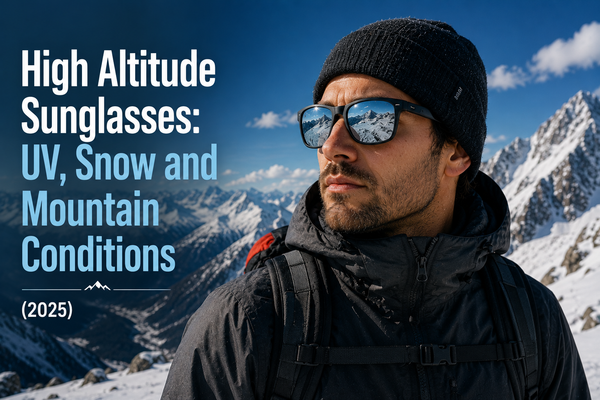

High Altitude Sunglasses: UV, Snow and Mountain Conditions
The temperature drops as you climb. The air thins. And the UV goes up. These three facts together describe the fundamental paradox of high-altitude outdoor activity: the conditions that feel milder than a summer beach day are delivering more UV than that beach in July. At 10,000 feet on a Colorado ski slope, the combination of altitude UV amplification and snow surface reflection creates one of the most intense UV environments humans voluntarily enter.
Most people who ski, hike at altitude, or recreate in mountain environments understand vaguely that UV is intense at altitude. Very few understand the specific physics, the actual UV Index values at typical recreational altitudes, how snow reflection compounds the altitude effect, or what lens category this genuinely requires. This guide covers all of it.
This is a C21 Geography & Climate supporting post. It links back to the cluster pillar atsunglasses by climate and geography: the complete US regional guide.
Quick Answer
UV400 Category 3 for most mountain hiking and outdoor activities above 5,000 feet. Category 3–4 for skiing, snowboarding, and extended alpine snow environments at typical ski resort elevations (8,000–12,000+ feet). Category 4 for glacier crossings, extreme high-altitude mountaineering, and extended time on highly reflective snow at peak UV hours. Gray polarized for driving mountain roads and all-conditions versatility. Amber or rose for flat-light overcast ski and snow conditions. Goggle format for skiing and snowboarding — not eyeglass sunglasses.

Table of Contents
Part 1: How Altitude Increases UV — The Physics
UV radiation from the sun must pass through the atmosphere before reaching the ground. The atmosphere contains ozone, water vapor, aerosol particles, and air molecules that absorb and scatter UV. The thicker the atmospheric column the solar beam passes through, the more UV is attenuated before it reaches the surface.
At sea level, the full depth of the atmosphere is between the sun and the eye. At altitude, a significant portion of the most UV-absorptive lower atmosphere is below the observer. Less atmosphere between the sun and the eye means less UV attenuation. More UV arrives at the surface per unit of solar radiation at altitude than at sea level under identical sun angle conditions.
The quantified relationship: for every 1,000 feet of altitude gain, UV intensity increases by approximately 3–4%. This is a compounding increase. At 5,000 feet (the elevation of Denver), UV is approximately 15–20% more intense than at sea level. At 10,000 feet (a typical ski resort mid-mountain), UV is approximately 30–35% more intense. At 14,000 feet (Colorado’s Fourteeners, many accessible to recreational hikers), UV is approximately 40–45% more intense than at sea level.
Part 2: UV at Typical US Recreational Altitudes
|
Elevation |
Location Examples |
UV vs Sea Level (same latitude) |
Effective UV Index (July noon, CO/UT latitude) |
|
Sea level (baseline) |
Miami, FL; Corpus Christi, TX |
Baseline |
9–11 (very high–extreme) |
|
5,280 ft (1 mile) |
Denver, CO; Reno, NV |
~+15–20% |
10–12 (extreme) |
|
6,000–7,000 ft |
Taos, NM; Flagstaff, AZ; Park City base |
~+18–25% |
10–12+ (extreme) |
|
8,000–9,000 ft |
Breckenridge base; Aspen base; Santa Fe |
~+24–32% |
11–13+ (extreme) |
|
10,000 ft |
Breckenridge mid-mountain; Vail peak |
~+30–35% |
12–14+ (extreme) |
|
12,000–14,000 ft |
Arapahoe Basin summit; CO Fourteeners |
~+36–45% |
13–15+ (above extreme scale) |
These values are before snow reflection is added. They represent direct UV from the sky alone at altitude. Snow reflection on top of these values produces total UV exposure significantly above what any standard UV Index scale was designed to measure as a single-number ground-level estimate.
Part 3: The Snow Reflection Multiplier
Snow is one of the most reflective natural surfaces on Earth for UV radiation. Fresh snow reflects 85–95% of the UV that strikes it. Old, compacted ski resort snow reflects 50–80%. Ice reflects up to 80%.
This reflection is upward. A skier or hiker on snow receives UV from two directions simultaneously: directly from the sun and sky above, and reflected upward from the snow surface below. The UV reaching the eye is not just the overhead direct UV — it is overhead direct UV plus reflected UV from below and around.
The specific vulnerability this creates: the lower eyelid, the underside of the nose, and the skin directly beneath the eyes receive reflected UV from below that sunglasses with standard frame geometry do not shade. This is why alpine climbers and glacier trekkers traditionally use side-shielded glacier goggles — the reflected UV from the snow surface enters from below and from the sides in ways that require coverage beyond standard sunglass frames.
Part 4: The Combined Effect — Altitude Plus Snow
Adding altitude UV amplification to snow surface reflection produces UV conditions that can exceed what any standard UV Index value suggests for the latitude. Consider a skier at Breckenridge, Colorado in March:
A March Breckenridge ski day delivers UV exposure comparable to or exceeding a July midday at a tropical beach, despite air temperatures in the 20–30°F range. Cold does not attenuate UV. Snow does not block UV — it reflects it. The skier who does not wear UV400 Cat 3–4 eye protection on a Colorado ski day is accumulating extreme UV exposure in conditions that feel cold enough to seem safe from sun damage.
Part 5: Why the Air Temperature Misleads
The intuitive association between warmth and UV risk is almost exactly backwards at altitude. The mechanisms:
Part 6: US High-Altitude Recreation Locations
|
Location |
State |
Elevation |
Primary UV Risk |
Spec |
|
Breckenridge Ski Resort |
CO |
Base 9,600 ft / Peak 12,840 ft |
Extreme — altitude + snow reflection |
Cat 3–4 UV400 goggle |
|
Vail Ski Resort |
CO |
Base 8,120 ft / Back Bowls 11,570 ft |
Extreme |
Cat 3–4 UV400 goggle |
|
Park City Mountain Resort |
UT |
Base 6,900 ft / Peak 10,026 ft |
Very high–extreme |
Cat 3 UV400 goggle |
|
Jackson Hole Mountain Resort |
WY |
Base 6,311 ft / Peak 10,450 ft |
Extreme |
Cat 3–4 UV400 goggle |
|
Mammoth Mountain |
CA |
Base 7,953 ft / Peak 11,053 ft |
Extreme |
Cat 3–4 UV400 goggle |
|
Mt. Baker Ski Area |
WA |
Base 3,500 ft / Peak 5,089 ft |
High (altitude + frequent snow) |
Cat 3 UV400 goggle |
|
Colorado Fourteeners (hiking) |
CO |
14,000+ ft |
Beyond extreme |
Cat 4 UV400 close-fit frame or glacier glasses |
|
Rocky Mountain National Park (hiking) |
CO |
Trailhead 8,000–11,000 ft |
Extreme |
Cat 3 UV400 with side coverage |
|
Grand Teton National Park (hiking) |
WY |
Trailheads 6,700–8,000 ft |
Very high–extreme |
Cat 3 UV400 |
|
Glacier National Park (hiking) |
MT |
Valley trails 3,000–5,000 ft / Alpine 7,000–10,000 ft |
High to extreme (upper elevations) |
Cat 2–3 UV400 by elevation |
Part 7: Lens Category at Altitude
Part 8: When Category 4 Is Appropriate
Category 4 lenses transmit only 3–8% of visible light. They are the darkest standard lens category. In most contexts they are too dark for practical use and they are specifically excluded from driving. But in high-altitude snow environments, they match the actual UV exposure conditions:
Cat 4 within a goggle frame is the correct specification for these situations. In goggle format, the driving exclusion is moot (you are not driving on skis). The complete facial coverage of a goggle frame also addresses the reflected UV from below that Cat 4 lenses with standard sunglass frames would still allow to reach the eye from underneath.
✨ NAVI EYEWEAR — UV400 FOR EVERY ALTITUDE.UV400 polycarbonate. Gray polarized Cat 3 for mountain hiking and driving. Amber for ski flat-light. At altitude, UV400 is not optional. The thinner the air, the more UV reaches the eye. Buy 1, Get Any 3 Pairs Free — $119 for four pairs (~$30 each). Free shipping. Free replacements. |
Part 9: Goggle vs Eyeglass Sunglasses for Skiing
For skiing and snowboarding, goggle format is strongly recommended over eyeglass sunglasses for multiple reasons beyond UV:
For hiking and non-skiing mountain use, close-fit wraparound sunglass frames with UV400 Cat 3 lenses are appropriate. The key frame requirement at altitude: enough frame coverage to reduce the reflected UV from below and from the sides, without the full goggle seal required for ski conditions.
Part 10: Tint Choice for Mountain Conditions
Gray Polarized UV400 Category 3 — All-Conditions Mountain Standard
Gray polarized Cat 3 is the mountain hiking and variable-condition outdoor pair. Color accuracy for trail navigation, color-coded trail markers, safety equipment signals, and driving mountain highways. Polarization eliminates the horizontal glare from stream crossings, mountain lakes, and wet rock surfaces. Cat 3 for altitude UV levels. The most versatile single mountain outdoor pair.
Amber Polarized UV400 Category 2–3 — Flat-Light Ski and Mountain Overcast
Amber polarized Cat 2–3 for flat-light overcast ski days where terrain definition is the primary visual challenge. Overcast ski days at Breckenridge, Vail, or Park City are characterized by diffuse flat light that eliminates the natural shadow-based terrain cues that define slope features. Amber’s blue-scatter filtering creates artificial depth contrast from the diffuse light, making slope features visible that gray would leave featureless. The most valuable tint for a skier who faces frequent overcast conditions.
Rose / Pink Polarized Category 1–2 — Extreme Flat-Light Ski
For the most extreme flat-light ski condition — complete whiteout overcast where even amber does not provide adequate terrain definition — rose or pink Cat 1–2 provides maximum contrast enhancement with a warm color cast. Rose is the flat-light specialist for ski goggles. Not for bright alpine sun conditions.
Part 11: Driving Mountain Roads
Mountain road driving presents specific lens category constraints different from open ski terrain:
Mountain road driving specification:gray polarized UV400 Category 2. Reserve Cat 3 for open mountain outdoor activity, not mountain highway driving.

Part 12: Summer Hiking at Altitude
Summer hiking above 10,000 feet in the Colorado Rockies, the Wind Rivers, the Sierra Nevada, and the Cascades involves the highest UV conditions accessible to recreational hikers without technical equipment:
Part 13: Year-Round Alpine UV
Mountain UV does not follow the intuitive seasonal pattern that lowland UV does. In spring and fall, mountain UV remains significantly above lowland equivalent values because snow cover extends well into May in Colorado and Wyoming, maintaining the snow reflection multiplier even as lowland UV declines. A late April ski day on Arapahoe Basin (which sometimes stays open through June) involves spring sun angle (UV Index 5–6 at sea level) multiplied by altitude and fresh spring snow reflection to produce total UV exposure comparable to a clear summer day at a lower elevation.
In winter, the low sun angle reduces direct UV significantly — but snow reflection from flat morning and afternoon light at low angles can still be intense for the eyes, particularly for the skin and eye areas directly beneath the brow line that receive reflected upward UV from the snow. UV400 eye protection year-round for any snow-environment mountain recreation is the correct protocol regardless of what the sun angle theoretically predicts for direct UV.
Part 14: Comparison Table — High-Altitude UV Scenarios
|
Scenario |
Elevation |
UV Risk |
Recommended Spec |
|
Driving I-70 Denver to Vail (variable) |
5,280–8,000 ft |
High (altitude) |
Gray polarized Cat 2 (tunnels + transitions) |
|
Ski resort day, overcast (flat-light) |
8,000–12,000 ft |
Very high (altitude + snow) |
Amber polarized Cat 2–3 goggle |
|
Ski resort day, clear (bright sun) |
8,000–12,000 ft |
Extreme (altitude + snow) |
Gray polarized Cat 3–4 goggle |
|
Above-treeline summer hiking, CO |
10,000–14,000 ft |
Extreme–beyond scale |
Gray or amber UV400 Cat 3 close-fit frame |
|
Colorado Fourteener summit |
14,000+ ft |
Beyond extreme scale |
Cat 4 UV400 close-fit or glacier glasses |
|
Glacier crossing (Mt. Rainier, WY Wind Rivers) |
8,000–14,000 ft |
Extreme (altitude + ice/snow) |
Cat 3–4 UV400 glacier glasses with side shields |
|
Mountain biking below treeline |
5,000–8,000 ft |
High to very high |
Amber or gray UV400 Cat 2–3 |
|
Snowshoeing, open terrain |
6,000–10,000 ft |
Very high (altitude + snow) |
Gray or amber UV400 Cat 3 |
|
Rocky Mountain National Park trail hiking |
8,000–11,000 ft |
Very high–extreme |
Gray UV400 Cat 3 with coverage frame |
|
Overcast flat-light winter ski, Cascade resorts |
3,500–5,000 ft |
High (altitude + snow) |
Amber polarized Cat 2 goggle |
Part 15: Best For
Gray Polarized UV400 Category 3 — Best For:
Amber Polarized UV400 Category 2–3 (Goggle Format) — Best For:
Category 4 UV400 Close-Fit or Glacier Format — Best For:
Part 16: Common Mistakes
Bottom Line
High altitude is the UV environment that consistently surprises people because the conditions that feel least threatening — cold air, overcast sky, winter timing — are the conditions that most thoroughly mislead about UV exposure. Altitude amplifies UV by 30–45% above sea level at typical ski resort and high hiking elevations. Snow reflects 85–95% of that already-amplified UV back upward. The result is UV exposure that can exceed a tropical beach in July, delivered in conditions that feel cold enough to suggest no UV risk.
UV400 Cat 3 for mountain hiking and ski resort use. Cat 4 for Fourteeners and glacier crossings. Goggle format for skiing and snowboarding. Gray for driving mountain roads and clear-day hiking. Amber for flat-light ski days. Year-round because snow extends the high-UV window well into spring and fall at mountain elevations.
Browse UV400 polarized options atnavieyewear.com/collections/polarized. Add 4 pairs — Buy 1, Get Any 3 Free auto-applies. Free shipping. Free replacements.

Frequently Asked Questions
How much does altitude increase UV?
Approximately 3–4% per 1,000 feet of altitude gain, compounding. At 5,280 feet (Denver), UV is approximately 15–20% above sea-level equivalent. At 10,000 feet (typical ski resort mid-mountain in Colorado), UV is approximately 30–35% above sea level. At 14,000 feet (Colorado Fourteeners), approximately 40–45% above sea level. This is before snow reflection is added.
How much does snow increase UV?
Fresh snow reflects 85–95% of UV back upward, adding reflected UV from below to direct UV from above. On a ski slope with fresh snow, total UV exposure (direct + reflected) can be nearly double the direct UV alone. Combined with altitude amplification, this produces some of the highest UV conditions accessible to recreational users.
Do I need Category 4 sunglasses for skiing?
For most ski resort conditions, Category 3 in goggle format is appropriate. Category 4 is warranted for extended time in the most extreme conditions: Fourteener summits, glacier crossings, open above-treeline terrain on clear days with fresh snow. Most recreational skiers are adequately protected by Cat 3 goggle. Cat 4 within a goggle is appropriate for extreme conditions without driving transitions.
Can I wear regular sunglasses skiing instead of goggles?
Not recommended. Ski goggles provide face coverage that blocks reflected UV from snow below and to the sides, anti-fog performance for the temperature changes of skiing, secure fit through falls and high-speed runs, and wind protection at skiing speeds. Standard sunglass frames leave peripheral and lower-orbital areas exposed to the reflected UV from snow surfaces and wind at ski speeds.
What sunglasses do I need for hiking Colorado Fourteeners?
UV400 Category 3 minimum, with Category 4 for extended time above 13,000 feet on clear days or in snowfield crossings. Close-fit wraparound frame geometry to reduce lateral and under-eye reflected UV from snow and rock. If crossing significant snowfields above treeline, traditional glacier glasses (Cat 3–4 with side leather shields) are appropriate for maximum coverage.
Is UV worse in winter or summer at ski resorts?
Summer produces higher direct UV per hour due to the higher sun angle. But total ski-day UV can be high in both winter and summer at altitude because of snow reflection and extended outdoor duration. March and April produce particularly high UV at ski resorts: sun angle is rising (increasing direct UV) while snow cover is still full (maintaining snow reflection). Late-season spring skiing may deliver higher total UV per day than midwinter, counterintuitively.
What tint is best for flat-light ski days?
Amber polarized Cat 2–3 for most flat-light overcast ski conditions. Rose or pink Cat 1–2 for extreme flat-light whiteout conditions where even amber does not provide adequate terrain definition. Gray Cat 3 for clear bright-snow days. The tint switches by sky condition; the lens category is driven by altitude and UV intensity regardless of conditions.
Do I need UV400 sunglasses even on cloudy ski days?
Yes. Overcast ski days at altitude still deliver significant UV through cloud cover (clouds scatter rather than block UV) plus full snow reflection from below. A flat-light overcast day at 10,000 feet on fresh snow delivers UV comparable to a clear summer day at lower elevation. UV400 is non-negotiable for all-day outdoor time at ski resort elevations regardless of sky conditions.
Supporting Articles
UV400 AT EVERY ALTITUDE. CAT 3 FOR THE MOUNTAIN.UV400 polycarbonate. Gray polarized Cat 3 for above-treeline hiking. Amber for flat-light ski. The higher you go, the more UV reaches the eye. UV400 is not optional at altitude. Buy 1, Get Any 3 Pairs Free — $119 for four pairs. Free shipping. Free replacements. |
SOURCES & CITATIONS[1] Sliney DH.“UV radiation ocular exposure dosimetry.”Documenta Ophthalmologica, 1994.View source [2] Diffey BL.“Sources and measurement of ultraviolet radiation.”Methods, 2002.View source [3] World Health Organization.“Global solar UV index: a practical guide.”WHO/SDE/OEH/02.2, 2002.View source [4] Taylor HR, West SK, Rosenthal FS, et al..“Effect of ultraviolet radiation on cataract formation.”New England Journal of Medicine, 1988.View source [5] Rosenthal FS, Bakalian AE, Lou CQ, Taylor HR.“The effect of sunglasses on ocular exposure to ultraviolet radiation.”American Journal of Public Health, 1988.View source [6] American Academy of Ophthalmology.“Sunglasses: choosing the right pair for UV protection.”AAO EyeSmart, 2023.View source |