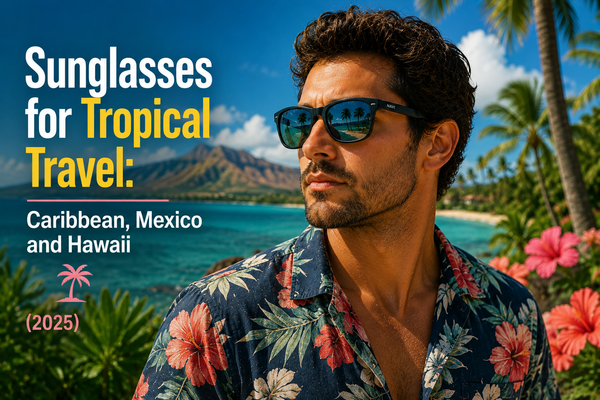

Sunglasses for Tropical Travel: Caribbean, Mexico and Hawaii
The Yucatan Peninsula, the Caribbean islands, and Hawaii sit between latitudes 15–25°N. At these latitudes, the sun reaches near-overhead elevation at solar noon for much of the year. UV Index values of 11–12+ — the extreme category — are routine from sunrise to sunset during midday hours, and the clear air, white sand, and turquoise water of tropical beach destinations provide the most reflective combination of surfaces outside of high alpine snow environments.
Most Americans traveling to tropical destinations think of sunscreen but not sunglasses when preparing UV protection. And most of those who do bring sunglasses bring whatever pair they own without considering whether those lenses are appropriate for the UV conditions they’re traveling into. This guide covers what the UV actually looks like at popular American tropical travel destinations, what lens specification matches it, and the specific practical considerations of tropical beach and water use that most sunglass guides do not address.
This is a C21 Geography & Climate supporting post. It links back to the cluster pillar atsunglasses by climate and geography: the complete US regional guide.
Quick Answer
Category 3 UV400 polarized for all tropical travel destinations. Category 4 for extended open beach and open water activity at peak UV hours. Gray polarized for water and beach versatility. Copper polarized for fishing, snorkeling, and any activity where sub-surface water visibility matters. Anti-saltwater coating for all coastal and water use. The pair most Americans bring to tropical destinations — their everyday Cat 2 pair — is adequate for UV protection but undersized for the brightness management that tropical midday conditions demand.

Table of Contents
Part 1: Tropical UV — Why It Is Different
The sun’s elevation angle at solar noon is the primary determinant of UV intensity. At the equator (0°), the sun reaches directly overhead at the equinoxes. At 20°N — the approximate latitude of Cancun, the Yucatan Peninsula, the central Caribbean, and Hawaii — the maximum noon sun angle is approximately 88–90 degrees in June: near-vertical. The UV Index on a clear tropical day at these latitudes routinely reaches 11–12+ in summer and 9–10 even in winter.
The second tropical UV factor is the relatively clean, low-aerosol tropical atmosphere. Caribbean and Pacific tropical air masses have less dust, pollution, and urban aerosol than continental US air, meaning less UV scattering between the sun and the ground. More UV arrives at the surface per unit of solar radiation in the clear tropical atmosphere than in the continental US atmosphere at the same latitude.
The third factor is the absence of a low-UV season. The sun’s angle at 20°N varies less across the year than at temperate latitudes: the difference between summer and winter noon sun angle at Cancun is approximately 47 degrees (from 43 to 90 degrees elevation), compared to approximately 47 degrees at New York City between a lower winter low and a lower summer high. The practical result: tropical destinations have no month where UV is as low as a typical US winter.
Part 2: UV Index Data for Popular American Tropical Travel Destinations
|
Destination |
Latitude |
Jan UV Index |
July UV Index |
Year-Round Pattern |
|
Cancun, Mexico |
21°N |
7–8 |
12–13 |
Very high to extreme all year; no low-UV season |
|
Cabo San Lucas, Mexico |
22°N |
6–7 |
12–13 |
Similar to Cancun; dry desert air adds UV intensity |
|
Puerto Vallarta, Mexico |
20°N |
7–8 |
12–13 |
Tropical; rainy season (Jun–Oct) reduces UV on rain days only |
|
Riviera Maya (Playa del Carmen) |
20°N |
7–8 |
12–13 |
Clear Caribbean water + white sand = high reflection |
|
Jamaica |
18°N |
9–10 |
13–14 |
Extreme year-round; close to equatorial UV intensity |
|
Bahamas |
24°N |
8–9 |
11–12 |
Extreme in summer; very high in winter; clear shallow water |
|
US Virgin Islands |
18°N |
9–10 |
12–13 |
Extreme year-round; same latitude as Jamaica |
|
Puerto Rico |
18°N |
9–10 |
12–13 |
Extreme year-round; US territory; same intensity as USVI |
|
Hawaii (Honolulu) |
21°N |
7–8 |
11–12 |
Extreme in summer; very high in winter; year-round use |
|
Maui |
20°N |
7–8 |
11–12 |
Similar to Honolulu; volcanic elevation areas add altitude UV |
Part 3: The White Sand and Turquoise Water Reflection Effect
Tropical beach environments combine two of the most UV-reflective natural surface types: white coral sand and shallow clear tropical water.
White Coral Sand
The white or near-white sand beaches of the Caribbean and Mexican Pacific coast are composed primarily of coral and shell fragments that have a very high reflectance for visible light and UV. White sand reflects approximately 15–25% of UV — higher than typical continental beach sand. On a beach with high-reflectance white sand under UV Index 12 overhead conditions, the total UV reaching the eye (direct from above plus reflected from below and from the surrounding beach) is meaningfully above the direct-only overhead value.
Shallow Tropical Water
The turquoise color of Caribbean and Pacific tropical water is produced by the reflection of blue sky from very shallow, white-sand-bottom water. The water is so clear and so shallow over much of the Caribbean shelf that UV and visible light penetrate to the sandy bottom and reflect back upward. A swimmer or snorkeler in shallow turquoise water receives UV from above, reflected UV from the water surface, and some transmitted-and-reflected UV from the bottom.
The polarization relevance: tropical water surface reflection is predominantly horizontally polarized, just as other water surfaces are. Polarized lenses eliminate this reflection specifically. For beach and water activities in tropical destinations, polarized lenses improve the visual quality of the experience (colors are more vivid, water more transparent) while also reducing the UV contribution from surface reflection.
Part 4: Year-Round Tropical UV — No Off-Season
Most Americans take tropical vacations in January through April (escaping northern winter) or June through August (summer vacation). UV Index data for popular tropical destinations shows:
The practical message:there is no tropical travel season where Cat 2 is the appropriate primary outdoor lens for sustained beach and outdoor use. Tropical UV is very high to extreme throughout the year at these latitudes. Americans visiting the Caribbean, Mexico, and Hawaii in January need Cat 3 UV400 as much as those visiting in July.

Part 5: What Category 2 Gets Right and Wrong in the Tropics
Category 2 (18–43% VLT) lenses are the correct US all-conditions default. They provide complete UV400 protection at any category. In tropical destinations:
The bottom line: for tropical travel, the minimum UV400 specification should be upgraded from Cat 2 to Cat 3 for the brightness management benefit, even though the UV protection is equivalent. A Cat 3 UV400 pair for tropical destination use is not a safety upgrade over Cat 2 UV400 — it is a comfort and visual performance upgrade that makes the outdoor tropical experience significantly more pleasant and less visually fatiguing.
Part 6: Category 3 for Tropical Daily Use
Category 3 UV400 polarized is the appropriate tropical travel daily pair. It provides:
The limitation: Cat 3 may feel slightly dark in deeply shaded resort environments (jungle restaurants, covered terraces) or in the transition from bright beach to indoor. For resort guests who move frequently between intensely bright outdoor areas and air-conditioned indoor spaces, a secondary Cat 2 pair for transitional use is a practical addition. The four-pair Navi purchase makes this a $30 rotation addition.
Part 7: Category 4 — When and Where in the Tropics
Category 4 UV400 (3–8% VLT) is warranted for:
Cat 4 is excluded from driving use — tropical resort rental car driving, airport transfers, and any road use should remain with Cat 3.
Part 8: Tint Choice for Tropical Travel
Gray Polarized UV400 Category 3 — The Tropical Versatility Standard
Gray polarized Cat 3 is the primary tropical travel pair for most visitors. Color accuracy for navigating resort environments, reading water conditions, assessing ocean safety, and using water equipment where color coding matters. Polarization for water surface glare elimination. Cat 3 for adequate brightness management under tropical conditions. The most versatile single pair for tropical travel across all activities.
Copper Polarized UV400 Category 3 — For Water Activity
Copper polarized Cat 3 is the specialist tropical water pair. Copper’s wavelength profile is specifically optimized for sub-surface water visibility — it reduces the surface reflection that obscures the water below while enhancing the contrast of features under the surface (reef fish, coral, sandy bottom, depth cues). For snorkeling on the surface, reef viewing, fishing on flats or in nearshore tropical water, and any activity where what is under the water matters, copper polarized provides a visual advantage that gray does not.
Amber Polarized UV400 Category 3 — For Overcast Tropical Days
Tropical destinations have rainy seasons and overcast periods. Cancun and Puerto Vallarta have a summer rainy season (June–October) with daily afternoon rain and significant overcast. Hawaii has persistent cloud cover on windward sides of islands year-round. On overcast tropical days, amber polarized provides better contrast than gray in the flat tropical light while maintaining the UV400 protection and polarization that the still-elevated tropical UV warrants.
Part 9: Anti-Saltwater Coating — The Tropical Essential
Salt water in tropical destinations has higher salinity than many temperate ocean environments. Caribbean and Pacific tropical water is clear and warm — and it evaporates quickly on lens surfaces, leaving salt crystal deposits that damage standard lens coatings rapidly.
On a typical Caribbean beach vacation, sunglasses are exposed to:
Without anti-saltwater coating, a quality pair of sunglasses can develop coating degradation, haze, and surface damage within a single week of tropical beach use. Anti-saltwater coating — a hydrophobic oleophobic surface treatment resistant to salt crystal adhesion — extends lens surface integrity significantly in tropical salt-water environments.
Navi’s polarized lenses include anti-saltwater coating as a standard feature, making them appropriate for tropical travel without the coating degradation concerns that affect standard lenses in heavy beach and ocean use.
✨ NAVI EYEWEAR — UV400 CAT 3 FOR TROPICAL TRAVEL.UV400 polycarbonate. Gray or copper polarized Cat 3 for tropical beach and water. Anti-saltwater coating standard. Oleophobic. TR90. Stainless hinges. Buy 1, Get Any 3 Pairs Free — $119 for four pairs (~$30 each). Free shipping. Free replacements. |
Part 10: Snorkeling and Shallow Water UV
Snorkeling on the surface of Caribbean, Mexican Pacific, and Hawaiian water creates a specific UV exposure scenario that most people do not anticipate:
Prescription or non-prescription diving masks with UV400 lenses are available and are the appropriate eye protection for in-water snorkeling. For surface snorkeling without a mask, a close-fitting UV400 Cat 3 frame with adequate side coverage provides the best available protection while maintaining above-water vision.
Part 11: Boating and Open Water
Day boat trips, sailing, fishing excursions, and open-water activities are among the highest-UV tropical experiences because they combine:
Specification for tropical boating:UV400 Cat 3 minimum, Cat 4 for extended offshore activity. Copper polarized for fishing (sub-surface water visibility for spotting fish and reading currents). Gray polarized for sailing and general offshore activities where color accuracy for navigation, weather reading, and equipment is needed. Secure fit and anti-saltwater coating essential.
Part 12: Beach and Poolside Use
Beach and poolside use in tropical destinations is the most straightforward UV scenario: sustained outdoor time under extreme UV, with white sand and water surface reflection adding to direct overhead UV. The specific considerations:
Category 3 UV400 polarized with anti-saltwater coating is the complete beach and poolside specification. Cat 4 is appropriate if the priority is maximum visual comfort during peak midday hours with no driving transitions during that period.
Part 13: Urban and Resort Town Use
Tropical vacation time is not only beach time. Resort towns, historic downtown areas (Cancun Downtown, Old San Juan, Lahaina on Maui, Charlotte Amalie in St. Thomas), open-air markets, and cultural sites involve walking in tropical sun environments where UV is extreme but the visual task includes color-accurate navigation, shopping, and cultural observation.
Gray polarized Cat 3 handles urban tropical use well: adequate darkness for the extreme UV outdoor environment, color accuracy for the rich visual environment of tropical towns and markets, and polarization for the vehicle and building surface glare that urban tropical environments produce. Cat 3 is appropriate for resort town walking even if Cat 4 is used for the beach portion of the same day.
Part 14: The Travel Packing Consideration
Most Americans traveling to tropical destinations bring one pair of sunglasses. Given the range of activities — beach, snorkeling, boating, urban exploring, resort dining, airport transiting — and the UV variation across those activities, two pairs cover the range more effectively than one:
The Navi four-pair purchase at $119provides both of these pairs plus two more (amber Cat 2 for overcast tropical days, second Cat 3 backup) for a total cost of approximately $30 per pair. Losing, breaking, or scratching a pair on a tropical vacation is common. Having a backup pair already in the bag eliminates the vacation-disrupting experience of going unprotected or buying poor-quality replacements at a resort shop at premium prices.
Part 15: Comparison Table — Tropical Travel Scenarios
|
Scenario |
UV Risk |
Recommended Lens |
Key Feature |
|
Caribbean beach (January) |
Very high (UV 7–9 + sand/water reflection) |
Gray polarized Cat 3 |
Brightness management + polarized water glare |
|
Caribbean beach (July) |
Extreme (UV 12–13+ + sand/water reflection) |
Gray or copper polarized Cat 3–4 |
Cat 4 for extended midday peak sun |
|
Mexican resort pool (year-round) |
Very high to extreme |
Gray polarized Cat 3 |
Water surface glare + UV management |
|
Reef snorkeling (surface) |
Extreme + reflected from below |
Close-fit Cat 3 UV400 |
Full orbital coverage important |
|
Day boat trip / offshore fishing |
Extreme + 360° water reflection |
Copper polarized Cat 3 |
Sub-surface visibility + maximum glare elimination |
|
Open water sailing (day) |
Extreme + extensive water reflection |
Gray polarized Cat 3–4 |
Color accuracy for navigation + glare elimination |
|
Tropical urban exploring |
Very high to extreme |
Gray polarized Cat 3 |
Color accuracy for tropical environment navigation |
|
Hawaii beach day |
Extreme (UV 11–12+) |
Gray or copper polarized Cat 3 |
Same as Caribbean; anti-saltwater coating |
|
Cancun / Riviera Maya driving |
Very high to extreme |
Gray polarized Cat 3 |
Color accuracy; Cat 3 adequate for driving (not Cat 4) |
|
Resort dining / indoor-outdoor |
Variable |
Gray polarized Cat 2 |
Cat 2 for transitional comfort between indoor and outdoor |
Part 16: Best For
Gray Polarized UV400 Category 3 — Best For:
Copper Polarized UV400 Category 3 — Best For:
Gray Polarized UV400 Category 2 — Best For:
Part 17: Common Mistakes
Bottom Line
Tropical travel UV is extreme. The Caribbean, Mexican Pacific, and Hawaiian destinations that Americans visit year-round produce UV Index 7–13+ depending on season and destination — consistently in the very high to extreme range. White sand and turquoise water add reflective UV components that compound the direct overhead intensity. The extended duration of beach vacation outdoor time multiplies the total UV dose beyond what most everyday US outdoor exposure involves.
Category 3 UV400 polarized with anti-saltwater coating is the tropical travel specification. Gray for versatility across all activities. Copper for water-centric activities where sub-surface visibility matters. Cat 4 for peak midday beach and offshore time. A Cat 2 pair as backup for resort transitions and indoor-outdoor movement. Four pairs from the Navi purchase provides all of this at approximately $30 per pair.
Browse UV400 polarized options atnavieyewear.com/collections/polarized. Add 4 pairs — Buy 1, Get Any 3 Free auto-applies. Free shipping. Free replacements.

Frequently Asked Questions
What sunglasses do I need for a Caribbean vacation?
Category 3 UV400 polarized as the primary pair. The Caribbean delivers UV Index 9–13+ depending on season and specific island latitude. Cat 2 provides the same UV protection but inadequate brightness management for sustained beach and outdoor use. Copper polarized for water activities and reef viewing. Anti-saltwater coating for all coastal and water use. A Cat 2 UV400 backup for resort indoor-outdoor transitions.
Do I need different sunglasses for Mexico vs the Caribbean?
Not significantly. Both regions produce UV Index 9–13+ in summer and 7–10 in winter. Both involve white sand and turquoise or clear water reflection. Both require Cat 3 UV400 polarized with anti-saltwater coating. Cabo San Lucas adds a slight desert-air UV amplification from its dry Pacific climate; Caribbean islands and the Yucatan Peninsula are broadly equivalent in UV terms.
Is UV in Hawaii the same as the Caribbean?
Very similar. Hawaii sits at 19–22°N, similar to the central Caribbean (Jamaica, USVI, Puerto Rico at 18°N). UV Index peaks in Hawaii reach 11–12+ in summer and 7–8 in winter — comparable to Caribbean values. Year-round Cat 3 UV400 is appropriate for Hawaii outdoor use. Maui’s Haleakala volcano area adds altitude UV for visitors to the summit area.
Why is copper tint good for tropical water?
Copper’s wavelength profile reduces the specific wavelengths that contribute to water surface scatter and glare while transmitting the wavelengths that are most useful for sub-surface visibility. In shallow Caribbean or Hawaiian water, copper polarized eliminates the surface reflection (which obscures what’s below) while enhancing the contrast of reef, fish, and bottom features. Gray polarized also eliminates the surface reflection but without copper’s sub-surface contrast enhancement.
Do I need anti-saltwater coating for tropical travel?
Yes, for any significant coastal, beach, or water activity. Tropical salt water has high salinity and evaporates quickly on lens surfaces in tropical heat, leaving concentrated salt crystal deposits. These deposits damage standard coatings rapidly with repeated exposure. Anti-saltwater coating prevents this degradation. A week of tropical beach use can noticeably damage standard coatings on quality sunglasses; anti-saltwater coating extends their functional life.
Can I just bring my regular everyday sunglasses to a tropical destination?
If your everyday pair is UV400 Cat 2 or better, you have complete UV protection — UV400 is UV400 at any category. The limitation is visual comfort: Cat 2 is often too light for sustained tropical beach and outdoor use, resulting in more squinting and visual fatigue than Cat 3 would cause. Your everyday UV400 pair is a safe choice; a Cat 3 upgrade is a comfort and performance choice for the tropical environment.
What category sunglasses should I use for snorkeling?
For surface snorkeling without going underwater, a close-fit UV400 Cat 3 frame with side coverage provides the best above-water protection. For actual in-water snorkeling, prescription or non-prescription diving masks with UV400 lenses are available and are the appropriate tool since standard sunglasses cannot be worn over a mask and do not function submerged.
Should I pack multiple pairs of sunglasses for tropical travel?
Yes. At minimum: a Cat 3 UV400 polarized primary pair for beach and outdoor use, and a Cat 2 UV400 polarized secondary pair for indoor-outdoor resort transitions. Ideally: copper Cat 3 for water activities, gray Cat 3 for versatility, and a Cat 2 backup. The Navi four-pair purchase at $119 provides this complete rotation for approximately $30 per pair, with the backup value of four pairs against the real risk of vacation sunglass loss or damage.
Supporting Articles
UV400 CAT 3. BUILT FOR TROPICAL UV.UV400 polycarbonate. Gray or copper polarized Cat 3 for beach, water and resort. Anti-saltwater coating. Oleophobic. TR90. Stainless hinges. $30/pair. Buy 1, Get Any 3 Pairs Free — $119 for four pairs. Free shipping. Free replacements. |
SOURCES & CITATIONS[1] World Health Organization.“Global solar UV index: a practical guide.”WHO/SDE/OEH/02.2, 2002.View source [2] National Oceanic and Atmospheric Administration.“UV index forecast by location.”NOAA Weather Service, 2024.View source [3] Diffey BL.“Sources and measurement of ultraviolet radiation.”Methods, 2002.View source [4] Taylor HR, West SK, Rosenthal FS, et al..“Effect of ultraviolet radiation on cataract formation.”New England Journal of Medicine, 1988.View source [5] Rosenthal FS, Bakalian AE, Lou CQ, Taylor HR.“The effect of sunglasses on ocular exposure to ultraviolet radiation.”American Journal of Public Health, 1988.View source [6] American Academy of Ophthalmology.“Sunglasses: choosing the right pair for UV protection.”AAO EyeSmart, 2023.View source |