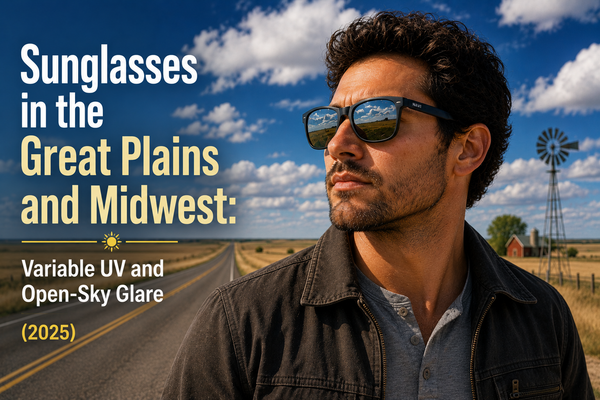

Sunglasses in the Great Plains and Midwest: Variable UV and Open-Sky Glare
Drive across Kansas on I-70 in July. The sky is enormous. The horizon stretches to 360 degrees of flat or gently rolling land without the trees, mountains, or buildings that block the sky in most other US regions. The sun has an unobstructed path from low on the horizon to directly overhead. And the road surface ahead, slightly wet from morning dew or overnight rain, reflects that low-angle morning sun directly into the driver’s eyes in a shimmer that covers the full forward field of view.
The Great Plains and Midwest are not thought of as high-UV regions the way the Southwest and Florida are. They are not. But they have their own specific sunglass requirements driven by four distinct seasons of UV variation, the open-sky horizontal glare of flat terrain, and the extensive driving culture of a region built around long-distance roads. This guide covers all of it.
This is the final C21 Geography & Climate supporting post. It links back to the cluster pillar atsunglasses by climate and geography: the complete US regional guide.
Quick Answer
Gray polarized UV400 Category 2 is the Great Plains and Midwest all-conditions answer. Cat 2 handles the four-season UV variation without the Cat 3 penalties in winter or the Cat 1 inadequacy in summer. Gray for driving accuracy on extensive highway networks. Polarized because the open-sky horizontal glare from flat paved surfaces is the dominant Great Plains glare source — present in summer, fall, and spring in ways that make polarization a consistent daily benefit. Cat 3 for summer peak outdoor activity. Cat 1 for heavy winter overcast.

Table of Contents
Part 1: The Great Plains and Midwest UV Profile
The Great Plains — Kansas, Nebraska, South Dakota, North Dakota, Oklahoma, eastern Colorado, eastern Wyoming — and the adjacent Midwest — Iowa, Missouri, Minnesota, Wisconsin, Illinois, Indiana, Ohio, Michigan — span a broad latitude range from approximately 37°N (Kansas-Oklahoma border) to 49°N (the Canadian border). This latitude range produces significant UV variation between the southern and northern portions of the region.
Southern Great Plains states (Kansas, Oklahoma, Nebraska) are closer in UV profile to the Sun Belt than to the northern Midwest. Kansas in July produces UV Index 8–9. Minnesota in July produces UV Index 6–7. Both are in the high to very high range that warrants UV400 eye protection, but the intensity differs by approximately 25–30% between the southern and northern ends of the region.
The defining characteristic of this region’s UV exposure is the open sky. Unlike the forested Northeast, the tree-canopied South, or the canyon-shaded Southwest, the Great Plains presents an unobstructed sky dome from horizon to horizon. Direct UV overhead, diffuse UV from the broad sky hemisphere, and surface reflection from flat terrain all reach the eye without the partial screening of trees, topography, or buildings that characterizes most other US environments.
Part 2: Seasonal UV Variation by Region
|
Location |
Latitude |
Jan UV Index |
April UV Index |
July UV Index |
Oct UV Index |
|
Wichita, KS |
37°N |
2–3 |
6–7 |
9–10 |
4–5 |
|
Omaha, NE |
41°N |
2 |
5–6 |
8–9 |
3–4 |
|
Sioux Falls, SD |
43°N |
1–2 |
5–6 |
7–8 |
3–4 |
|
Bismarck, ND |
46°N |
1 |
4–5 |
7–8 |
2–3 |
|
Des Moines, IA |
41°N |
2 |
5–6 |
8–9 |
3–4 |
|
Chicago, IL |
41°N |
1–2 |
5–6 |
7–8 |
3–4 |
|
Minneapolis, MN |
44°N |
1 |
4–5 |
6–7 |
2–3 |
|
Columbus, OH |
39°N |
2 |
5–6 |
8–9 |
4–5 |
|
Kansas City, MO |
39°N |
2–3 |
6–7 |
9–10 |
4–5 |
|
Oklahoma City, OK |
35°N |
3–4 |
7–8 |
10–11 |
5–6 |
Part 3: The Open-Sky Horizontal Glare Problem
The Great Plains’ defining landscape characteristic — flat, open terrain with a 360-degree visible horizon — creates a specific glare geometry that has no equivalent in forested, mountainous, or heavily urbanized regions:
Part 4: The Driving Culture and Its Sunglass Implications
The Great Plains and Midwest are among the most driving-dependent regions in the US. Inter-city distances are long, public transit is minimal outside of major cities, and the region’s economy — agriculture, energy, manufacturing, distribution — involves extensive professional driving. Commercial truck traffic on I-70, I-80, I-90, and I-35 is among the highest in North America.
For the commuter driving east out of Kansas City at 7am on a clear fall morning, the I-70 alignment with the rising sun produces some of the most intense low-angle glare in everyday American driving. The flat terrain means the sun is at driver’s eye level for the first 30–45 minutes of the drive without any horizon obstruction. The road surface reflects this low-angle sun as a near-continuous specular reflection across the lane surfaces.
Gray polarized UV400 Category 2 is the Great Plains driving specification. Gray for traffic signal color accuracy on the extensive urban and suburban road networks of Kansas City, Omaha, Des Moines, Minneapolis, and Chicago. Polarized for the horizontal road surface glare that is the dominant daily driving glare source on flat Great Plains highways. Cat 2 for the four-season variable conditions of the Midwest.
The complete dawn and dusk driving guide is insunglasses for dawn and dusk driving: the low-angle glare problem.
Part 5: Seasonal Specification — Summer
Great Plains and Midwest summer (June–August) produces the peak UV of the year: UV Index 7–10 across the region, with southern states approaching very high and northern states in the high category.

Part 6: Seasonal Specification — Fall
Fall is the Great Plains’ most distinctive UV and glare season. The harvest period (September–November) involves:
Part 7: Seasonal Specification — Winter
Great Plains and Midwest winter (December–February) has the lowest UV of the year but its own specific optical challenges:
Part 8: Seasonal Specification — Spring
Spring (March–May) is the season where Great Plains UV most consistently surprises residents. As temperatures rise and outdoor activity increases, UV rises sharply from the February low:
✨ NAVI EYEWEAR — GRAY POLARIZED UV400 FOR GREAT PLAINS DRIVING.UV400 polycarbonate. Gray polarized Cat 2 — four-season versatility across variable Great Plains conditions. Horizontal glare from flat terrain eliminated. Color-accurate for extensive highway driving. Buy 1, Get Any 3 Pairs Free — $119 for four pairs (~$30 each). Free shipping. Free replacements. |
Part 9: Great Plains Agriculture and Outdoor Work UV
Agriculture is the defining industry of the Great Plains, and agricultural work is among the most UV-exposed occupational categories in the US. Farmers, ranchers, and agricultural workers spend extended outdoor time across the full seasonal UV window:
Agricultural outdoor workers on the Great Plains accumulate some of the highest occupational UV doses of any American workforce. UV400 Cat 2–3 for all daytime agricultural outdoor work from April through September is the evidence-based occupational health recommendation.
Part 10: Water Bodies — Lakes, Rivers, and Reservoirs
Despite the Great Plains’ reputation as dry and flat, the region has extensive water bodies that create significant polarized glare environments:
Part 11: Tint Choice for Great Plains and Midwest Conditions
Gray Polarized UV400 — The Driving and Urban Standard
Gray polarized UV400 Category 2 is the primary Great Plains and Midwest pair for most residents. The region’s driving-dependent lifestyle and extensive urban and suburban road networks make color accuracy for traffic signals the first priority. Gray maintains this accuracy while polarization addresses the horizontal road surface glare that is the dominant daily glare source across the region’s flat highway network.
Amber Polarized UV400 — Open Landscape Outdoor Recreation
Amber polarized UV400 Category 2 for outdoor recreation in the Great Plains landscape. The open sky and flat terrain that reduce contrast in the landscape (everything is similar distance, similar height) benefit from amber’s blue-scatter filtering, which differentiates terrain features from their backgrounds more clearly. For hunting (pheasant, deer, waterfowl), fishing, trail running on open Great Plains trails, and agricultural outdoor work, amber provides contrast enhancement appropriate for the flat, open landscape.
Copper Polarized UV400 — Water Recreation
Copper polarized for Great Plains lake and river fishing, where sub-surface water visibility for spotting fish structure and reading water is the primary visual task. The Missouri River, the Great Plains reservoirs, and the Ozarks lake system all benefit from copper’s sub-surface contrast enhancement.
Part 12: The Highway Driving Context
Interstate highway driving is the central outdoor visual task for millions of Great Plains and Midwest residents. The specific highway driving glare conditions of this region:
Part 13: Urban vs Rural Great Plains
Major Urban Centers (Kansas City, Omaha, Des Moines, Minneapolis, Chicago)
Great Plains and Midwest urban centers share most characteristics with other US metros: traffic signal density, mixed driving environments, indoor-outdoor transitions, and the UV variation of the regional climate. Gray polarized UV400 Cat 2 as the primary pair. The urban outdoor environment is not significantly different from other US metro areas in UV terms — it follows the regional seasonal pattern.
Rural Great Plains and Small Towns
Rural Great Plains residents spend more outdoor time overall, often in more UV-exposed open-terrain agricultural or recreational settings. The outdoor worker on a farm or ranch in central Kansas faces more cumulative daily UV than an office worker in Wichita. Amber polarized UV400 Cat 2–3 for rural Great Plains outdoor use provides the contrast enhancement appropriate for the open landscape alongside complete UV protection.
Part 14: Comparison Table — Great Plains and Midwest Scenarios
|
Scenario |
Season |
UV Risk |
Recommended Lens |
|
I-70 eastbound commute, clear morning |
Year-round |
Low-angle glare (spring/fall worst) |
Gray polarized Cat 2 |
|
Kansas / Oklahoma summer outdoor work |
Summer |
Very high (UV 9–10) |
Amber or gray UV400 Cat 2–3 |
|
Great Plains lake fishing (Milford Lake, Lake Oahe) |
Summer |
High (UV 8–9) + water reflection |
Copper polarized Cat 2–3 |
|
Minnesota / Wisconsin summer outdoor recreation |
Summer |
High (UV 6–8) |
Amber polarized Cat 2 |
|
Great Plains post-storm morning drive |
Spring/Fall |
Moderate UV + intense wet glare |
Gray polarized Cat 2 |
|
Agricultural harvest operations |
Fall |
Moderate UV + dust haze + low-angle |
Amber polarized Cat 2 |
|
Winter driving, clear with snow |
Winter |
Low UV + snow reflection + road glare |
Gray polarized Cat 1–2 |
|
Spring outdoor activity (April–May) |
Spring |
Moderate–high UV (UV 5–7) |
Gray or amber UV400 Cat 2 |
|
Chicago / KC urban commute |
Year-round |
Seasonal UV + road glare |
Gray polarized Cat 2 |
|
Ozarks summer boating (Lake of Ozarks) |
Summer |
High UV + water reflection |
Gray or copper polarized Cat 3 |
Part 15: Best For
Gray Polarized UV400 Category 2 — Best For:
Amber Polarized UV400 Category 2 — Best For:
Copper Polarized UV400 Category 2–3 — Best For:
Part 16: Common Mistakes
Bottom Line
The Great Plains and Midwest are four-season UV environments with a distinctive regional glare problem: the open-sky, flat-terrain horizontal glare from road surfaces, agricultural fields, and water bodies that polarized lenses specifically address. Gray polarized UV400 Category 2 covers the full regional range from winter overcast driving to summer peak outdoor activity, while amber polarized adds the open-landscape contrast enhancement that the flat Great Plains terrain specifically benefits from.
The Great Plains is not the Southwest. UV Index 8–10 in Kansas summer is not 11–13 in Arizona. But it is in the very high range that warrants consistent UV400 protection from April through September, and the dawn-dusk low-angle driving glare of I-70 and I-80 on flat terrain is a year-round polarization case that exists regardless of UV season. Gray polarized UV400 Cat 2. It’s the answer to more Great Plains sunglass questions than any other specification.
Browse UV400 polarized options atnavieyewear.com/collections/polarized. Add 4 pairs — Buy 1, Get Any 3 Free auto-applies. Free shipping. Free replacements.
Frequently Asked Questions
Do people in the Midwest need sunglasses year-round?
For UV protection: March through October in most Midwest states, with April through September being the priority window. For driving polarization benefit: year-round, because road surface glare from flat terrain is present on clear days in any season and wet road glare is present on any rainy or post-rain day. A gray polarized UV400 Cat 2 pair worn consistently year-round covers both needs.
What is the UV Index in Kansas in summer?
Kansas (latitude 37°N) reaches UV Index 9–10 in July — the very high to extreme range. This is comparable to the Southeast and lower than the Southwest desert (11–13+) but well into the range where WHO recommends UV eye protection. Year-round Kansas sunglass habits should include UV400 from April through September at minimum.
Why do I need polarized sunglasses for Great Plains driving?
The Great Plains’ flat, open terrain means horizontal paved surfaces reflect low-angle and overhead sun as predominantly horizontally polarized glare with no terrain interruption to the horizon. This road surface reflection is the dominant daily driving glare source in the region. Polarized lenses eliminate it specifically; non-polarized lenses only dim it proportionally. On I-70, I-80, and I-90 across the Great Plains, polarized gray Cat 2 is the correct specification for the region’s most consistent daily optical problem.
What sunglasses are best for Great Plains farming and agricultural work?
Amber polarized UV400 Category 2–3 for most agricultural outdoor work. Amber’s contrast enhancement improves differentiation of crop rows, terrain features, and machinery in the open, relatively low-contrast Great Plains landscape. Category 2–3 for the UV exposure of extended outdoor agricultural work from April through September. Gray polarized for agricultural drivers who also drive on highways and need traffic signal color accuracy.
How does Great Plains UV compare to Arizona or Florida?
Significantly lower at peak. Kansas in July produces UV Index 9–10; Phoenix produces 11–13+; Miami produces 10–11. All three are in the very high to extreme range requiring UV400, but the Great Plains’ lower intensity means Cat 2 is generally adequate for daily use where Cat 3 is more appropriate for sustained outdoor use in the Southwest and Sun Belt. The Great Plains’ distinctive feature is not UV intensity but the open-sky horizontal glare from flat terrain.
Is the Midwest UV higher in summer than the South in winter?
In summer yes — Midwest July UV Index 7–9 can exceed Deep South February UV Index 4–5. But Southern states maintain higher UV year-round. Oklahoma City (35°N) in January produces UV Index 3–4; Minneapolis (44°N) in January produces UV Index 1. The South’s winter UV warrants protection; the northern Midwest’s winter UV is largely discretionary.
What should I wear for Great Plains lake fishing?
Copper polarized UV400 Category 2–3 for Great Plains and Midwest lake fishing. Copper’s wavelength profile enhances sub-surface water visibility by reducing surface reflection while improving the contrast of fish structure, vegetation, and bottom features below the surface. Polarization eliminates the horizontal water surface reflection. Cat 2–3 depending on season (Cat 2 for spring and fall, Cat 3 for peak summer at high-UV latitudes like Lake of the Ozarks or Table Rock Lake).
How do I handle the fall time change as a Great Plains commuter?
The November time change is the highest annual risk period for dawn and dusk commute glare in the Great Plains. The morning commute moves back into the low-angle sunrise window and the evening commute moves into darkness simultaneously. The week following the time change: keep gray polarized UV400 Cat 2 in the car and wear it for the full morning commute. The low-angle sun on flat Great Plains terrain during this window — often on east-west I-70 or I-80 corridors — is among the most disruptive daily driving glare events in the US.
Supporting Articles
GRAY POLARIZED UV400. FOUR SEASONS. FLAT ROADS. BIG GLARE.UV400 polycarbonate. Gray polarized Cat 2 for Great Plains and Midwest four-season driving. Horizontal surface glare eliminated. Color-accurate for highway networks. Buy 1, Get Any 3 Pairs Free — $119 for four pairs. Free shipping. Free replacements. |
SOURCES & CITATIONS[1] World Health Organization.“Global solar UV index: a practical guide.”WHO/SDE/OEH/02.2, 2002.View source [2] National Oceanic and Atmospheric Administration.“UV index forecast by location.”NOAA Weather Service, 2024.View source [3] Sliney DH.“UV radiation ocular exposure dosimetry.”Documenta Ophthalmologica, 1994.View source [4] De Faber JT, Naeser K, Kessing SV.“Polarized light and contrast sensitivity under glare conditions.”Ophthalmic Research, 2013.View source [5] National Highway Traffic Safety Administration.“Traffic safety facts: pedestrians.”NHTSA Publication, 2022.View source [6] American Academy of Ophthalmology.“Sunglasses: choosing the right pair for UV protection.”AAO EyeSmart, 2023.View source |