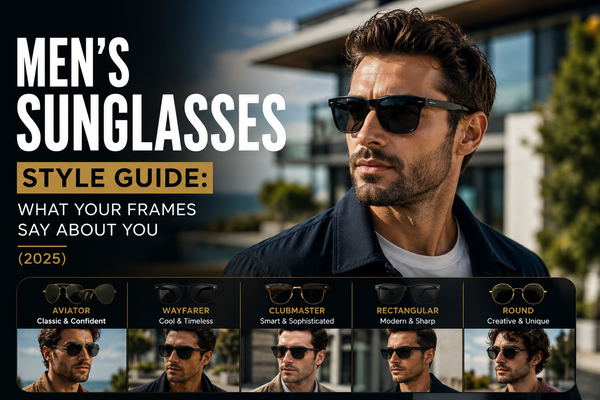

Men’s Sunglasses Style Guide: What Your Frames Say About You
Sunglasses are one of the few accessories men wear on their face. That makes them unusually communicative — they are visible in almost every interaction, photograph, and impression. The frame shape, the lens darkness, the construction quality, the colour of the hardware: all of these contribute to a visual impression that precedes any conversation. Most men choose sunglasses with some vague instinct about what looks right. This guide makes that instinct explicit.
What different frame styles communicate. How to match sunglasses to context. Which styles are genuinely versatile and which are context-specific. How to build a rotation that covers the full range of situations a man moves through without buying ten pairs. And how to make the style choice without compromising the specification that protects your eyes.
This is the final C15 Men’s Sunglasses supporting post, completing the cluster. It links back to the cluster pillar atthe complete guide to men’s sunglasses. For the psychology of sunglasses as a broader topic, seethe psychology of sunglasses: confidence, focus and social perception.
Quick Answer
Classic aviators communicate confidence and timeless taste without making a strong statement. Rectangular thin metal frames communicate clean professionalism. Round frames communicate deliberate aesthetic intelligence. Thick acetate Wayfarers communicate cultural awareness and deliberate heritage choices. Sport wraparounds communicate active seriousness. The universal principle: thin construction reads as considered; thick construction reads as bold. Neutral colours read as refined; bright colours read as playful. Match the frame to the context and face shape, then put the right lens specification inside it.

Table of Contents
Part 1: Why Sunglasses Are a Communication Tool
Accessories communicate style personality in the absence of words. Sunglasses are among the most powerful accessories men wear because they occupy the most socially significant part of the body — the face, and specifically the eyes. A man in dark sunglasses communicates mystery. A man in classic slim aviators communicates a particular kind of assured ease. A man in thick-framed vintage glasses communicates deliberate aesthetic identity.
This is not a superficial observation. Research in social psychology consistently demonstrates that eyewear significantly affects perceived personality attributions. Studies have found that eyewear affects perceptions of intelligence, trustworthiness, attractiveness, and confidence — and that different frame styles produce reliably different attributions. The frame shape, construction weight, lens darkness, and colour all contribute to this impression.
None of this means men should approach sunglasses as a performance or a calculated signal. It means that understanding what different frames communicate makes it possible to choose intentionally — selecting a frame that aligns with the impression you want to make in the contexts you move through rather than wearing something that sends an inadvertent message.
Part 2: The Six Major Men’s Frame Styles and What They Signal
1. Classic Aviator
The teardrop metal aviator communicates: confidence, timelessness, and an easy relationship with style. It is the frame with the broadest demographic and contextual reach of any men’s sunglass shape. The aviation heritage gives it authority; the thin metal construction gives it refinement; the near-universal flattery across face shapes gives it accessibility. Aviators read as the choice of a man who knows what works and wears it without overthinking it.
Context range: very wide. Casual, professional, beach, active — all work. The classic aviator is the safe choice in the best sense: it is safe because it is genuinely good, not because it is timid.
2. Rectangular / Thin Metal
Clean rectangular frames in thin metal communicate: professionalism, precision, and understated quality. The frame says the wearer cares about how he looks but is not trying to be noticed for his eyewear. This is the professional man’s frame — it contributes to the overall impression without dominating it. In gunmetal or matte black at moderate size, thin rectangular frames disappear into the face in the best possible way: they are noticed in retrospect as a detail that works.
Context range: wide, with a professional-leaning emphasis. These are the frames that work at work, at dinner, on a flight, and at casual outdoor events without requiring a change.
3. Thick Acetate / Wayfarer-Style
Thick acetate frames in the Wayfarer tradition communicate: cultural awareness, deliberate style choice, and confidence in making a visual statement. The heritage of the Wayfarer is explicitly cultural — the frame associated with multiple decades of creative and intellectual identity. Wearing a thick acetate frame in dark tortoiseshell or black says the wearer knows the history and endorses it.
Context range: narrower. These frames make a strong statement that works in casual, creative, and cultural contexts but can read as overly casual in formal professional settings. They are the frames for the man who uses clothing and accessories as expression and is comfortable with that.
4. Round / Circular
Round frames communicate: intellectual confidence, aesthetic independence, and deliberate style identity. The circular sunglass is the choice that communicates the wearer has thought about their aesthetic and is not defaulting to the obvious. It reads as knowledgeable about style history — the round frame has specific associations with creative and intellectual culture. On the right face shape and in the right context, round frames are among the most striking and intentional-looking choices available.
Context range: specific. Round frames work best in casual, creative, and cultural contexts. In purely professional environments they read as somewhat informal. Best for: men with oval or oblong face shapes who want a distinctive look; less recommended for round faces (see
best sunglasses for men with round faces for detail).
5. Sport / Wraparound
Sport and wraparound frames communicate: active seriousness, performance orientation, and functional over decorative priorities. The man in a quality wraparound sport frame is telling you he uses his equipment for its purpose. In active outdoor contexts — running, cycling, fishing, hiking — this reads as entirely appropriate and confident. In non-active social contexts, sport frames can read as out of context — wearing the running gear to the restaurant.
Context range: narrow but appropriate within its context. The correct frames for any outdoor sport or active use; not the correct frames for professional or social settings.
6. Geometric / Fashion-Forward
Hexagonal, octagonal, and other geometric frames communicate: deliberate fashion intelligence, willingness to make bold choices, and active engagement with contemporary style. These are the most context-specific frames in men’s eyewear — they read as intentional style statements rather than neutral choices. In fashion-conscious, creative, and social contexts, they work strongly. In professional or active contexts, they are mismatched.
Part 3: Matching Frames to Context
|
Context |
Best Frame Style |
Why |
|
Daily professional / office |
Thin rectangular metal or slim aviator |
Understated quality; does not dominate the impression |
|
Smart-casual / social |
Aviator or thin metal oval |
Versatile; works across dressed-up and dressed-down |
|
Casual outdoor / weekend |
Any — widest context range |
Choose based on face shape and personal style preference |
|
Active / sport |
Sport wraparound in TR90 |
Functional design signals; secure fit; appropriate equipment |
|
Beach / travel |
Aviator or casual oval |
Relaxed; appropriate to context; functional with polarized |
|
Creative / cultural / arts |
Round, geometric, or bold acetate |
Deliberate style statement; context rewards individuality |
|
Formal event |
Slim aviator or thin metal |
Subtle; contributes to overall look without distracting |
|
Driving (daily commute) |
Rectangular or aviator in gray polarized |
Colour accuracy; appropriate professional register |
Part 4: The Color and Construction Dimension
Frame Color
Neutral frame colors — matte black, gunmetal, silver, dark tortoiseshell — have the broadest contextual range. They work across most outfit combinations and read as considered rather than flashy. They are the safe starting point for any man building a sunglass rotation.
Warm neutrals — gold, havana brown, warm tortoiseshell — suit warmer skin tones and add a subtle warmth to the overall impression. They read as carefully chosen rather than defaulted to. Particularly effective with amber or green lens tints.
Bold colors — bright acetate, colored metal finishes — are deliberate statements. They narrow the contextual range significantly. Appropriate for men who use colour intentionally as part of their style identity.
Construction Weight
Thin construction — thin metal frames, thin TR90 — reads as refined and considered. The lightness of thin construction is visually associated with quality and precision. Thin frames require confidence because they make no compensating visual statement; they rely on the face shape and the man wearing them to do the work.
Medium construction — medium acetate, standard TR90 — is the most neutral weight. Not making a thin-refined statement, not making a thick-bold statement. The most versatile construction weight for men building a practical rotation.
Thick construction — thick acetate, bold plastic — makes a statement. Deliberately bold. Reads as a confident stylistic choice when done well; reads as trying too hard when poorly executed or mismatched to the context.
Lens Color
Gray lenses maintain the color of the world and photograph neutrally. The impression is clean and direct. Brown and amber lenses add warmth to the visual scene and photograph with a warmer quality. Green lenses maintain clarity and read as clean and functional. Mirror lenses add a surface quality that reads as modern and bold when done in silver or gold, flashy when done in bright colors.

Part 5: The Rotation Model — Covering Every Context
The most practical approach to men’s sunglasses style is not to find the single perfect pair but to build a small rotation that covers the main contexts of a man’s life. This is also the most UV-protective approach: multiple pairs in relevant locations means protection is consistently accessible rather than frequently absent.
At $119 for four pairs through Navi’s Buy 1, Get Any 3 Free deal, building this rotation costs approximately $30 per pair — less than a single pair from most mid-tier heritage brands. Browse the full collection atnavieyewear.com/collections/polarized.
Part 6: Style Without Compromising Specification
The most important style principle in sunglasses is that style and specification are not in conflict. The right frame shape for your face and context can also be UV400 polycarbonate with quality polarization. The beautiful aviator and the well-specified daily driver are the same object when the product is built correctly.
The mistake to avoid: choosing a frame purely for style and ignoring the lens specification. A stylistically perfect frame with a dark non-UV400 lens is failing at its primary function — it is a style accessory that actively worsens eye UV exposure through pupil dilation. The style choice and the specification choice are made simultaneously.
For the full specification explanation, seewhy Navi Eyewear: our approach to UV400 and polarization.
Part 7: Common Style Mistakes Men Make
Part 8: Frame Style Quick Reference Table
|
Frame Style |
Signals |
Context Range |
Face Shape Suitability |
Navi Category |
|
Classic aviator |
Confidence, timeless taste |
Very wide |
Most face shapes |
Everyday polarized |
|
Thin rectangular metal |
Professional precision, understated quality |
Wide — professional lean |
Oval, round, oblong |
Everyday polarized |
|
Thick acetate / Wayfarer |
Cultural awareness, deliberate statement |
Medium — casual/creative |
Oval, oblong |
Casual polarized |
|
Round / circular |
Intellectual confidence, aesthetic independence |
Narrow — casual/creative |
Oval, oblong, square |
Casual polarized |
|
Sport / wraparound |
Active seriousness, functional priority |
Narrow — active contexts |
Any — function over form |
Sport polarized |
|
Geometric |
Bold fashion intelligence |
Narrow — fashion/social |
Round, square |
Casual/statement |
✨ NAVI EYEWEAR — EVERY STYLE. ONE SPECIFICATION.Every Navi frame ships with UV400 polycarbonate, polarized lenses, oleophobic and anti-saltwater coating. Style your rotation. The specification is consistent across every pair. Buy 1, Get Any 3 Pairs Free — $119 for four pairs (~$30 each). Free shipping. Free replacements. |
Part 9: Best For
Classic Aviator or Thin Metal — Best For:
Thick Acetate or Round — Best For:
Sport / Wraparound — Best For:
Part 10: Who This Is Not For
Bottom Line
Sunglasses communicate. The frame style, construction weight, lens color, and hardware finish all contribute to an impression that precedes the conversation. Classic aviators and thin metal frames are the most contextually versatile and broadly flattering. Thick acetate and round frames make deliberate statements that work in specific contexts. Sport frames belong in active use. The right choice is the one that matches your face shape, your context, and your personal style identity — with UV400 polarized polycarbonate inside it.
The rotation model is the practical answer to covering all contexts: a professional everyday pair, an active pair, a casual style pair, and a travel pair. At $119 for four Navi pairs with free replacements, building a complete rotation costs less than a single entry-level pair from most heritage brands.
Browse the full collection atnavieyewear.com/collections/polarized. Add 4 pairs — Buy 1, Get Any 3 Free auto-applies. Free shipping. Free replacements.

Frequently Asked Questions
What frame style is most versatile for men?
Classic thin metal aviators are the most versatile men’s sunglass style. The teardrop shape flatters most face geometries, the thin construction is appropriate across casual, professional, and smart-casual contexts, and the heritage of the design gives it authority without making a bold statement. For men who want one pair that works everywhere, the classic aviator is the starting point recommendation.
What do aviator sunglasses say about a man?
Aviators communicate confidence and an easy relationship with style. The frame has aviation heritage that lends it authority, and its near-universal flattery across face shapes means the man wearing aviators has made a choice that works without overthinking it. The impression is: knows what works, wears it without drama.
Are round sunglasses stylish for men?
Yes, on the right face shape and in the right context. Round frames communicate deliberate aesthetic intelligence and are associated with creative and intellectual identity. They work best on oval, oblong, and square faces where the circular shape provides contrast. They are least flattering on round faces where the circular lens mirrors the face shape. In casual and creative contexts, a well-chosen round frame in thin metal is one of the most distinctive-looking choices available.
How should men choose sunglasses to match their style?
Match the frame style to the context you wear sunglasses in most, then match the frame shape to your face geometry. A man who wears sunglasses primarily driving and commuting wants a professional-register thin metal frame in gray polarized. A man who primarily uses sunglasses for outdoor sport wants a wraparound TR90 in amber polarized. A man who wants a social style statement wants something more deliberate in round or thick acetate. Then verify UV400 certification on whatever style is chosen.
What color sunglasses look best on men?
Neutral dark colous — matte black, gunmetal, silver, dark tortoiseshell — have the broadest range and suit most complexions and outfit combinations. They are the safe starting point for any man building a rotation. Warm neutrals — gold, havana, warm tortoiseshell — suit warmer complexions and add subtle warmth. Bold or bright frame colous narrow the contextual range and suit men who use color intentionally as part of their style identity.
Should men have more than one pair of sunglasses?
Yes — three to four pairs in active rotation is the practical ideal. One professional everyday pair (slim aviator or thin rectangular, gray polarized, lives in the car or bag), one active pair (amber polarized TR90 for sport and outdoor exercise), one casual style pair (a more expressive frame for weekends and social contexts), and one travel or beach pair (acceptable to lose or scratch). At $119 for four Navi pairs, building this rotation is genuinely accessible.
Do thick or thin frames look better on men?
It depends on the context and the face. Thin frames read as refined and considered — they suit professional contexts and men who want understated style. Thick frames make a deliberate statement and suit creative or casual contexts and men who use accessories expressively. Thin construction is more broadly contextually appropriate; thick construction is more specifically expressive. For most men building a practical rotation, thin metal frames cover the widest range.
Is style important in sunglasses or just protection?
Both matter, and they are not in conflict. The right frame shape for your face and context can simultaneously be UV400 polycarbonate with quality polarization. Style and specification are chosen simultaneously — not as competing priorities. A frame that looks right and has the correct lens specification is achievable at every price point above the unverified budget tier.
Supporting Articles
STYLE. SPEC. BOTH.UV400 • FDA-Cleared Polycarbonate • Polarized • Oleophobic • Anti-Saltwater • TR90 • Stainless Hinges Every Navi frame. Every pair. No compromises on protection. Buy 1, Get Any 3 Pairs Free — $119 for four pairs. Free shipping. Free replacements. |
SOURCES & CITATIONS[1] Hellström Å, Tekle J.“Person perception through facial photographs: effects of glasses, hair, and beard on judgements of occupation and personal qualities.”European Journal of Social Psychology, 1994.View source [2] Dain SJ.“Sunglasses and sunglass standards.”Clinical and Experimental Optometry, 2003.View source [3] Rosenthal FS, Bakalian AE, Lou CQ, Taylor HR.“The effect of sunglasses on ocular exposure to ultraviolet radiation.”American Journal of Public Health, 1988.View source [4] American Academy of Ophthalmology.“Sunglasses: choosing the right pair for UV protection.”AAO EyeSmart, 2023.View source |