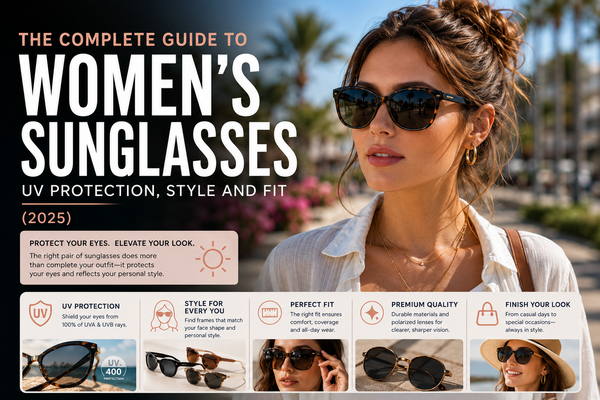

The Complete Guide to Women’s Sunglasses: UV Protection, Style and Fit
Women are the primary sunglass purchasers in most households. They buy for themselves, for their partners, and for their children. They navigate a market full of style-forward products with almost no specification transparency, and they do so while facing the same UV eye risks as men — plus some specific vulnerabilities that are unique to women’s biology.
This guide covers the complete picture: the UV science specific to women, the face shapes and frame rules, the styles that work across different contexts and personalities, the activity-specific lenses for the outdoor lives women actually lead, what price actually buys, and how to build a rotation that covers everything. It also covers the topics that no other sunglass brand publishes: the hormonal connection to light sensitivity, the specific UV risk changes after 50, and the specific ways women’s lifestyle patterns interact with outdoor UV exposure.
This is the C16 Women’s Sunglasses pillar post. The supporting guides in this cluster cover specific topics:sunglasses for women with oval faces,sunglasses for women with heart-shaped faces,sunglasses for running and outdoor fitness for women,sunglasses and light sensitivity in women: the hormonal connection, andbest sunglasses for women over 50.
Quick Answer
For most women: UV400 polarized polycarbonate at Category 2 in a frame shape that contrasts your face geometry — angular for oval and round faces, curved for square and heart faces. Gray polarized for everyday driving and variable conditions. Amber or brown polarized for outdoor sport, beach, and any activity where terrain or surface contrast matters. The complete specification: UV400 certified polycarbonate, polarized, oleophobic and anti-saltwater coating, TR90 or quality metal frames. At $119 for four pairs through Navi’s Buy 1, Get Any 3 Free deal, the complete rotation is accessible.

Table of Contents
Part 1: UV Risk for Women — What’s Different
The Same Core Biology, Some Unique Factors
The core UV eye risk is the same across sexes: cumulative UV exposure to the eye drives cataract formation in the crystalline lens and retinal damage in the macula that progresses toward age-related macular degeneration. The mechanism — UV-driven oxidative stress in ocular tissue — does not differentiate by sex. UV400 protection is equally important for women and men.
Light Sensitivity: The Hormonal Variable
Women experience higher rates of photophobia — abnormal light sensitivity — than men, and the connection to hormonal biology is well-documented. Oestrogen and progesterone fluctuations across the menstrual cycle, during pregnancy, and through menopause are associated with changes in light sensitivity and migraine frequency. Migraines, which affect approximately three times as many women as men, are strongly associated with photophobia — with bright light being one of the most commonly reported triggers.
The practical consequence for sunglasses: women who experience hormonal fluctuations may find that their light sensitivity varies across the month, and that UV400 polarized lenses provide relief from discomfort that goes beyond simple UV protection into genuine symptom management for light-sensitive conditions.
Cosmetic UV: The Periocular Skin
The skin immediately around the eyes — the periocular zone — is among the thinnest and most UV-sensitive skin on the body. UV exposure to this area accelerates photoageing: fine lines, crow’s feet, and skin thinning. Sunglasses with close-fitting frames and adequate coverage geometry provide meaningful protection to the periocular skin alongside the protection to the eye itself. For women for whom periocular skin health is a priority, sunglass frame coverage is both an eye health and a skin health decision.
Makeup and Lens Maintenance
Women who wear eye makeup — mascara, eyeshadow, eyeliner — transfer these products to lens surfaces through routine facial contact. Oleophobic coating dramatically reduces the maintenance burden of this: cosmetic products that would smear across an uncoated lens wipe clean from an oleophobic surface with a single pass of a microfibre cloth. For women, oleophobic coating is less of a premium feature and more of a daily practicality.
The full UV disease science is inUV and eye disease: the complete guide. The specific light sensitivity and hormonal connection is insunglasses and light sensitivity in women: the hormonal connection.
Part 2: The UV400 Lens Specification for Women
UV400: The Complete Standard
UV400 means the lens blocks all ultraviolet radiation to 400 nanometres — 100% of UVA and 100% of UVB. It is the complete standard. UV380, which some products use, leaves the 380–400nm UVA band open. Any lens without explicit UV400 certification should not be trusted for outdoor UV protection. For the full UV400 science, seewhat does UV400 actually mean.
Polycarbonate: The Right Lens Material
Polycarbonate provides inherent UV400 protection throughout the lens material — not a surface coating. It is FDA-cleared for impact resistance and lightweight for comfortable all-day wear. These properties matter for women who wear sunglasses for extended periods: on school runs, at the beach, during exercise, while driving. The complete lens material comparison is inpolycarbonate vs glass sunglass lenses.
Lens Category for Women’s Everyday Use
Part 3: Polarization — The Practical Case for Women’s Lives
Polarized lenses eliminate horizontal surface glare — the reflections from roads, water, car hoods, beach sand, and glass surfaces that produce the squinting, discomfort, and visual fatigue of being outdoors in bright conditions. Non-polarized lenses darken the scene uniformly. Polarized lenses remove the specific horizontally polarized reflection that causes the problem.
For women who drive the school run in early morning sun, who spend extended time at the beach or pool with children, who run or cycle outdoors during the highest UV hours of the day, or who work in outdoor environments — the functional improvement of polarized over non-polarized is daily and significant. Polarized UV400 is the complete everyday outdoor specification.
The complete polarization science is inpolarized vs non-polarized sunglasses: the definitive guide.
Part 4: Women’s Face Shapes and Frame Rules
The same contrast principle that applies to men applies to women: choose frame shapes that differ from your face shape to create visual balance. The frame shapes that work are mirrored by the face shapes that suggest them.
Oval Face
Oval faces have balanced proportions with a slightly wider forehead than chin and gently curved edges. Almost any frame shape works on an oval face. The most versatile face shape for sunglasses. The only limit: very large oversized frames that overwhelm the proportions. Cat-eye, aviator, rectangle, round, oversized — all work.
The detailed guide for oval face women is inbest sunglasses for women with oval faces.
Round Face
Round faces benefit from the same angular contrast rule as round-face men: rectangular frames, angular shapes, and frames wider than they are tall. Avoid circular or very rounded oval frames that mirror the face shape. Cat-eye frames work particularly well on round faces because the upswept outer corners add vertical definition and break the circular impression.
Heart-Shaped Face
Heart-shaped faces are wider at the forehead and taper to a narrower chin. Frames that add visual width to the lower face — wider at the bottom than the top, or with visual weight distributed downward — create balance. Aviators and oval frames work well. Avoid very prominent top-heavy frames (strong browline, heavily upswept cat-eye) that add width to the already-wider forehead.
The detailed guide for heart-shaped faces is inbest sunglasses for women with heart-shaped faces.
Square Face
Square faces benefit from the same softening approach as square-face men: curved frames that contrast the jaw’s angularity. Round frames, ovals, and classic aviators. Avoid strongly rectangular or geometric frames that mirror and amplify the jaw angles.
Oblong / Rectangle Face
Oblong faces are longer than wide. Wider frames that add horizontal breadth balance the vertical length. Oversized frames, wide aviators, and wide cat-eyes all help. Avoid narrow or very small frames that emphasise the face’s length.
Diamond Face
Diamond faces are widest at the cheekbones with narrower forehead and jaw. Oval frames and rimless styles that do not compete with the prominent cheekbones work best. Avoid very wide or very geometric frames that emphasise the cheekbone width.

Part 5: Women’s Sunglass Frame Styles Explained
Cat-Eye
The cat-eye is the most distinctively feminine sunglass shape. The upswept outer corners add character and an uplifting quality to the face. A gentle cat-eye — subtle upswept corners in thin metal or acetate — is one of the most universally flattering women’s sunglass shapes. It works particularly well on round, square, and oblong faces where the upswept corners add vertical definition. A strong, very pronounced cat-eye is a bold statement that works in fashion-conscious contexts.
Oversized
Oversized frames provide maximum UV coverage, periocular skin protection, and a fashion-forward statement. They work best on oval and oblong faces where the large lens area does not overwhelm. For women concerned about periocular skin UV exposure — the area where photoageing is most visible — oversized frames with good coverage geometry provide the most complete protection.
Classic Aviator
Thin metal teardrop aviators are as flattering on women as they are on men. The universal face-shape flexibility of the aviator, combined with its clean contemporary aesthetic and the association with confident ease, makes it one of the most versatile women’s everyday choices. In gold or silver metal with gray or brown polarized lenses, the aviator is appropriate for professional, casual, and outdoor contexts without requiring a change.
Round / Oval
Round and oval frames in thin metal or thin acetate are consistent women’s favourites because of their soft, feminine quality. On oval and oblong faces, they work beautifully. On square faces, they provide the softening contrast that balances the jaw. On round faces, they provide minimal contrast — rectangular or cat-eye shapes are more effective.
Rectangular / Wraparound
Rectangular frames in thin metal provide a clean, professional quality that suits oval, round, and oblong faces. For outdoor sport and active use, wraparound geometry in lightweight TR90 provides maximum UV coverage and secure fit.
Wayfarer-Style
The thick acetate Wayfarer-style frame in women’s sizing communicates deliberate, culturally aware style. It works across oval, oblong, and round faces (where the angular top line adds definition). It is a casual-to-smart-casual frame rather than a professional or active one.
Part 6: Lens Tint Guide for Women
|
Tint |
Best For |
Why |
Category |
|
Gray polarized |
Driving, everyday, professional |
Neutral colour rendering; maximum glare reduction |
Cat 2–3 |
|
Brown / Amber polarized |
Beach, outdoor activities, fitness |
Blue-scatter filtering; terrain and surface contrast |
Cat 2–3 |
|
Rose / Copper |
Low light, variable conditions, fashion |
Bright, enhancing quality; contrast in flat light |
Cat 1–2 |
|
Green |
All-round outdoor; running; tennis |
High contrast with good colour accuracy |
Cat 2–3 |
|
Mirror (any base tint) |
Very bright conditions; beach; fashion statement |
Additional brightness reduction; aesthetic quality |
Cat 3 |
Part 7: Activity-by-Activity Guide for Women
Driving and the School Run
Gray polarized UV400 at Category 2 is the non-negotiable morning commute and school run specification. The low-angle morning sun from the east, combined with road surface reflection and oncoming traffic, creates the most intense horizontal glare events of the everyday driving day. Polarized lenses eliminate this. Gray maintains colour accuracy for traffic signals. Category 2 handles the full range from bright morning sun to overcast afternoon.
Running and Outdoor Fitness
Lightweight TR90 with rubberised nose pads and temple tips, amber or gray polarized UV400 at Category 2. Secure fit is the primary requirement for running — a frame that slides is worse than no frame. For the complete women’s running and fitness guide, seesunglasses for running and outdoor fitness for women.
Beach and Pool
Amber or gray polarized UV400 with anti-saltwater coating at Category 3. Beach and pool environments are the most UV-intense of everyday life — overhead UV plus surface reflection from below. Anti-saltwater coating is important for any regular beach use. Oversized frames with good coverage geometry provide additional periocular skin protection. The full beach guide is inbest sunglasses for the beach.
Outdoor Work and Garden
Women who garden, work outdoors, or spend significant time in outdoor environments during the highest UV hours of the day accumulate UV at rates comparable to outdoor workers. UV400 polarized at Category 2–3 for any extended outdoor work. The UV dose from regular outdoor hobby time is not trivial and is rarely considered in the context of sunglass choice.
Travel
UV400 polarized at Category 3 packed before departure for high-UV destinations. Mediterranean, Caribbean, and tropical travel delivers UV index 10–12+ — significantly higher than home locations. Tourist shop and resort shop products have the highest UV certification failure rates. Pack verified UV400 before travel. The summer travel UV guide is inthe complete summer sunglasses guide.
✨ NAVI EYEWEAR — FOR EVERY WOMAN. EVERY OCCASION.UV400 certified polycarbonate. Polarized. Oleophobic coating (essential for makeup wearers). Anti-saltwater coating. TR90 frames. Stainless 5-barrel hinges. Buy 1, Get Any 3 Pairs Free — $119 for four pairs (~$30 each). Free shipping. Free replacements. Shop the collection:navieyewear.com/collections/polarized |
Part 8: The Hormonal Connection — Light Sensitivity and UV Risk
Light sensitivity in women is not simply a matter of personal preference — it has a documented biological basis. Oestrogen and progesterone fluctuations are associated with changes in neural pain thresholds, including the sensory pathways that process light intensity. During phases of the menstrual cycle when oestrogen drops sharply — the days immediately before menstruation — many women experience increased light sensitivity and headache frequency.
Migraine, which is approximately three times more prevalent in women than men and is primarily driven by hormonal fluctuations, has photophobia as one of its defining features. For the estimated 28% of women who experience migraines, light sensitivity is a recurring and sometimes debilitating symptom. UV400 polarized lenses reduce the intensity of ambient light and eliminate the horizontal glare that can trigger or intensify photophobic discomfort.
During pregnancy, many women report increased light sensitivity alongside other sensory sensitivities. During perimenopause and menopause, the hormonal environment changes significantly — and dry eye symptoms, which affect light comfort, become more prevalent. Dry eye itself increases light sensitivity by reducing the tear film that normally moderates light entry to the eye.
The complete guide to the hormonal connection and what it means for sunglass choice is insunglasses and light sensitivity in women: the hormonal connection.
Part 9: Women Over 50 — Why UV Protection Becomes More Important
The crystalline lens becomes progressively more UV-absorbing with age as it yellows naturally. This means the lens itself provides increasing UV protection to the retina as women age — but this yellowing is also the early process of nuclear cataract formation. The cataract risk from accumulated lifetime UV is highest in the 50s, 60s, and 70s, when the consequences of decades of UV accumulation become clinically apparent.
Macular degeneration — the leading cause of central vision loss in people over 65 — is more prevalent in women than men, partly because women live longer and partly because of potential hormonal contributions. The UV contribution to AMD risk is cumulative and has a multi-decade lag from exposure to manifestation. The protection that matters most for preventing AMD in the 60s and 70s is the UV protection worn in the 30s, 40s, and 50s.
After 50, dry eye syndrome becomes more prevalent as oestrogen levels decline during perimenopause and menopause. Dry eye increases light sensitivity and discomfort in outdoor environments — making UV400 polarized lenses not just a health choice but a comfort requirement for sustained outdoor activity.
The complete guide for women over 50 is inbest sunglasses for women over 50: UV protection as vision changes.
Part 10: Women as Household UV Protectors
Women make the majority of household purchasing decisions including sunglasses for partners, children, and family members. The same UV400 verification principles that apply to personal purchases apply to every pair purchased for any household member.
Children are the most UV-vulnerable household members. Their crystalline lenses are more UV-transparent than adults, admitting more UV to the retina for the same ambient exposure. The WHO estimates that up to 80% of lifetime UV dose may be accumulated before age 18 — making summer holiday UV protection for children a significant long-term health investment, not a parental over-caution.
The specific risk for children’s sunglasses: the brightly coloured, character-themed, attractively priced children’s sunglasses sold in beach shops and resort areas have the highest UV certification failure rates of any purchase channel. A child wearing dark non-UV400 sunglasses is experiencing greater UV retinal exposure than with no glasses at all.
The complete children’s UV protection guide is inthe complete guide to sunglasses for kids and teenagers.
Part 11: What Price Buys for Women’s Sunglasses
The Heritage Brand Premium
Women’s sunglasses from heritage brands at $150–$250 buy: the specific designer silhouette, the brand’s creative direction, the iconic design, and the cultural recognition that comes with the name. These are coherent reasons to purchase. They are not UV protection reasons. The UV400 polycarbonate specification is achievable at every price tier above the unverified budget zone.
The Fashion Brand Trap
Fashion brand sunglasses at $30–60 from clothing retailers and fast-fashion channels are particularly prevalent in women’s sunglasses. They offer current-season styling at accessible prices. The UV certification problem is severe in this channel: many fashion brand sunglasses are UV380 or unverified, optimised for style rather than protection. Always verify UV400 explicitly on any fashion brand purchase.
The Direct-to-Consumer Value
Navi Eyewear’s Buy 1, Get Any 3 Free at $119 for four pairs represents the direct-to-consumer model applied to a complete specification: UV400 polycarbonate, polarized, oleophobic and anti-saltwater coating, TR90 frames, stainless hardware. Four pairs at approximately $30 each with free replacements. For women who buy sunglasses for the whole household and want verified UV400 across multiple pairs at a realistic price, this is the most efficient purchasing model in the market.
Part 12: The Multi-Pair Case for Women
Women’s sunglass use is typically more context-varied than men’s. The school run pair (gray polarized, professional register, stays in the car), the beach/pool pair (amber polarized, anti-saltwater, in the beach bag), the running pair (lightweight TR90, rubberised grip, in the gym bag), and the style pair (more expressive frame for social and fashion contexts) each have different optimal characteristics.
Four pairs in active rotation also provides household UV coverage: having an accessible verified UV400 pair in the car, at home, in the travel bag, and in the activity kit means the right pair is always to hand rather than frequently absent in the wrong location.
At $119 for four Navi pairs with free replacements, the complete rotation costs less than a single designer pair from most fashion brands. Browse the full collection atnavieyewear.com/collections/polarized.
Part 13: Fit — The Practical Checklist for Women
Frame Width
The frame should approximately match the face width at its widest point. Women’s faces typically have a total frame front width in the range of 120–138mm, compared to 130–145mm for men. Women’s-specific or smaller-size frames (labelled ‘small’ or with lens widths of 50–52mm rather than 54–56mm) often fit better than unisex or men’s frames.
Nose Fit
Women tend to have slightly lower nose bridges on average than men. Frames with adjustable nose pads allow the pad angle to be customised for a flush fit without sliding. Fixed plastic bridges in standard positions may sit too high on women with lower nose bridges.
Temple Length
Standard temple lengths of 140–145mm suit most women. Shorter temples (130–135mm) can feel more comfortable for smaller head geometries.
Eye Coverage
The lens should fully cover the eye from above the brow line to below the cheekbone. For women concerned about periocular skin UV protection, larger coverage frames provide additional protection to the skin around the eyes.
The complete frame measurement guide is inhow to tell if sunglasses actually fit.
Part 14: Women’s Sunglasses Quick Reference Table
|
Use Case |
Lens Tint |
Category |
Frame Style |
Key Spec |
|
Driving / school run |
Gray polarized |
Cat 2 |
Aviator or rectangle |
UV400, colour accuracy |
|
Beach / pool |
Amber or gray polarized |
Cat 3 |
Oversized or classic |
Anti-saltwater coating |
|
Running / fitness |
Amber or gray polarized |
Cat 2 |
Sport TR90 or lightweight |
Rubberised grip, lightweight |
|
Cycling |
Amber polarized |
Cat 2–3 |
Wraparound or sport |
Impact resistant, coverage |
|
Travel — high UV |
Gray polarized |
Cat 3 |
Any UV400 verified |
Pack before departure |
|
Fashion / social |
Any UV400 polarized |
Cat 2 |
Cat-eye, oversized, round |
Style + UV400 non-negotiable |
|
Light-sensitive women |
Gray polarized |
Cat 2–3 |
Close-fitting, good coverage |
Polarized essential for glare |
|
Women over 50 |
Gray polarized |
Cat 2–3 |
Oversized for skin coverage |
UV400 + anti-saltwater |
Part 15: Best For
UV400 Polarized Gray — Best For:
UV400 Polarized Amber / Brown — Best For:
The Four-Pair Rotation — Best For:
Part 16: Common Mistakes Women Make When Buying Sunglasses
Bottom Line
Women’s sunglasses should do three things simultaneously: protect eyes from the cumulative UV that drives cataract and macular degeneration over a lifetime, address the specific light sensitivity vulnerabilities that women’s biology creates, and look right for the contexts and face shapes they are worn in. These three requirements are not in conflict. UV400 polarized polycarbonate in a well-fitted frame that suits the face shape and the occasion is achievable at any price point above the unverified budget tier.
The most common failure mode in women’s sunglass purchasing is choosing style without verifying specification — particularly in the fashion brand channel where UV certification failure rates are significant. The second most common failure mode is not buying enough pairs: one pair cannot optimally serve driving, beach, sport, and social use simultaneously.
Navi Eyewear’s $119 Buy 1, Get Any 3 Free model at approximately $30 per pair with free replacements is the practical solution to the multi-pair rotation that women’s outdoor lives require.
Browse the full collection atnavieyewear.com/collections/polarized. Add 4 pairs — Buy 1, Get Any 3 Free auto-applies. Free shipping. Free replacements.

Frequently Asked Questions
What are the best sunglasses for women?
UV400 polarized polycarbonate in a frame shape suited to the face and the primary use context. Cat-eye, aviator, oval, and oversized frames in thin metal or quality acetate are the most broadly flattering women’s styles. Gray polarized at Category 2 for everyday driving and variable conditions; amber at Category 2–3 for beach and sport. Browse quality UV400 options atnavieyewear.com/collections/polarized.
Do women need UV400 sunglasses?
Yes — UV400 is the non-negotiable standard for outdoor UV eye protection for all adults. Women face the same core UV eye disease risks as men (cataract and AMD) plus specific light sensitivity vulnerabilities linked to hormonal biology and higher migraine prevalence. UV400 polycarbonate with quality polarization is the correct specification for all women who spend time outdoors.
What frame shape suits women?
Cat-eye suits round, square, and oblong faces by adding upswept definition. Aviator suits most face shapes through its universal proportions. Oversized suits oval and oblong faces. Round and oval suits square and oblong faces by providing softening contrast. The universal rule: frames that contrast the face shape provide better balance than frames that mirror it.
Are polarized sunglasses better for women?
Yes for outdoor use involving driving, beach, water, or any reflective surface environment. Polarized lenses eliminate horizontal glare specifically — the type that causes squinting, visual fatigue, and discomfort in outdoor conditions. For women with light sensitivity linked to hormonal factors or migraine, polarized lenses also reduce the intensity of glare that can trigger or worsen photophobic symptoms. The full polarization guide is inpolarized vs non-polarized sunglasses: the definitive guide.
Why do women experience more light sensitivity?
The primary driver is hormonal. Oestrogen and progesterone fluctuations are associated with changes in neural pain thresholds and light sensitivity. Migraine — which affects approximately three times as many women as men and is strongly hormonally driven — has photophobia as a defining feature. Dry eye syndrome, more prevalent in women particularly after menopause, also increases light sensitivity by reducing the tear film. The complete guide is insunglasses and light sensitivity in women: the hormonal connection.
What sunglasses should women wear for driving?
Gray polarized UV400 at Category 2. Gray maintains colour accuracy for traffic signals. Polarization eliminates horizontal road surface reflection — particularly significant in morning school-run conditions with low-angle sun and dew-damp roads. Category 2 handles the full range from bright morning sun to overcast afternoons.
How do sunglasses protect the skin around the eyes?
The periocular skin — around and below the eyes — is among the thinnest and most UV-sensitive skin on the body. UV exposure accelerates photoageing: fine lines, crow’s feet, and skin thinning in this zone. Sunglasses with close-fitting frames and adequate vertical coverage protect this skin alongside the eyes. Oversized frames with generous coverage geometry provide the most comprehensive periocular skin protection. This is both an eye health and a skin health benefit.
What are the best sunglasses for women who exercise outdoors?
UV400 polarized polycarbonate in lightweight TR90 with rubberised nose pads and temple tips. Amber polarized at Category 2 for most outdoor fitness. Under 25g for sessions over 45 minutes. Rubberised contact points are the critical feature for any vigorous activity. The full guide for women who exercise outdoors is insunglasses for running and outdoor fitness for women.
Are expensive sunglasses better for women?
Above the UV400 polycarbonate quality threshold, additional cost primarily buys brand heritage, iconic design, and retail distribution — not better UV protection or optical performance for most use cases. The specification that matters for eye health is achievable at approximately $30 per pair through the direct-to-consumer model. The complete analysis is incheap vs expensive sunglasses: a spec-by-spec comparison.
How many pairs of sunglasses should a woman own?
Ideally three to four in active rotation: an everyday driving pair (gray polarized, in the car), a beach or outdoor pair (amber polarized with anti-saltwater coating), a sport or fitness pair (lightweight TR90 with rubberised grip), and a fashion or style pair for social contexts. At $119 for four Navi pairs, building this rotation costs less than a single designer pair from most fashion brands.
Supporting Articles
FOR EVERY WOMAN. EVERY OCCASION. COMPLETE UV400.UV400 • FDA-Cleared Polycarbonate • Polarized • Oleophobic • Anti-Saltwater • TR90 • Stainless Hinges One for the car. One for the beach. One for fitness. One for going out. Buy 1, Get Any 3 Pairs Free — $119 for four pairs. Free shipping. Free replacements. |
SOURCES & CITATIONS[1] Taylor HR, West SK, Rosenthal FS, et al..“Effect of ultraviolet radiation on cataract formation.”New England Journal of Medicine, 1988.View source [2] Cruickshanks KJ, Klein R, Klein BE.“Sunlight and age-related macular degeneration: the Beaver Dam Eye Study.”Archives of Ophthalmology, 1993.View source [3] Lipton RB, Stewart WF, Diamond S, et al..“Prevalence and burden of migraine in the United States: data from the American Migraine Study II.”Headache, 2001.View source [4] Rosenthal FS, Bakalian AE, Lou CQ, Taylor HR.“The effect of sunglasses on ocular exposure to ultraviolet radiation.”American Journal of Public Health, 1988.View source [5] World Health Organization.“Solar ultraviolet radiation: global burden of disease from solar ultraviolet radiation.”WHO Environmental Burden of Disease Series, 2006.View source [6] Dain SJ.“Sunglasses and sunglass standards.”Clinical and Experimental Optometry, 2003.View source [7] American Academy of Ophthalmology.“Sunglasses: choosing the right pair for UV protection.”AAO EyeSmart, 2023.View source [8] Sliney DH.“UV radiation ocular exposure dosimetry.”Documenta Ophthalmologica, 1994.View source |