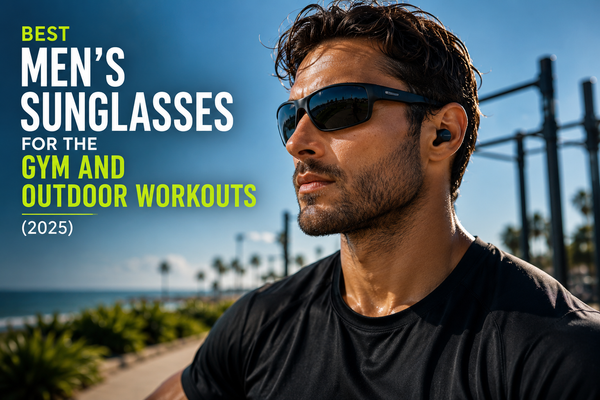

Best Men’s Sunglasses for the Gym and Outdoor Workouts
The single biggest complaint men have about workout sunglasses is that they slide down their nose. It is also the most preventable problem. A frame that fits correctly and uses rubberised contact points stays put during a 10km run, a tempo cycling session, or an outdoor HIIT circuit. A frame that is slightly too wide or has smooth plastic nose pads slides from the first stride and requires constant readjustment for the duration of the session.
Beyond fit, workout sunglasses have a short list of non-negotiable requirements: UV400 to protect eyes during the outdoor UV accumulation that comes with extended outdoor exercise, lightweight construction for all-session comfort, impact-resistant lenses for the physical environment of active outdoor use, and a lens tint that serves the specific visual demands of the activity. This guide covers all of it: what to look for, which frame features matter, which lens tints serve which activities, and what to avoid.
This is a C15 Men’s Sunglasses supporting post. It links back to the cluster pillar atthe complete guide to men’s sunglasses. For the complete sport and outdoor activity guide covering all activities, seethe complete outdoor and sport sunglasses guide.
Quick Answer
For outdoor workouts: UV400 polarized polycarbonate in a lightweight TR90 frame with rubberised nose pads and temple grips. Amber polarized at Category 2 for most outdoor exercise — contrast enhancement helps with terrain, trail surface, and ball tracking. Gray polarized for road running and cycling where colour accuracy matters. Weight under 25g. Secure fit is the primary functional requirement — a frame that slides during exercise is worse than no frame.

Table of Contents
Part 1: Why Outdoor Exercise Creates Specific UV Exposure
Men who exercise outdoors accumulate UV at significantly higher rates than those in indoor or sedentary routines. A 45-minute outdoor run at 10am in summer delivers a UV dose comparable to several hours of casual outdoor exposure, because peak exercise often coincides with peak UV hours. Cyclists, runners, and outdoor sport participants frequently train between 7am and noon — overlapping with the highest UV index periods of the day.
Altitude amplifies this further. Trail runners, hikers, and mountain cyclists experience approximately 10–12% more UV per 1,000 metres of elevation, because the thinner atmosphere filters less UV. A trail run at 2,000 metres delivers roughly 20–25% more UV than the same duration at sea level.
Outdoor exercise also increases the duration of uninterrupted UV exposure compared to casual outdoor time, because there is no seeking shade, no ducking into buildings, no pausing. The UV accumulation is continuous for the duration of the session. UV400 sunglasses during outdoor workouts are not a comfort accessory. They are the intervention that prevents this concentrated UV accumulation from contributing to lifetime cataract and macular degeneration risk.
The full UV accumulation and disease science is inUV and eye disease: the complete guide.
Part 2: The Secure Fit Requirement — Why It Comes First
Every other specification — lens tint, polarization, weight — is irrelevant if the frame slides during exercise. A pair of sunglasses that requires manual repositioning every 2–3 minutes during a run is not a running sunglass regardless of its other qualities. This is the threshold requirement for workout sunglasses and it eliminates a large proportion of the general sunglass market.
Rubberised Nose Pads
The nose pads are the primary contact point that determines frame stability. Smooth plastic or metal nose pads slide on a sweating nose. Rubberised or silicone nose pad material provides significantly better grip on a wet face. For men with lower or flatter nose bridges — where the frame already has less bridge support — rubberised adjustable nose pads are the critical feature. Many quality everyday frames have smooth metal nose pads that are fine for casual wear but inadequate for running.
Rubberised Temple Grips
The temple tips that hook behind the ear are the secondary contact point. Standard plastic temple tips slide behind the ear during running. Rubberised or silicone temple tips grip the skin behind the ear and prevent the frame from sliding forward with the bouncing motion of running. For cycling, the temples also need to fit cleanly over or under helmet straps without creating pressure points.
Frame Width and Bridge Fit
A frame slightly too wide for the face sits on the nose with reduced pressure and slides more easily. A frame that fits the face width correctly distributes temple grip more effectively. For running, a frame that is 2–3mm narrower than the absolute maximum comfortable width often provides better stability than the widest comfortable fit. The bridge geometry also matters: a frame whose bridge matches the nose geometry requires less nose pad pressure to stay in place.
Part 3: Frame Materials for Workout Sunglasses
TR90 Nylon — The Workout Standard
TR90 nylon is the correct frame material for workout sunglasses. It is significantly lighter than acetate (typically 20–25g vs 28–35g for acetate frames), flexible without snapping under the physical stress of exercise, and maintains its shape through the temperature and sweat exposure of outdoor activity. TR90 also does not corrode in salt and sweat environments in the way that some metal frame elements do over extended active use.
Wraparound Geometry — For High-Intensity Activity
Wraparound frames — where the lens curves around the sides of the face — provide two benefits for high-intensity exercise: better peripheral UV coverage from lateral UV sources, and a more secure frame position because the curved lens geometry sits closer to the face and reduces the leverage that head movement creates. For running, cycling, and outdoor ball sports, wraparound geometry is the correct frame shape regardless of face shape considerations.
Stainless Hardware
Stainless steel hinges and hardware resist the corrosion that sweat and salt accelerate in standard base-metal alloys. For workout sunglasses that are used regularly in sweating conditions, stainless hardware extends the frame’s functional life compared to frames with lower-grade metal hardware that loosens and corrodes.
Part 4: Lens Specification for Active Outdoor Use
UV400 Polycarbonate: Mandatory
Polycarbonate provides UV400 protection inherently throughout the lens material — not a surface coating that can be scratched away during the physical demands of active use. It is also FDA-cleared for impact resistance, which matters in any physical activity environment where the lens could encounter a projectile, a branch, or a hard ground surface. Polycarbonate is the standard lens material for all sports and protective eyewear for precisely this combination of UV protection and impact performance.
Polarization for Outdoor Exercise
Polarized lenses benefit outdoor exercise in the same way they benefit driving: by eliminating horizontal surface glare from road surfaces, water, wet trails, and reflective outdoor surfaces. For trail running and cycling specifically, polarized lenses improve the legibility of terrain features — wet rock surfaces, water crossings, road surface texture — by eliminating the reflective glare that obscures them. For ball sports (tennis, golf, cricket), polarization reduces the visual fatigue of sustained outdoor play in reflective conditions.

Part 5: Lens Tint Guide by Activity
|
Activity |
Tint |
Why |
Category |
|
Road running |
Gray polarized |
Colour accuracy; road surface contrast; traffic awareness |
Cat 2 |
|
Trail running |
Amber polarized |
Terrain contrast; trail surface definition; root and rock visibility |
Cat 2 |
|
Road cycling |
Gray polarized |
Colour accuracy for traffic; road surface reflection elimination |
Cat 2–3 |
|
Mountain biking |
Amber polarized |
Maximum terrain contrast; variable shade on trails |
Cat 2 |
|
Outdoor gym / HIIT |
Gray or amber polarized |
General outdoor glare reduction; versatile for mixed conditions |
Cat 2 |
|
Golf |
Amber or green polarized |
Green contrast; ball tracking; course terrain definition |
Cat 2 |
|
Tennis / padel |
Gray or amber polarized |
Ball tracking; court surface reflection |
Cat 2 |
|
Beach volleyball |
Amber polarized |
Sand reflection; ball against sky contrast |
Cat 3 |
|
Open water swimming (poolside) |
Gray polarized |
Water reflection elimination; UV from above and reflected |
Cat 3 |
Part 6: Weight — Why It Matters More Than You Think
The difference between a 22g frame and a 32g frame is imperceptible when picking the sunglasses up. It becomes noticeable at the 30-minute mark of a run and significant at the 60-minute mark. Heavier frames create greater nose pad pressure and more pronounced temple pressure over extended wear. For sessions under 30 minutes, frame weight is not a significant factor. For runs and rides over an hour, lighter frames are meaningfully more comfortable.
TR90 nylon frames consistently come in at the lower end of the weight range — most quality TR90 sunglasses weigh 18–26g. Acetate frames are heavier; metal frames vary but quality thin metal frames can also be light. The weight specification is typically listed in the product description. Under 25g is the target for extended-duration workout sunglasses.
The practical consequence: the frame you forget is on your face during a long run is the frame doing the best job. Heavy frames that create pressure points do not get forgotten.
Part 7: Outdoor Workout Sunglasses by Activity
Running
Secure fit is the dominant specification. Rubberised nose pads, rubberised temple tips, frame weight under 25g. Amber polarized UV400 at Category 2 for trail running; gray polarized UV400 for road running in traffic environments. Wraparound geometry for long runs where peripheral UV coverage and frame stability combine. The bouncing motion of running creates more frame-shifting force than any other common exercise — the secure fit requirement is most demanding here.
Cycling
Larger lens coverage to block wind and road debris from the eyes. Wraparound or large-coverage frames. Gray polarized UV400 for road cycling; amber polarized for mountain biking and trail. Frames that fit cleanly with helmet straps — either under the strap or with specific sport geometry that avoids strap conflict. For the complete cycling guide, seethe complete outdoor and sport sunglasses guide.
Outdoor HIIT and Boot Camp
Variable movement — including jumping, lateral movement, and prone positions — means the frame must stay stable across all movement planes. Rubberised contact points across nose and temples. Category 2 amber polarized for most outdoor conditions. The frame needs to survive being knocked without shattering — polycarbonate’s impact resistance is the relevant specification here.
Golf
Extended outdoor duration (3–5 hours) at high UV index, sustained concentration on terrain and ball tracking. Amber or green polarized UV400 at Category 2. The amber tint specifically enhances the contrast between the ball and sky, and between the green and the surrounding terrain. For the complete golf guide, seebest sunglasses for golf.
Open Water Swimming and Triathlon
Poolside and open water environments combine maximum overhead UV with intense reflected UV from water surfaces. Gray polarized UV400 at Category 3 for high-sun open water environments. Anti-saltwater coating for any marine or coastal open water swimming. For the complete triathlon guide, seesunglasses for triathletes.
✨ NAVI EYEWEAR — BUILT FOR ACTIVE MEN. COMPLETE UV400 SPEC.UV400 certified polycarbonate. Polarized. Oleophobic and anti-saltwater coating. TR90 nylon — lightweight and flexible. Stainless 5-barrel hinges. Buy 1, Get Any 3 Pairs Free — $119 for four pairs (~$30 each). Free shipping. Free replacements. |
Part 8: What to Avoid in Workout Sunglasses
Part 9: Comparison Table — Workout Sunglass Features
|
Feature |
Requirement |
Why |
|
UV certification |
UV400 — mandatory |
Concentrated outdoor exercise UV exposure |
|
Lens material |
Polycarbonate — mandatory |
Impact resistance; inherent UV400; lightweight |
|
Polarization |
Recommended |
Terrain contrast; glare elimination; visual fatigue reduction |
|
Nose pad material |
Rubberised or silicone |
Secure fit on sweating face during movement |
|
Temple material |
Rubberised tips |
Grip behind ear; prevents forward slide |
|
Frame material |
TR90 nylon preferred |
Lightweight; flexible; sweat-resistant |
|
Lens category |
Category 2 |
Versatile for variable outdoor workout conditions |
|
Frame weight |
Under 25g preferred |
Comfort over extended sessions |
|
Hinge material |
Stainless steel |
Corrosion resistance in sweat/salt environments |
|
Lens coverage |
Full eye coverage |
UV protection from all angles during movement |
Part 10: Best For
Amber Polarized UV400 in TR90 with Rubberised Contact Points — Best For:
Gray Polarized UV400 in TR90 with Rubberised Contact Points — Best For:
Part 11: Who This Is Not For
Part 12: Common Mistakes
Bottom Line
The outdoor workout sunglass specification is short and specific: UV400 polycarbonate, polarized, amber tint for most activities, TR90 frame with rubberised nose pads and temple tips, weight under 25g, Category 2 for all-conditions versatility. The secure fit is the first requirement — everything else is secondary to a frame that stays on the face during the full session.
Navi Eyewear’s TR90 nylon frames with stainless hardware and the full UV400 polarized polycarbonate specification provide the foundation for an effective outdoor workout pair at approximately $30 per pair through the Buy 1, Get Any 3 Free deal at $119. Four pairs in rotation — one for running, one for cycling, one for casual outdoor sport, one as a backup — is the practical outdoor active man’s approach.
Browse the full collection atnavieyewear.com/collections/polarized. Add 4 pairs — Buy 1, Get Any 3 Free auto-applies. Free shipping. Free replacements.

Frequently Asked Questions
What sunglasses are best for men who run outdoors?
UV400 polarized polycarbonate in a lightweight TR90 frame with rubberised nose pads and temple tips. Amber polarized at Category 2 for trail running; gray polarized for road running in traffic environments. Weight under 25g for sessions over 45 minutes. Rubberised contact points are the critical feature — they are what separates running sunglasses from sunglasses that slide during running.
Do I need polarized sunglasses for the gym?
For indoor gym use, polarization is not necessary — there are no significant outdoor reflective surfaces inside. For outdoor workouts, polarized UV400 is recommended: it eliminates horizontal surface glare from road, trail, water, and court surfaces, and reduces the visual fatigue of sustained outdoor exposure. The performance benefit is most significant for trail running, cycling, and golf where terrain legibility matters.
Why do my sunglasses slide during running?
Almost always a nose pad material issue, not a fit issue. Smooth plastic or metal nose pads slide on a sweating nose regardless of frame width or bridge fit. Frames with rubberised or silicone nose pads grip the skin and maintain position during running. If your current pair slides, the solution is a frame with rubberised nose pad elements, not a different size of the same frame type.
What is the best lens tint for outdoor exercise?
Amber polarized for most outdoor activity: trail running, cycling, golf, tennis, and any activity involving terrain contrast, ball tracking, or variable outdoor surfaces. The amber tint’s blue-scatter filtering enhances surface and terrain contrast in ways that aid trail visibility and ball tracking. Gray polarized for road running and road cycling where colour accuracy for traffic is a safety requirement.
Can I use regular sunglasses for outdoor workouts?
If they have rubberised nose pads, are lightweight, and carry explicit UV400 certification, yes. The functional requirements of outdoor workout sunglasses — secure fit, lightweight, UV400 polycarbonate — are achievable in many general sunglass frames. The problem is that most everyday sunglasses have smooth contact points that slide during vigorous activity. Check for rubberised nose and temple elements specifically.
Does outdoor exercise increase UV eye exposure?
Yes, significantly. Outdoor exercise during peak UV hours accumulates UV at high rates because the exposure is continuous for the full session duration, often coinciding with the highest-UV hours of the day. Athletes who train regularly outdoors in the morning hours accumulate substantially more annual UV than sedentary individuals. This is one of the strongest arguments for UV400 sunglasses as a training equipment item rather than an optional accessory. The full UV exposure science is inUV and eye disease: the complete guide.
Are there sunglasses for both running and cycling?
Yes — amber polarized UV400 in a wraparound TR90 frame covers both effectively. Wraparound geometry provides the larger lens coverage and peripheral protection that cycling benefits from while remaining secure and lightweight enough for running. The amber tint serves trail running and mountain biking contrast equally well. For road cycling in traffic, a gray polarized pair provides better colour accuracy. Two pairs covering running/mountain biking and road cycling is the ideal rotation.
How important is weight in workout sunglasses?
Increasingly important as session duration increases. Under 30 minutes: weight is barely perceptible. 30–60 minutes: heavier frames begin to create noticeable nose and temple pressure. Over 60 minutes: lightweight frames are significantly more comfortable and are less likely to be removed mid-session. A frame removed during exercise is not providing UV protection. Under 25g is the target for extended outdoor sessions.
Supporting Articles
UV400. LIGHTWEIGHT. STAYS ON YOUR FACE.UV400 polycarbonate. Polarized. Oleophobic and anti-saltwater coating. TR90 nylon. Stainless hinges. Built for sessions. Add 4 pairs to cart — Buy 1, Get Any 3 Free. $119. Free shipping. Free replacements. |
SOURCES & CITATIONS[1] Gies HP, Roy CR, Toomey S, et al..“Solar UVR exposures of three groups of outdoor workers on the Sunshine Coast, Queensland.”Health Physics, 1995.View source [2] Sliney DH.“UV radiation ocular exposure dosimetry.”Documenta Ophthalmologica, 1994.View source [3] Dain SJ.“Sunglasses and sunglass standards.”Clinical and Experimental Optometry, 2003.View source [4] U.S. Food and Drug Administration.“Impact resistance requirements for sunglass lenses (21 CFR Part 801).”FDA Regulations, 2023.View source [5] American Academy of Ophthalmology.“Sunglasses: choosing the right pair for UV protection.”AAO EyeSmart, 2023.View source [6] Taylor HR, West SK, Rosenthal FS, et al..“Effect of ultraviolet radiation on cataract formation.”New England Journal of Medicine, 1988.View source |