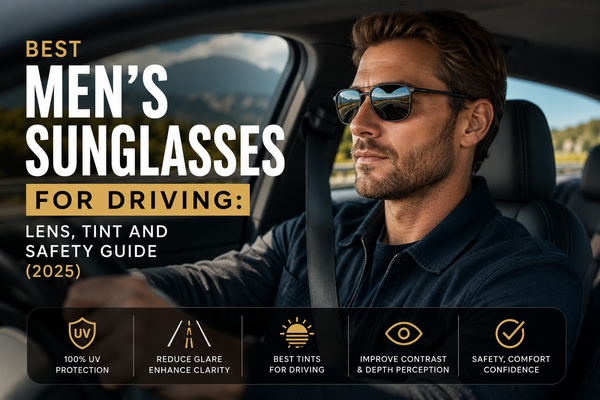

Best Men’s Sunglasses for Driving: Lens, Tint and Safety Guide
Most men who wear sunglasses while driving are doing it instinctively right — reducing the discomfort of sun in the eyes during the commute. What most men are getting wrong is the lens. The dark tint reduces visible light but does not address the specific type of glare that makes driving dangerous. A polarized lens specifically eliminates horizontal surface reflection from roads — the type that creates the shimmering road haze and the blinding post-rain surface glare that are the most genuinely hazardous driving visibility events.
This guide covers the complete driving sunglass specification: why gray specifically matters over other tints, why polarization is not optional for serious driving use, what lens category to wear in different driving conditions, what not to wear behind the wheel, and how to build a driving rotation that covers every scenario from the morning commute to the summer road trip.
This is a C15 Men’s Sunglasses supporting post. It links back to the cluster pillar atthe complete guide to men’s sunglasses. For the full driving sunglass guide covering all drivers, seebest sunglasses for driving: polarized lenses and glare reduction.
Quick Answer
Gray polarized UV400 at Category 2 is the correct everyday driving lens. Gray maintains colour accuracy for traffic signals and road markings. Polarization eliminates horizontal road surface reflection that non-polarized lenses cannot address. Category 2 (18–43% VLT) is versatile enough for bright sun, variable conditions, and early morning and late afternoon lower-angle sun. Category 3 for summer driving in sustained bright conditions. Never Category 4 — too dark for safe road use.

Table of Contents
Part 1: Why Driving Creates Specific UV and Glare Challenges
Driving combines several of the most demanding conditions for eye protection and optical performance simultaneously: high UV exposure through windshield glass, direct low-angle sun during morning and evening commute hours, horizontal surface reflection from road surfaces, windshield glass itself creating additional glare from overhead and reflected sources, and the safety-critical requirement that road markings, traffic signals, and hazards remain visually legible.
UV exposure through car windshields is significant. Laminated windshield glass blocks most UVB but transmits a meaningful proportion of UVA — the deeper-penetrating UV associated with cataract and retinal damage. Side windows in most vehicles are not laminated and transmit UV more freely. Men who drive for more than 90 minutes a day accumulate substantial annual UV exposure to the eyes from driving alone.
The glare problem in driving is specifically horizontal. Road surface reflection, car hood glare, and post-rain shimmer all produce horizontally polarized light. This is the type of glare that causes the squinting and visibility reduction that makes driving uncomfortable and occasionally dangerous. Standard dark lenses reduce the overall amount of light — including the non-glare light that provides useful visibility. Polarized lenses eliminate the horizontal component specifically, which is why polarization improves driving visibility rather than just reducing it.
The full UV disease science for why driving UV exposure matters long-term is inUV and eye disease: the complete guide.
Part 2: Why Gray Is the Correct Driving Tint
Gray is the neutral tint. It reduces the intensity of visible light across the full spectrum proportionally, without emphasising or de-emphasising any colour range. This neutrality is what makes gray the correct driving tint for a specific safety reason: traffic signals and road signs use colour as a language. A red traffic light, an amber signal, a green light, blue emergency vehicle indicators, and the various colours of road hazard signage must all read as their correct colours through a sunglass lens.
Amber and brown tints filter blue wavelengths selectively, which warms the scene. They improve terrain and surface contrast in outdoor environments. For driving, this blue filtering can alter the apparent colour of traffic signals — subtly changing the perceived colour temperature of amber and red signals in ways that, while not making them unrecognisable, reduce the immediate colour-code clarity that traffic safety depends on.
Green tints maintain reasonable colour accuracy — better than amber for driving but still not neutral. Yellow tints are inappropriate for daytime driving — they increase contrast but alter colour perception significantly and are too light for bright conditions.
Gray polarized UV400 is the universal driving recommendation from road safety authorities, optometric associations, and driving vision specialists. It does the specific job of driving visibility better than any other tint: neutral colour rendering, maximum glare elimination through polarization, UV protection for the accumulated hours behind the wheel.
Part 3: Why Polarization Is Not Optional for Driving
Non-polarized dark lenses reduce overall light intensity. They make bright conditions more comfortable by reducing the amount of light reaching the eye. But they do this uniformly — they reduce the glare light and the useful visibility light by the same proportion. The road surface shimmer is dimmer, but so is the contrast of road markings. The road ahead is generally darker, but not specifically cleaner.
Polarized lenses work fundamentally differently. The vertically oriented PVA filter in a polarized lens blocks horizontally oscillating light — the specific type produced by road surface reflection, car hood reflection, and the low-angle sun bouncing off wet surfaces. This horizontal glare is eliminated specifically. The vertically oscillating light — which carries the useful visual information from road markings, traffic signals, and hazards — passes through. The result is not a darker image but a cleaner one: road markings that are more visible, not less.
This is the specific advantage that makes polarization the driving safety specification rather than a comfort preference. Eliminating glare while maintaining useful visibility is the goal in driving conditions. Non-polarized darkness achieves neither selectively.
The complete polarization science and the physics of how PVA film works is inpolarized vs non-polarized sunglasses: the definitive guide.
Part 4: Lens Category — How Dark Should Driving Sunglasses Be?
Lens categories are defined by visible light transmission (VLT) — the percentage of visible light that passes through the lens:
The recommendation for most men: a Category 2 gray polarized UV400 pair as the primary driving pair covering all conditions, plus a Category 3 gray polarized pair for summer road trips and extended bright-condition driving. Two pairs serving two distinct driving scenarios is more effective than a compromise Category 2-3 pair that does neither perfectly.
Part 5: What to Wear in Different Driving Conditions
|
Condition |
Lens Category |
Tint |
Polarized? |
Notes |
|
Morning commute — variable sun |
Cat 2 |
Gray |
Yes |
Low-angle sun; road reflection; need colour accuracy |
|
Motorway — full summer sun |
Cat 3 |
Gray |
Yes |
Sustained bright; maximum glare elimination |
|
Overcast / cloudy driving |
Cat 1–2 |
Gray |
Yes |
UV still present through cloud; Cat 3 too dark |
|
Evening commute — low sun |
Cat 2 |
Gray |
Yes |
Low-angle glare most intense; polarization essential |
|
Post-rain roads |
Cat 2 |
Gray |
Yes |
Wet road reflection maximised; polarization critical |
|
Night driving |
No sunglasses |
N/A |
N/A |
Never wear sunglasses at night — reduces visibility |
|
Tunnel entry/exit |
Cat 1 or remove |
Gray |
Yes |
Rapid light change; Cat 3 dangerous for tunnel transition |
|
Winter driving — low sun |
Cat 2 |
Gray |
Yes |
Winter sun angle produces intense low glare |
Part 6: The Specific Glare Events Polarized Lenses Address
Post-Rain Road Surface Reflection
After rain, road surfaces become highly reflective mirrors for horizontal light. The surface film of water and the road texture combine to produce intense horizontal glare that significantly reduces the contrast of road markings, lane lines, and hazard visibility. At low sun angles — morning and evening — this effect is most severe. Polarized lenses eliminate this reflection entirely. Non-polarized lenses dim the scene without addressing the specific reflection.
Morning and Evening Low-Angle Sun
At low sun angles in the morning and evening, the sun sits near the horizon and light travels nearly horizontally across road surfaces and car bonnets. This produces the most intense horizontal glare events of the driving day. The reflection angle from car bonnets and road surfaces at these moments can temporarily blind non-polarized wearers. Polarized lenses block the horizontal component of this reflection, eliminating the temporary blindness events while preserving forward visibility.
Approaching Vehicle Windshield Glare
Oncoming vehicles at low sun angles reflect their windshields and bonnets directly into the driver’s line of sight, producing intense horizontal glare bursts. This is a specific safety event that polarized lenses significantly attenuate. The reduction in glare burst intensity from oncoming vehicles in early morning and late afternoon conditions is one of the most consistently reported benefits of polarized driving sunglasses.
Motorway Road Shimmer
On hot summer days, the road surface ahead appears to shimmer and ripple with reflected heat and light. This shimmer is horizontally polarized reflection from the road surface. Polarized lenses eliminate this shimmer, revealing the road surface and any hazards ahead more clearly. Non-polarized lenses show a darker shimmer rather than no shimmer.

Part 7: Frame Considerations for Driving
For driving, the frame serves two purposes beyond aesthetics: it must maintain position on the face reliably during the hours of wear, and it must not create peripheral visual obstructions that reduce awareness of hazards in the side visual field.
Secure Nose Fit
A frame that slides during driving requires regular manual readjustment — hands off the wheel, eyes partially off the road. In low-speed urban driving this is a minor inconvenience. At motorway speeds it is a safety event. Frames with adjustable nose pads or well-fitted bridge geometry that does not slide on the nose are the driving requirement. For men with low or wide nose bridges, adjustable metal nose pads are particularly important.
Peripheral Coverage
Driving requires full peripheral vision to detect hazards from the sides. Very narrow frames that sit well inside the brow-to-cheek range leave significant unfiltered UV exposure from the sides and do not address lateral glare sources. Standard-coverage frames that reach reasonably close to the brow line and cheekbone provide better peripheral UV coverage and glare management for driving.
Frame Style
Aviators, rectangulars, and ovals all provide adequate peripheral coverage for driving. Wraparound sport frames provide maximum peripheral coverage but may not suit the professional context of a work commute. Very small frames, high-fashion minimal frames, and narrow strip lenses are not adequate driving sunglasses regardless of their UV400 certification.
Part 8: What Not to Wear While Driving
Part 9: Driving Sunglasses by Time of Day
Morning Commute (6am–10am)
Low-angle sun from the east, intense horizontal road surface reflection from dew and overnight moisture, glare from oncoming traffic bonnets. This is when polarized lenses provide their most significant driving safety benefit. Gray polarized Category 2 is the specification. The low sun angle means the glare is horizontal and intense; polarization eliminates it specifically.
Midday Driving (10am–3pm)
Sun overhead, less horizontal surface reflection, higher overall light intensity. Gray polarized Category 2–3 depending on conditions. Category 3 appropriate in summer full sun; Category 2 in variable or overcast conditions.
Evening Commute (3pm–7pm)
Low-angle sun from the west, the mirror image of morning glare. The evening commute produces some of the most intense horizontal glare events of the day as the sun descends toward the horizon. Gray polarized Category 2. Same specification as morning.
Twilight and Dusk (7pm onward)
Rapidly reducing light levels. Remove sunglasses as ambient light drops below comfortable levels for the lens category. Category 1 sunglasses can remain appropriate slightly longer into twilight but should be removed as visibility requires. Do not wear sunglasses at night under any circumstances.
✨ NAVI EYEWEAR — GRAY POLARIZED UV400. THE DRIVING SPECIFICATION.UV400 certified polycarbonate. Quality-controlled polarized lenses. Oleophobic coating. Gray tint for colour-accurate traffic signal reading. TR90 frames. Stainless 5-barrel hinges. Buy 1, Get 3 Free — $119 for four pairs. One for the car. One as a spare. Two for other activities. |
Part 10: Comparison Table — Driving Lens Options
|
Lens Option |
Driving Performance |
Colour Accuracy |
Verdict |
|
Gray polarized UV400 Cat 2 |
Best all-round driving lens |
Neutral — traffic signals correct |
Best choice — everyday driving |
|
Gray polarized UV400 Cat 3 |
Best for sustained bright sun |
Neutral |
Best choice — summer driving |
|
Gray non-polarized UV400 |
Reduces brightness; no glare elimination |
Neutral |
Acceptable; polarized is better |
|
Amber polarized UV400 |
Good contrast; glare elimination |
Warmer; subtly alters signal colour |
Good for rural/trail driving; caution in traffic |
|
Yellow UV400 |
Enhances contrast in overcast |
Strongly alters colour perception |
Not recommended for daytime driving |
|
Category 4 (any tint) |
Too dark; legal issues in most regions |
N/A |
Avoid — not legal for driving |
|
Non-UV400 dark lens |
Worsens UV exposure; glare not addressed |
N/A |
Never — dangerous |
Part 11: Best For
Gray Polarized UV400 Category 2 — Best For:
Gray Polarized UV400 Category 3 — Best For:
Part 12: Who This Is Not For
Part 13: Common Mistakes
Bottom Line
Driving sunglasses have a specific specification: gray polarized UV400 at Category 2 for everyday use, Category 3 for sustained summer driving. The gray tint is the traffic safety requirement — it maintains colour accuracy for signals and road signage. The polarization is the driving performance requirement — it eliminates horizontal road surface reflection that non-polarized lenses darken but cannot address. The UV400 is the long-term health requirement — accumulated driving UV exposure is one of the highest everyday UV exposure scenarios most men experience.
The practical recommendation: keep a gray polarized UV400 Category 2 pair in the car. Not the beach pair. Not the festival pair. A dedicated pair that is always there for the commute. At $30 per pair in Navi’s four-pair model, the rotation that includes a dedicated car pair is genuinely affordable.
Browse gray polarized UV400 options atnavieyewear.com/collections/polarized. Add 4 pairs — Buy 1, Get 3 Free auto-applies. Free shipping. Free replacements.

Frequently Asked Questions
What is the best lens color for driving sunglasses for men?
Gray. Gray polarized UV400 maintains colour accuracy for traffic signals and road markings — critical for driving safety. Amber and brown improve outdoor terrain contrast but alter colour perception in ways that affect signal legibility. Gray is the universal recommendation from road safety authorities and optometric associations for driving sunglasses.
Should men’s driving sunglasses be polarized?
Yes, strongly recommended. Polarized lenses eliminate horizontal road surface reflection — the specific type of glare produced by wet roads, car bonnets, and low-angle sun on road surfaces. Non-polarized lenses darken the scene but do not address the horizontal glare specifically. For morning and evening commuting, post-rain driving, and any driving in variable reflective conditions, polarization is the performance specification that makes the most meaningful difference.
What lens category is best for driving?
Category 2 (18–43% VLT) for everyday driving across variable conditions — adequate for bright sun, comfortable in overcast, appropriate for low-angle morning and evening light. Category 3 (8–18% VLT) for sustained bright summer driving on motorways and road trips. Never Category 4 — too dark for safe driving and illegal in most jurisdictions.
Can you wear polarized sunglasses while driving?
Yes — polarized sunglasses are specifically recommended for driving. The one caveat: polarized lenses can reduce the visibility of some LCD screens — GPS navigation screens, dashboard displays — at certain angles. Modern vehicle displays are generally designed to be visible through polarized lenses, but if a specific screen becomes difficult to read, adjusting the viewing angle usually resolves it.
Are amber sunglass lenses safe for driving?
Amber lenses provide excellent outdoor contrast for rural driving in open terrain. The concern for urban and motorway driving is colour accuracy: amber’s blue-filtering effect warms the perceived colour of amber and red traffic signals, subtly altering the colour-code clarity that traffic safety depends on. Gray is the safer choice for traffic-dense driving. Amber is reasonable for rural road driving where traffic signal density is low.
What sunglasses should I keep in my car?
One dedicated pair of gray polarized UV400 Category 2 sunglasses. This is the everyday driving pair — not borrowed from the beach bag, not the festival pair, not the sport pair. A dedicated car pair that is always there means the right lens is always available. At $25 per pair in Navi’s four-pair model, keeping a dedicated car pair is a $25 decision.
Do sunglasses help with morning driving glare?
Significantly, when polarized. Morning commuting at low sun angles from the east produces the most intense horizontal glare events of the driving day. Road surfaces damp with dew, low-angle sun reflecting from car bonnets and windshields, oncoming traffic glare — all of these are horizontal surface reflections that polarized lenses eliminate specifically. Non-polarized dark lenses reduce the overall brightness without addressing the horizontal glare component.
Is UV protection important for driving?
Yes. Laminated windshield glass blocks most UVB but transmits a significant proportion of UVA — the deeper-penetrating UV associated with cataract and retinal damage. Side windows in most vehicles are not laminated and transmit UV freely. Men who drive regularly accumulate substantial annual ocular UV exposure. UV400 polycarbonate driving sunglasses address this exposure directly. The full UV disease science is inUV and eye disease: the complete guide.
Supporting Articles
THE DRIVING SPECIFICATION. $30 PER PAIR.Gray polarized UV400. FDA-cleared polycarbonate. Oleophobic coating. TR90 frames. Stainless hinges. Keep one in the car. Always have the right lens for the commute. Buy 1, Get 3 Free — $119 for four pairs. Free shipping. Free replacements. |
SOURCES & CITATIONS[1] Rosenthal FS, Bakalian AE, Lou CQ, Taylor HR.“The effect of sunglasses on ocular exposure to ultraviolet radiation.”American Journal of Public Health, 1988.View source [2] De Faber JT, Naeser K, Kessing SV.“Polarized light and contrast sensitivity under glare conditions.”Ophthalmic Research, 2013.View source [3] Sliney DH.“UV radiation ocular exposure dosimetry.”Documenta Ophthalmologica, 1994.View source [4] Dain SJ.“Sunglasses and sunglass standards.”Clinical and Experimental Optometry, 2003.View source [5] Taylor HR, West SK, Rosenthal FS, et al..“Effect of ultraviolet radiation on cataract formation.”New England Journal of Medicine, 1988.View source [6] American Academy of Ophthalmology.“Sunglasses: choosing the right pair for UV protection.”AAO EyeSmart, 2023.View source |