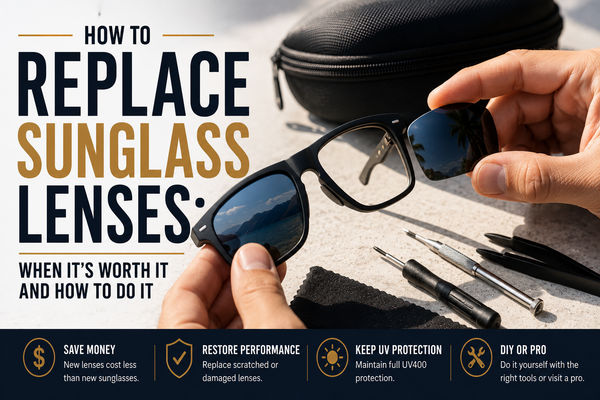

How to Replace Sunglass Lenses: When It's Worth It and How to Do It
Lens replacement makes sense when the frame is in excellent condition but the lenses have degraded — scratched past optical clarity, delaminated coatings, or damaged polarization film. It's less straightforward than most people expect: lens replacement requires finding compatible replacement lenses for the specific frame, a process that ranges from trivially easy (popular frames from major brands with established replacement part supply) to impossible (budget frames from no-name manufacturers with no replacement parts available). This guide covers when lens replacement is worth doing, how the process works for different frame types, and when buying a new pair is the more practical decision. For the full maintenance context, see the complete sunglass care and maintenance guide.

1. When Lens Replacement Makes Sense
The Economic Decision
Lens replacement is worth pursuing when the frame has meaningful residual value that exceeds the cost and effort of finding and installing replacement lenses. The frame has residual value when:
- The frame is a premium brand frame in excellent structural condition (no hinge wear, no frame deformation, no significant scratching) that the owner is attached to or that cost significantly more than the replacement lens cost
- The frame has been custom-fit, adjusted, or personalized to the owner's face and head geometry in ways that take time to replicate with a new frame
- The frame is part of a prescription sunglass setup where the lens prescription is still current and the frame fits the prescription correctly
When Replacement Is Not Worth It
Lens replacement is not worth pursuing when:
- The replacement lens cost approaches or exceeds the cost of a new complete pair with frame — at Navi Eyewear's Buy 1, Get 2 Free pricing of $85 for three pairs, a complete new pair with frame is approximately $28 — less than most aftermarket replacement lens sets cost even before installation effort
- The frame has hinge wear, structural damage, or significant scratching that will limit its post-replacement service life
- Replacement lenses are unavailable for the specific frame (common with budget and no-name frames)
- The frame geometry requires professional tools for lens removal and installation, making DIY replacement impractical
The Practical Reality at Direct-to-Consumer Pricing
At premium retail pricing ($200–$400 per pair), lens replacement at $40–$80 per lens set is clearly economical compared to full frame replacement. At direct-to-consumer pricing of $28–$40 per complete pair, the economics of lens replacement are less compelling — replacement lenses alone often cost more than a complete new pair. The decision to replace lenses vs replace the complete pair should be based on actual cost comparison, not the assumption that replacement is always cheaper than replacement.
2. Types of Frame Construction and Lens Removal Methods
Full-Rim Frames: The Most Common Type
Full-rim frames have a complete frame edge surrounding the lens — the lens is held by the frame rim on all sides. Lens removal in full-rim frames typically involves:
- Flex-out removal: sport and some lifestyle frames are designed to allow lens pop-out — the frame front flexes slightly to release the lens from its seat. The lens is usually installed and removed by pressing from behind on one side, flexing the frame, and popping the lens out of its seat. Designed for user lens replacement in some sport frame designs.
- Screw-retained rim: some full-rim frames use a barrel screw at the bottom of the frame to open the rim for lens removal. Loosening this screw allows the rim to open slightly and the lens to slide out. Installation reverses the process.
- Bonded rim: budget frames sometimes bond the lens to the frame with adhesive — these do not support lens replacement as the frame is destroyed attempting lens removal.
Semi-Rimless Frames
Semi-rimless (browline) frames have a frame on the top half of the lens and a nylon cord or groove on the lower half. Lens removal involves:
- Locating the nylon cord end where it's anchored to the frame
- Carefully unthreading the cord from the lens groove or notch
- Removing the lens from the upper frame seat
Replacement requires threading a new cord through the lens groove and reanchoring it — fiddly but achievable with patience and the correct replacement cord width. Nylon cord wears over time and may need replacement alongside the lens.
Rimless Frames
Rimless (three-piece) frames have the lens connected to the bridge and temples by drilled lens holes and mounting hardware. Lens replacement requires:
- Removing the screws or compression fittings that hold the mounting hardware through the lens holes
- Carefully removing the old lens
- Placing new lenses into position and reinstalling hardware
Rimless lens replacement is the most technically demanding and highest breakage-risk lens replacement type — the lens holes must align precisely with the mounting hardware, and improper installation or overtightening can crack the new lens. Professional optician installation is recommended for rimless lens replacement.
3. Finding Replacement Lenses
OEM (Original Equipment Manufacturer) Replacement Lenses
Major sunglass brands — Oakley, Costa del Mar, Maui Jim, Ray-Ban — sell OEM replacement lenses for their most popular frame models through their websites and authorized dealers. OEM lenses match the exact geometry, tint, and specification of the original lenses. Availability is limited to current and recently discontinued models; older frame models may have discontinued OEM replacement availability.
Aftermarket Replacement Lenses
Several companies specialize in aftermarket replacement lenses cut to fit popular sunglass frames — Seek Optics, Revant, Fuse Lenses, and others offer replacement UV400 polarized polycarbonate lenses cut to fit hundreds of popular frame models. Aftermarket lenses vary in quality — verify UV400 certification, polarization quality, and lens material specification before purchasing. Lower-priced aftermarket lenses may use lower-quality PVA film or lesser polycarbonate substrates than the original lenses.
Custom Optical Lens Replacement
An optician can fit prescription or non-prescription lenses to almost any frame by cutting lenses to the frame's lens shape — the "edging" process. This provides the highest-quality lens option (optician-grade polycarbonate, UV400, polarization to spec) but requires the frame to be brought to the optician and the process typically takes 1–7 days. Cost is typically $60–$150 for non-prescription UV400 polarized lenses, which at these prices only makes economic sense for premium frames worth more than the lens cost.
4. DIY Lens Replacement: Step-by-Step for Sport Frames
The Flex-Out Method for Sport Frames
Many TR90 sport frames are designed with lens pop-out capability for field lens replacement. The process:
- Identify the lens release point: most sport frames with pop-out lenses have a small tab, notch, or designated flex point — typically at the bottom center or at one corner of the lens where the frame is designed to flex. Consult the frame manufacturer's instructions if available.
- Warm the frame slightly: TR90 frames flex more easily at slightly warm temperatures. Run the frame front under warm water for 15–20 seconds to slightly soften the material, making flex-out easier and reducing risk of cracking.
- Apply outward pressure at the release point: press the lens from behind at the flex point, applying gradual outward pressure while flexing the frame front slightly. Do not force — the frame should flex rather than crack. Work slowly from one corner, not all at once.
- Remove the old lens: once one edge breaks free of the frame seat, the remaining edges typically release with gentle pressure.
- Clean the lens seat: remove any debris, old adhesive, or gasket material from the lens seat in the frame before installing the new lens.
- Install the new lens: press the new lens into the frame seat starting at the corner opposite the flex release point. Work around the perimeter, pressing the lens into the seat groove with thumb pressure. The final edge at the release point snaps in under light pressure when the lens is properly seated.
- Verify full seating: inspect the complete perimeter of the lens to confirm it is fully seated in the frame groove with no gaps or raised edges.
Tools Helpful for DIY Lens Replacement
- Rubber-tipped pliers or rubber-coated vice grips — for grip without scratching
- Plastic trim tools (automotive pry tools, available at hardware stores) — for leveraging lenses without scratching the frame
- Warm water — for softening TR90 frame material to facilitate flex-out
- A clean microfiber cloth — for protecting lens surfaces during handling
5. Lens Replacement vs Complete Pair Replacement: The Decision Framework
| Situation | Replace Lenses? | Replace Complete Pair? | Reasoning |
|---|---|---|---|
| Premium frame ($150+), excellent frame condition, OEM lenses available | Yes — worth it | Optional | Frame value exceeds replacement lens cost |
| Mid-range frame ($40–$100), good condition, aftermarket lenses available | Maybe — compare costs | Consider | Depends on replacement lens cost vs new pair cost |
| Direct-to-consumer frame ($25–$40), good condition | Rarely — check economics | Usually preferable | New complete pair often costs less than replacement lenses |
| Budget frame, any condition | No | Yes | Replacement lenses rarely available; frame not worth preserving |
| Frame with hinge wear or structural damage | No | Yes | Replacement lenses extend life of a failing frame briefly |
| Prescription sunglass frame, current Rx, good condition | Yes — use optician | Only if frame damaged | Prescription lens fitting is worth preserving in a good frame |
| Tint change desired (gray to amber, etc.) | Yes — if frame is premium | Buy new pair for new tint | Multi-pair strategy more cost-effective than lens swapping |
6. Verifying Replacement Lens Specification
What to Confirm Before Purchasing Replacement Lenses
When buying replacement lenses from any source, verify:
- UV400 certification: explicitly stated — not implied by tint or darkness
- Lens material: polycarbonate specifically stated — not generic "optical plastic"
- Polarization quality: if replacing polarized lenses, verify the replacement is polarized. Test with the LCD screen test after installation: rotate the lens in front of a phone screen — genuine polarization causes the screen to go dark at 90 degrees.
- Coating suite: hard coat at minimum; oleophobic, hydrophobic, and anti-saltwater coatings if replacing lenses for water or active use
- Frame compatibility: confirm the specific frame model and lens dimensions match before purchasing — return policies for cut lenses are typically non-existent
Frequently Asked Questions
Can I replace the lenses in my sunglasses myself?
For sport frames designed with pop-out lens capability: yes — the process is designed for user lens replacement and takes 5–10 minutes with the correct replacement lens. For full-rim lifestyle frames with screw-retained rims: yes, with a precision screwdriver and patience. For rimless frames: professional installation is recommended — the drilling and hardware alignment requirements make DIY installation high-risk for lens cracking.
How much does sunglass lens replacement cost?
OEM lenses for major brands: $30–$100+ per lens pair depending on brand and lens type. Aftermarket lenses: $15–$50 per lens pair for most popular frame models. Optician custom lens fitting: $60–$150 for non-prescription UV400 polarized. Compare these costs to complete pair pricing — at Navi Eyewear's Buy 1, Get 2 Free at $85 for three pairs, lens replacement is economically justified only for premium frames where the frame itself has significant value.
Where can I find replacement lenses for my sunglasses?
For major brands (Oakley, Costa, Maui Jim, Ray-Ban): the brand's own website or authorized dealers sell OEM replacement lenses. For popular frame models from any brand: Revant, Seek Optics, and Fuse Lenses offer aftermarket replacement lenses for hundreds of specific frame models. For any frame: an optician can custom-edge lenses to fit most full-rim frames using the existing lens as a template.
Can scratched lenses be polished or repaired?
No — scratches in polycarbonate hard coat are physical depressions that cannot be polished out without removing surrounding coating material. "Scratch repair" products abrade the surface around the scratch to blend it visually, but this removes additional coating and produces a hazy area rather than restoring optical clarity. Scratched lenses that impair optical quality should be replaced, not polished.
Is the UV400 protection in replacement lenses the same as original lenses?
Only if the replacement lenses explicitly state UV400 polycarbonate — the UV400 protection must be a property of the replacement lens material, not assumed from the brand of the original lenses. Verify UV400 certification explicitly on any replacement lens purchase. Aftermarket lens quality varies — some aftermarket lenses provide full UV400 polycarbonate specification; others use lower-quality materials with inadequate UV protection.
When should I replace the frame instead of just the lenses?
Replace the frame when: hinge action is loose or stiff despite screw tightening, the frame front has structural cracks or stress fractures, frame geometry cannot be restored to proper fit through adjustment, nose contacts are damaged beyond replacement, or the frame material has degraded to brittleness from UV and heat exposure. A frame with degraded structural integrity does not benefit from new lenses — the investment in new lenses is wasted on a frame that will fail shortly after lens installation.
The Bottom Line
Lens replacement makes economic and practical sense for premium frames in excellent structural condition where the frame value clearly exceeds the replacement lens cost. For direct-to-consumer priced frames, the economics of lens replacement often favor complete pair replacement — the complete pair costs less than replacement lenses alone, delivers new coatings, new frame geometry, and renewed structural integrity. When lens replacement is the right decision, verify UV400 polycarbonate polarized specification on replacement lenses before purchasing, and use professional installation for rimless frame designs. Browse complete UV400 polarized pairs at navieyewear.com — Buy 1, Get 2 Free for $85.
Related Reading
- The Complete Guide to Sunglass Care and Maintenance | Navi Eyewear
- How to Clean Sunglasses Without Scratching | Navi Eyewear
- How Long Do Sunglasses Last? When to Replace Them | Navi Eyewear
- How to Fix Loose Sunglass Hinges and Screws | Navi Eyewear
- Cheap vs Expensive Sunglasses | Navi Eyewear
- Polycarbonate vs Glass Lenses | Navi Eyewear
- How to Read Sunglass Specs | Navi Eyewear
- Shop Polarized UV400 Sunglasses | Navi Eyewear
Sources & Citations
[1] Dain SJ. "Sunglasses and sunglass standards." Clinical and Experimental Optometry, 2003. View source →
[2] ISO 12312-1:2013. "Eye and face protection — Sunglasses and related eyewear." International Organization for Standardization. View source →
[3] FDA. "Impact resistant lenses — 21 CFR Part 801.410." US Food and Drug Administration. View source →