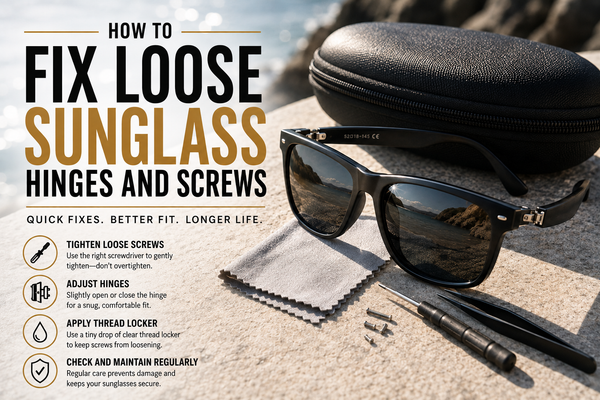

How to Fix Loose Sunglass Hinges and Screws
A loose sunglass hinge — where the temple arm wobbles or doesn't hold its position — is almost always a loose or missing hinge screw. It is the most common sunglass frame repair, and it is fixable in under two minutes with a precision eyeglass screwdriver that costs $3–$8 at any pharmacy. The same $3 screwdriver that tightens the screw also prevents the progressive hinge wear that a loose screw causes — a screw that's allowed to wobble in its barrel accelerates wear on the hinge mechanism faster than decades of normal use would. This guide covers the complete hinge repair process: tightening, replacing stripped screws, dealing with missing screws, and preventing recurrence. For the full maintenance context, see the complete sunglass care and maintenance guide.

1. Understanding Sunglass Hinge Construction
How Barrel Hinges Work
Most sunglass frames use a barrel hinge — interlocking hinge barrels (knuckles) on the frame front and temple arm that are aligned and held together by a small screw running through the barrel stack. The standard configuration: three barrels from the frame front interlocked with two barrels from the temple arm, for a total of five barrels — hence "5-barrel hinge." A single screw runs through the center of all five barrels, clamping them together and allowing the temple arm to pivot on the barrel stack.
The screw is the only retention mechanism — without it, the barrels simply fall apart. When the screw loosens, the barrel stack develops play (wobble) that produces the felt looseness and the clicking sound of a loose hinge. The play accelerates wear on the barrel bore that the screw threads into, progressively enlarging the bore and making tight screw retention harder to achieve.
Spring Hinges: The Flexible Alternative
Spring hinges incorporate a spring mechanism in the temple arm that allows the arm to flex outward beyond the 90-degree open position — accommodating wider head geometries without bending stress on the frame. Spring hinges are more complex than barrel hinges and use a spring cartridge that can wear or break independently of the retaining screw. A spring hinge that no longer springs (won't return to the closed position under spring tension) has a failed spring cartridge — a repair that typically requires professional optician service or frame replacement. A spring hinge that is loose (wobbles at the barrel) is the same screw-loosening problem as a standard barrel hinge and is fixed the same way.
2. What You Need for Hinge Repair
The Essential Tool: Precision Eyeglass Screwdriver
Sunglass hinge screws use small cross-head (Phillips) or flat-head screws, typically 1.0mm–1.4mm in diameter. Standard household screwdrivers are far too large — they will strip the screw head immediately. The correct tool is a precision eyeglass screwdriver — the smallest screwdrivers in a jeweler's or watchmaker's screwdriver set.
Where to get one: any pharmacy (they're typically in the eyeglass care aisle for $3–$8), hardware stores (in the precision screwdriver or watchmaker's tool section), online (precision screwdriver sets for $5–$15), or opticians and eyeglass shops (they often give away replacement screws for free and will tighten a loose hinge at no charge as a service).
Optional: Thread-Locking Solution
Clear fingernail polish applied to the screw threads before installation provides mild thread-locking that prevents the screw from loosening under the vibration and repeated opening/closing of normal hinge use. This is the same principle as Loctite threadlocker used in industrial fastening — the fingernail polish fills the thread engagement gap slightly, preventing the micro-vibration that gradually backs screws out. A single coat applied to clean screw threads, allowed to cure for 10 minutes before installation, provides weeks to months of additional screw retention before re-tightening is needed.
3. Tightening a Loose Hinge Screw
Step-by-Step Process
- Identify the screw head type: look closely at the hinge screw with good lighting. Most are Phillips cross-head; some (particularly on metal frames) are flat-head. Select the matching precision screwdriver tip.
- Hold the frame securely: place the frame on a flat surface or hold the frame front in one hand and the temple arm in the other. The hinge needs to be held still while the screw is turned — a frame that moves as the screwdriver is applied will make the screw harder to engage and increases the risk of slipping and stripping the screw head.
- Engage the screwdriver carefully: press the screwdriver tip gently but firmly into the screw head recess before applying any rotation. The driver must be fully seated in the screw head before turning — a partially engaged driver will slip and strip the screw head.
- Turn clockwise to tighten: apply light downward pressure while rotating clockwise. Tighten until the hinge feels snug — the temple arm should have resistance when moved but should still pivot smoothly. Over-tightening strips the screw threads or cracks the barrel bore.
- Test hinge action: open and close the temple arm several times — it should move with firm resistance and hold its position when released. If wobble persists after tightening, the screw threads may be stripped and the screw needs replacement.
- Optional: apply clear nail polish: if the screw was loose quickly after a previous tightening, apply a thin coat of clear nail polish to the screw threads, allow 10 minutes to set, and reinstall.
How Tight Is Right
The correct hinge tightness: the temple arm pivots with firm, controlled resistance — not flopping freely, not requiring force to move. A correctly tightened hinge allows the temple arm to open and close with the resistance of light friction that holds position when released. Over-tightening produces a stiff hinge that requires force to open — and stresses the screw threads, the barrel bore, and the frame material around the hinge.
4. Replacing a Stripped or Missing Hinge Screw
When the Screw Won't Tighten
A screw that turns but doesn't tighten, or that tightens but immediately becomes loose again, has either stripped its own threads or stripped the threads in the barrel bore. Stripped screw: the screw's threads are worn smooth and can no longer engage the barrel bore threads — replace the screw. Stripped barrel bore: the bore's threads are worn out and can no longer hold any screw — a more serious repair requiring professional attention or frame replacement.
Finding Replacement Screws
Hinge screws are standardized in a small range of sizes used across virtually all sunglass frames. A complete eyeglass repair kit (available at pharmacies and hardware stores for $5–$15) includes assorted hinge screws in the common sizes, precision screwdrivers, and typically replacement nose contacts. The assortment covers the sizes used in nearly all consumer sunglasses — find the screw that threads smoothly into the barrel bore and is the correct length (flush with or just below the hinge surface when fully tightened).
How to identify the correct screw size: bring the old screw (or the frame, if the screw is still in place) to a pharmacy or optician. Most pharmacy eyeglass repair kits have 10–20 screw sizes; the correct size engages the barrel bore threads smoothly and tightens with controlled resistance. If in doubt, an optician will match the screw size immediately.
Installing the Replacement Screw
- Thread the replacement screw gently by hand first — if it resists threading smoothly, it's the wrong size. Never force a screw that doesn't thread smoothly.
- Apply a small amount of clear nail polish to the screw threads for thread-locking before final installation.
- Tighten with the precision screwdriver to the correct tension — firm resistance, smooth pivot action.
- Allow the nail polish to cure for 10 minutes before flexing the hinge repeatedly.
5. What to Do When a Screw Has Fallen Out
Immediate Temporary Fix
When a hinge screw falls out and no replacement is immediately available, a temporary fix using a wooden toothpick:
- Align the hinge barrels carefully so all five barrel holes are aligned
- Push a thin wooden toothpick through the aligned barrel holes — trim to length flush with the outer barrel surface
- The toothpick holds the barrels aligned and provides temporary hinge function until a proper replacement screw is installed
This is a temporary field fix for 1–4 hours of careful use, not a permanent solution. The toothpick will eventually work loose and should be replaced with a proper screw as soon as one is available.
Carrying a Repair Kit
A small precision screwdriver and an assortment of hinge screws take up minimal space in a bag, car console, or desk drawer. The cost of the kit ($5–$15) is less than the cost of an optician visit for the same repair, and the repair time (under 2 minutes) is less than the travel time to an optician. Keeping a kit at the four sunglass storage locations (car console, home entry, desk, sport kit) means a loose screw is addressed immediately rather than after the loose hinge has had days or weeks to worsen through continued use.
6. Preventing Hinge Screw Loosening
Two-Handed Opening and Closing
Opening and closing glasses by pulling a single temple arm imposes asymmetric bending stress on that hinge — one hinge bears the full opening force rather than both hinges sharing it. Two-handed opening (holding the frame front in one hand and the temple in the other, opening both temple arms simultaneously or alternately with balanced force) distributes the stress evenly and significantly reduces the loosening rate of hinge screws.
Avoiding One-Temple Resting
Setting glasses open on a surface using one temple arm as a leg imposes sustained asymmetric force on the single supporting hinge — bending the temple arm outward and stressing the hinge barrel. Rest glasses folded in a case, or upside-down on the lens-side of the frame front with both temples folded, rather than open on one temple arm.
Saltwater Rinsing
Salt deposits in hinge barrels accelerate corrosion and mechanical wear — salt crystals act as abrasives in the tight hinge barrel clearances, and salt ions accelerate corrosion of standard alloy hardware. Fresh water rinsing of the complete frame including hinges after every saltwater or heavy sweat session prevents the salt accumulation that accelerates hinge wear. See the complete maintenance guide for the full post-use care protocol.
Quality Hardware: Stainless Steel Hinges
Stainless steel 5-barrel hinges — the standard in quality frames including all Navi Eyewear frames — resist the corrosion and wear that cause hinge failure in standard alloy hardware significantly better than plated zinc or standard steel hinges. The difference in hinge service life between stainless and standard alloy in saltwater and sweat-exposed use is substantial — stainless hinges functioning correctly after three seasons of regular surf or beach use vs standard alloy hinges seizing or corroding within one season of equivalent exposure.
Frequently Asked Questions
How do I tighten sunglass hinges without a screwdriver?
Without a proper precision screwdriver, options are limited and risk of screw head damage is high. A flat fingernail can sometimes engage a flat-head screw enough to tighten it slightly — not reliable. A credit card edge is occasionally thin enough to engage a flat-head screw — marginally useful. The best approach without a screwdriver: use the toothpick field fix to hold the hinge aligned temporarily, and find a precision screwdriver before attempting any screw work. Improvised tools that don't fit the screw head will strip it — making a straightforward repair into a more complex one.
Why do my sunglass screws keep coming loose?
Three causes: normal vibration and use (the screw gradually backs out through the micro-vibration of every hinge operation — apply clear nail polish to threads to slow this); stripped screw threads (the screw no longer engages the bore securely — replace the screw); or damaged barrel bore threads (no screw will hold — professional repair or frame replacement). Clear nail polish on threads at every installation significantly extends the time between re-tightening for all but the most damaged hardware.
Can an optician fix my loose sunglass hinges?
Yes — tightening a hinge screw is a routine 2-minute task for any optician. Most opticians will tighten hinge screws at no charge as a basic service. Many will also replace missing or stripped screws for free or for a nominal charge. If the barrel bore is damaged and no screw will hold, the optician can assess whether hinge replacement (welding or installing new hinge barrels) is feasible — a repair that requires specialized tools and is typically available at larger optical shops.
What size screws do sunglasses use?
Most sunglass hinge screws are M1.0, M1.2, or M1.4 metric screws (the M designates metric thread, the number designates diameter in millimeters). Length varies by hinge design — typically 2–4mm. An eyeglass repair kit with 10–20 screw sizes covers virtually all consumer sunglass hinge screw requirements. When replacing, the correct screw is the one that threads smoothly into the barrel bore and tightens with controlled resistance at a length that sits flush with the outer barrel surface.
My hinge screw tightened but the hinge still wobbles. Why?
The barrel bore threads are stripped — the bore can no longer grip any screw tightly enough to eliminate wobble. This happens after extended use with a loose screw (the wobbling screw gradually enlarges the bore) or after repeated over-tightening that strips the bore threads. Solutions: professional hinge repair (replacing the hinge barrels — feasible at specialty optical shops), frame replacement, or accepting the loose hinge as a cosmetic issue if the frame is otherwise functional.
How do I know if I need a new frame vs just a hinge repair?
Replace the frame when: the barrel bore is stripped and no screw will hold (professional hinge repair may be an option but is often not economical for mid-range frames), the hinge barrels themselves are cracked or broken, the frame has significant structural damage beyond the hinge, or the frame has reached the end of its useful service life on other criteria. For a frame in otherwise good condition with only a screw issue, repair is the correct first step — a $3 precision screwdriver and $5 repair kit extend many frames by years.
The Bottom Line
A loose sunglass hinge is almost always a loose or missing screw — a 2-minute fix with a $3 precision screwdriver. Addressed immediately when first noticed, a loose screw is trivial; allowed to wobble for weeks or months, it progressively damages the hinge barrel bore until no repair is possible. The tools cost less than one trip to the optician; keeping them at home and in the car makes the repair immediate rather than eventual. Clear nail polish on screw threads extends re-tightening intervals significantly. Stainless 5-barrel hinges in quality frames resist the corrosion and wear that make budget hinge hardware fail prematurely. Browse UV400 polarized options with stainless 5-barrel hinges at navieyewear.com — Buy 1, Get 2 Free for $85.
Related Reading
- The Complete Guide to Sunglass Care and Maintenance | Navi Eyewear
- How to Clean Sunglasses Without Scratching | Navi Eyewear
- How to Adjust Nose Pads and Temple Arms | Navi Eyewear
- How Long Do Sunglasses Last? When to Replace Them | Navi Eyewear
- Sunglass Frame Technology and Materials | Navi Eyewear
- TR90 Nylon Frames: Why the Material Matters | Navi Eyewear
- How to Replace Sunglass Lenses | Navi Eyewear
- Shop Polarized UV400 Sunglasses | Navi Eyewear
Sources & Citations
[1] Dain SJ. "Sunglasses and sunglass standards." Clinical and Experimental Optometry, 2003. View source →
[2] ISO 12312-1:2013. "Eye and face protection — Sunglasses and related eyewear." International Organization for Standardization. View source →
[3] Sliney DH. "Ocular exposure to environmental light and ultraviolet." Journal of AAPOS, 2014. View source →