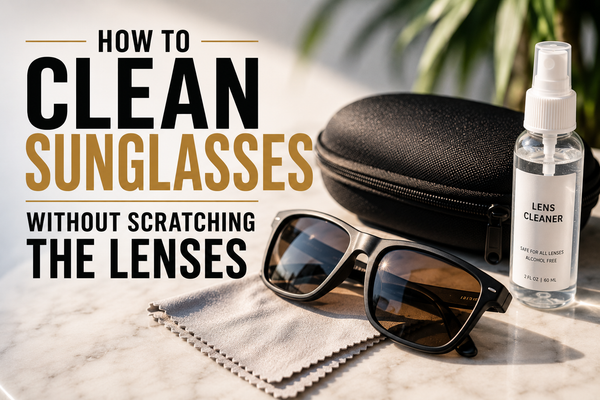

How to Clean Sunglasses Without Scratching the Lenses
The most common cause of lens scratches is cleaning — specifically, wiping a lens that hasn't been rinsed first. Dust, grit, and salt crystals on an unwashed lens become abrasive particles ground into the coating by cloth or fabric contact. The scratch that appears after wiping your glasses on your shirt didn't come from a drop or impact — it came from the sand grain or dust particle your shirt picked up before you used it as a lens cloth. This guide covers the correct cleaning method that prevents this, what to avoid, and how to handle specific types of contamination — sunscreen, salt, fingerprints, and smudging — without damaging the lens coatings that make sunglasses work properly. For the complete maintenance context, see the complete sunglass care and maintenance guide.

1. The Core Problem: Why Cleaning Scratches Lenses
The Abrasive Particle Mechanism
Polycarbonate lenses with hard coat are harder than bare polycarbonate but softer than glass. Dust, sand, salt crystals, and airborne grit are harder than most lens coatings. When a particle sits on the lens surface and a cloth is applied with any pressure, the particle becomes a fixed abrasive point that drags across the coating surface — producing a micro-scratch. A single large grit particle dragged across a lens produces a visible scratch; hundreds of fine dust particles dragged across a lens in a dry wipe produce a field of micro-scratches that collectively reduce optical clarity and scatter light.
The mechanism explains why "I barely touched the lens" still produces scratches — it's not the pressure applied but the presence of abrasive particles between the cloth and the lens surface. The solution is to remove those particles before any cloth makes contact: rinse the lens with running water to float grit off the surface before the first cloth contact.
The Shirt Problem
Shirt fabric is the most common lens cleaning tool and among the most damaging. Cotton and synthetic shirt fabric picks up airborne particulate throughout the day — the shirt that feels clean to the touch carries invisible abrasive grit from environmental exposure. Using a shirt hem to wipe a lens is using a particle-loaded rag on an optical surface. Even if the lens is rinsed first, shirt fabric's irregular weave and lint production make it an inferior cleaning cloth compared to a purpose-made optical microfiber. The shirt is a convenience substitute that reliably damages lenses over time.
2. The Correct Cleaning Method: Step by Step
The Rinse-First Protocol
The single most important lens cleaning rule is this: never touch the lens with any cloth before rinsing with water. Every other step is secondary to this one.
Complete cleaning sequence:
- Rinse under lukewarm running water — hold both lenses under a gentle stream of tap water for 10–15 seconds. The water flow physically moves particles off the lens surface. Lukewarm water (not hot — hot water can damage some coatings). Both sides of each lens.
- Apply a drop of mild dish soap — one small drop of plain dish soap (Dawn, Palmolive, or equivalent — without antibacterial additives, moisturizers, or citrus degreasers) on the wet pad of one finger.
- Gently work the soap across both lens surfaces — use wet, soapy finger pads in light circular motions on both sides of each lens. No pressure needed — the soap suspends and lifts oils and residue. Clean the frame front, nose contacts, and temple arms as well.
- Rinse thoroughly — rinse all soap from both sides of each lens and from the frame. Soap residue left on the lens creates a haze film — thorough rinsing is as important as the soap application.
- Shake off excess water — a gentle shake removes the majority of surface water before cloth contact.
- Pat dry with a clean microfiber cloth — a dedicated optical microfiber cloth, clean and free of lint or debris. Pat gently rather than wiping in broad strokes. The lens is already clean at this point — the microfiber is removing water drops, not cleaning contamination.
The Quick Field Clean (No Sink Available)
For on-the-go cleaning when a sink isn't available:
- Use a pre-moistened optical lens wipe (alcohol-free, ammonia-free) to wet the lens surface and lift contamination — the moisture performs a partial rinse function
- Or: breathe on the lens (exhaled breath creates condensation that lifts light contamination) then use a clean microfiber cloth
- Or: use a small spray bottle of water to wet the lens before microfiber contact
None of these field methods match the cleaning quality of soap-and-water. Use them only when a proper cleaning isn't immediately possible, and follow with a full soap-and-water cleaning at the next available opportunity.
3. What Never to Use for Cleaning
Products That Damage Coatings
- Window cleaner (Windex, glass cleaner): contains ammonia, which dissolves oleophobic and hydrophobic coatings on contact. A lens cleaned with Windex looks cleaner immediately but has lost the coating that repels fingerprints and water — and that coating cannot be restored. Avoid categorically.
- Hand sanitizer: 60–70% isopropyl alcohol — directly dissolves oleophobic coatings. Never use on lens surfaces.
- Rubbing alcohol or alcohol wipes: same as hand sanitizer — alcohol-based cleaners destroy oleophobic and hydrophobic coatings.
- Acetone (nail polish remover): dissolves lens coatings and polycarbonate substrate on contact. Never use near sunglasses.
- Dish soap with citrus degreaser, antibacterial additives, or moisturizers: these additives can leave residue that occludes coatings or react with coating chemistry. Use only plain dish soap without additives.
- Hot water (above 120°F): can soften lens coatings and accelerate coating delamination. Lukewarm or cool water only.
Materials That Abrade Lenses
- Paper towels and tissues: wood pulp fibers are abrasive against lens coatings. The softness of a tissue is irrelevant — the fiber hardness relative to the coating determines scratch potential, and tissue fiber is harder than most lens coatings.
- Shirt fabric (cotton, polyester, linen): picks up abrasive particulate throughout the day; inconsistent weave creates uneven pressure points; lint deposits. Always use a dedicated optical microfiber.
- Rough or dirty microfiber cloths: a microfiber cloth that has picked up sand or grit from its own storage or handling is as damaging as a shirt. Keep the microfiber cloth clean — wash regularly (gentle cycle, no fabric softener which clogs microfiber pores) and store in a protected location.
- Dry wiping without rinsing: even a perfect microfiber cloth applied to an unrinsed lens creates abrasion from the particles on the lens surface. The cloth itself is not the problem — the particles beneath the cloth are.
4. Cleaning Specific Types of Contamination
Fingerprints and Skin Oils
Fingerprint oils are addressed directly by oleophobic coating — a well-functioning oleophobic coating causes fingerprint oils to bead rather than spread, making them easy to remove with a clean microfiber cloth after a water rinse. When fingerprints smear persistently after cleaning rather than wiping cleanly, this indicates oleophobic coating failure rather than an aggressive fingerprint oil — cleaning method alone cannot restore a degraded oleophobic coating.
For heavy fingerprint contamination: soap-and-water cleaning as described above, using mild dish soap to cut through the oil layer. For light fingerprints on a well-functioning oleophobic lens: a water rinse followed by microfiber pat-dry is typically sufficient.
Sunscreen
Sunscreen — both mineral (zinc oxide, titanium dioxide) and chemical — is among the most adhesive lens contaminants. Mineral sunscreen in particular forms a thick, paste-like residue that adheres strongly to lens surfaces and can create a persistent haze if not properly removed. Sunscreen removal requires soap, not just water:
- Rinse thoroughly with lukewarm water to remove the water-soluble portions
- Apply one drop of mild dish soap and work gently across the lens surface
- Rinse thoroughly — sunscreen emulsifiers make complete soap removal more important than usual; residual soap mixed with sunscreen creates a milky haze
- Inspect in good light for remaining haze and repeat if needed
Oleophobic-coated lenses resist sunscreen adhesion more effectively than uncoated surfaces — the same water-beading property that repels water also reduces sunscreen adhesion. All Navi Eyewear lenses include oleophobic coating specifically for sunscreen-intensive outdoor use.
Salt and Saltwater
Salt contamination from ocean spray, sweat, or salt spray environments requires immediate rinsing before the salt crystallizes. Salt crystals that dry on the lens surface are mechanically abrasive — do not wipe a salt-contaminated lens before rinsing, even with a microfiber cloth. If salt deposits have already dried:
- Soak the lens surface briefly with lukewarm water to re-dissolve the salt deposits before any cloth contact
- Hold under running water for 30–60 seconds to ensure complete dissolution
- Proceed with soap cleaning
Never attempt to wipe dry salt deposits off a lens — this is the scenario that produces the most severe salt-crystal abrasion damage.
Water Spots and Mineral Deposits
Hard water (high mineral content) leaves mineral deposits on lens surfaces as the water evaporates — a haze of calcium and magnesium salts. For mild water spots: a mild acid solution (one part white vinegar to ten parts water) applied gently with a microfiber cloth dissolves mineral deposits. Rinse thoroughly with clean water after the vinegar solution — vinegar is mildly acidic and should not remain on the lens surface. For severe water spot buildup: an optician's professional lens cleaning solution or an ultrasonic cleaner (used by opticians) may be needed.
Cosmetics and Makeup
Foundation, mascara, and other cosmetics that contact lens surfaces create adhesive contamination that soap easily removes. Key consideration: most cosmetics are oil-based and require soap rather than water alone for complete removal. Apply soap to the lens before rinsing the cosmetic contamination — this prevents the oil from spreading across the lens surface during rinsing.
5. Microfiber Cloth Care and Management
Why Cloth Quality Matters
The microfiber cloth is the final physical contact with the lens surface — its cleanliness and condition directly determine whether pat-drying adds scratches or removes water without damage. A dirty, lint-laden, or grit-contaminated microfiber cloth defeats the rinse-first protocol by reintroducing contamination at the final cleaning step.
Keeping the Microfiber Effective
- Dedicated use: the lens microfiber should be used only for lenses — not for cleaning other surfaces that could contaminate it with grit or lint
- Storage: in the protective bag or case that came with the glasses, or in a small zip-lock bag — not loose in a pocket or bag where it can pick up particles
- Washing: hand wash or gentle machine cycle in warm water with a small amount of mild detergent — no fabric softener, which coats microfiber loops and destroys their absorbency and cleaning effectiveness
- Replacement: replace when the cloth appears to carry permanent contamination, when it has been used for non-lens surfaces, or when it loses its soft texture — a stiff or linty microfiber is no longer safe for lens contact
6. Quick Reference: The Dos and Don'ts
| DO | DON'T |
|---|---|
| Rinse with lukewarm water before any cloth contact | Wipe dry lens with any cloth without rinsing first |
| Use plain mild dish soap for cleaning | Use window cleaner, hand sanitizer, or alcohol |
| Use a clean dedicated optical microfiber cloth | Use shirt fabric, paper towels, or tissues |
| Rinse thoroughly to remove all soap | Leave soap residue on the lens |
| Pat dry gently with microfiber after rinsing | Rub vigorously with the drying cloth |
| Rinse salt contamination immediately before drying | Wipe dried salt deposits with a cloth |
| Use lukewarm or cool water | Use hot water (above 120°F) |
| Store microfiber in a clean bag or case | Store microfiber loose in a pocket or bag |
| Wash microfiber regularly without fabric softener | Use fabric softener on microfiber cloths |
| Inspect lens in good light after cleaning | Assume the lens is clean without checking |
Frequently Asked Questions
Can I use water alone to clean my sunglasses?
Water alone handles light contamination — fingerprints on oleophobic-coated lenses, light dust, and water spots — adequately when followed by a clean microfiber pat-dry. For sunscreen, heavy salt deposits, and cosmetics, water alone doesn't break down the contamination and soap is needed. The rinse-before-any-cloth-contact rule applies regardless of whether soap is used — a water-only cleaning that starts with a thorough rinse prevents the dry-wipe abrasion problem even if it doesn't fully remove all contamination.
Why does my lens still smear after cleaning?
Persistent smearing after soap-and-water cleaning indicates one of three things: oleophobic coating failure (the most common cause — once the oleophobic layer is gone, oils spread rather than beading regardless of cleaning method); soap residue not fully rinsed (creates a film that smears when wiped); or contamination in the microfiber cloth being redeposited on the lens. Diagnose by trying a fresh, known-clean microfiber after thorough rinsing — if smearing continues, the oleophobic coating has degraded.
Is it safe to clean polarized lenses the same way as regular lenses?
Yes — polarized UV400 polycarbonate lenses with coating suites are cleaned by the same soap-and-water method. The PVA polarization film is embedded within the lens structure and not on the surface — cleaning does not affect the polarization filter. The same chemical avoidances apply (no alcohol, no ammonia, no acetone).
How do I clean my sunglasses when I don't have water or a microfiber?
This is the situation where most lens damage occurs — the temptation to use a shirt or tissue is high when no better option seems available. Best approach without water or microfiber: if the contamination is significant, leave the lens uncleaned until proper cleaning is possible. A smudged lens is better than a scratched lens. If the contamination is impairing vision critically, breathing on the lens (creating condensation) and using the cleanest available soft fabric (inner shirt hem, not outer) is the least-bad option — with the understanding that some abrasion risk is present.
Can I use an ultrasonic cleaner on my sunglasses?
Ultrasonic cleaners used by opticians safely clean frames and lenses — the ultrasonic cavitation in water solution removes contamination without abrasion. Consumer ultrasonic jewelry cleaners at home can be used with caution: use water only or optical-safe solution (no alcohol), keep cleaning cycles short (60–90 seconds maximum), and verify the specific cleaner model is safe for optical coatings before use. Not necessary for most cleaning situations but genuinely effective for heavy contamination removal.
My sunglasses have a mirror coating. Is cleaning different?
Mirror coatings are more delicate than other lens coatings — the thin vacuum-deposited metallic layer at the surface is more susceptible to chemical damage and abrasion than the underlying hard coat. The same cleaning method applies (rinse first, mild soap, microfiber) but with even more emphasis on gentle application — no rubbing, very light soap application, thorough rinsing. Mirror coatings are particularly sensitive to alcohol and ammonia — avoid all cleaning products that contain either. A degraded mirror coating cannot be restored by any cleaning product.
The Bottom Line
Lens scratches from cleaning are entirely preventable with one rule: rinse before touching the lens with any cloth. The rest of the protocol — mild dish soap, clean microfiber, thorough rinsing, avoiding alcohol and ammonia — preserves the coating performance that makes UV400 polarized sunglasses work optimally. Clean lenses are clear lenses; scratched lenses scatter light, reduce contrast, and impair the optical performance that quality sunglasses are designed to deliver. The correct cleaning method takes 60 seconds and costs nothing beyond a drop of dish soap. Browse UV400 polarized options at navieyewear.com — Buy 1, Get 2 Free for $85.
Related Reading
- The Complete Guide to Sunglass Care and Maintenance | Navi Eyewear
- Sunglass Lens Coatings Explained | Navi Eyewear
- How Long Do Sunglasses Last? When to Replace Them | Navi Eyewear
- How to Fix Loose Sunglass Hinges and Screws | Navi Eyewear
- Polycarbonate vs Glass Lenses | Navi Eyewear
- How to Read Sunglass Specs | Navi Eyewear
- Cheap vs Expensive Sunglasses | Navi Eyewear
- Shop Polarized UV400 Sunglasses | Navi Eyewear
Sources & Citations
[1] Dain SJ. "Sunglasses and sunglass standards." Clinical and Experimental Optometry, 2003. View source →
[2] ISO 12312-1:2013. "Eye and face protection — Sunglasses and related eyewear." International Organization for Standardization. View source →
[3] Sliney DH. "Ocular exposure to environmental light and ultraviolet." Journal of AAPOS, 2014. View source →