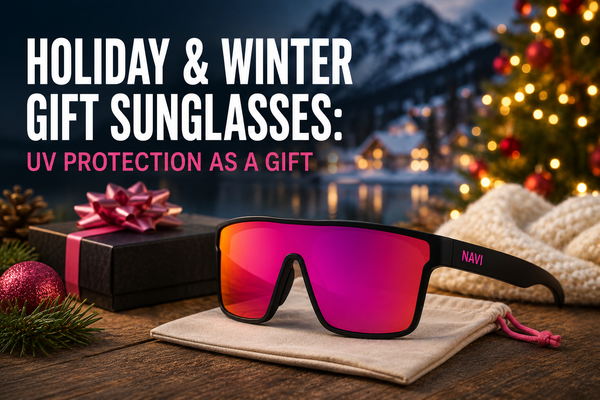

Holiday and Winter Gift Sunglasses: UV Protection as a Gift
Quality UV400 polarized sunglasses are among the most practically useful gifts in any category — worn daily, tangibly improving visual comfort, and providing real health protection every time they go outdoors. The holiday season (November–January) arrives right as people enter the period when UV protection habits lapse and when establishing a year-round wearing habit is most valuable. The gift specification that works across almost every recipient: UV400 certified polycarbonate, polarized, gray for the everyday and driving user, amber for the outdoor sport enthusiast. Buy 1, Get 3 Free for $119 from Navi Eyewear covers the gift plus replacements, backups, or additional family members.
Most gift categories involve trade-offs between practicality and desirability. Sunglasses are one of the few where both are high simultaneously — the recipient gets something they'll actually use daily, that meaningfully improves their visual experience outdoors, and that protects their long-term eye health every time they put them on. For the complete seasonal UV context, see the year-round seasonal UV guide.

1. Why Sunglasses Make an Exceptionally Good Gift
Daily Use: The Utility Argument
A gift that gets used daily delivers value on a different scale than one used occasionally. Sunglasses, for someone who wears them consistently, are reached for every morning when going outdoors — 365 days of interaction with the gift. Even for someone who currently doesn't wear sunglasses consistently, a quality pair that improves visual comfort enough to notice makes the habit stick. The daily utility of a well-chosen pair of sunglasses is matched by very few gift categories.
Immediate Perceptible Benefit
Quality polarized sunglasses produce an immediately noticeable benefit the first time the recipient wears them outdoors in bright conditions. The elimination of surface glare, the reduction in squinting, the visual comfort difference between polarized and non-polarized — these are not abstract or long-term benefits. Recipients who have never worn quality polarized lenses often describe the experience as "like turning the brightness down without losing clarity." That kind of immediate, obvious improvement creates a gift that recipients remember and credit specifically.
Health Protection That Compounds Over Time
Beyond the immediate comfort benefit, UV400 sunglasses provide cumulative health protection that most recipients are not providing themselves adequately. Consistent UV400 wearing over decades meaningfully reduces cataract, macular degeneration, and pterygium risk. A gift that delivers daily comfort and long-term health protection simultaneously is rare — quality polarized sunglasses feel noticeably better than going without, which is what makes the health habit stick.
The Timing Advantage: Winter Gift, Spring Impact
The holiday season gift window — November through January — delivers sunglasses at the end of the period when UV habits are lowest (fall/winter) and just before the period when they are most needed and most difficult to re-establish (spring UV ramp beginning in March). A recipient who receives quality sunglasses in December and starts wearing them has the habit established before spring UV rises. A recipient who doesn't receive them until May already has 6–8 weeks of high UV spring exposure without protection. The timing of a holiday sunglass gift aligns well with the seasonal UV calendar.
2. Who to Buy Sunglasses For: Gift Recipient Profiles
The Outdoor Enthusiast
Hikers, cyclists, runners, skiers, and outdoor sport participants are the most obvious sunglasses gift recipients because they spend the most time in UV-intense environments and have the most to gain from performance-optimized eyewear. For outdoor enthusiasts, amber or brown polarized is the primary recommendation — contrast enhancement for terrain and object tracking, glare elimination for water and surface reflection, UV400 for health protection during extended outdoor time.
The Daily Driver
Commuters and regular drivers spend meaningful time in a UV-exposure context that most people don't consider: the car. Side windows transmit UV-A even when blocking visible glare and UV-B. Long commutes and road trips accumulate UV through car windows. For daily drivers, gray polarized UV400 is the precise recommendation — color neutral for traffic signal and road marking accuracy, polarized for road and windshield glare elimination, UV400 for window UV blocking.
The 50+ Family Member
Parents, grandparents, aunts, uncles — adults in the 50+ demographic who spend time outdoors have accumulated substantial lifetime UV and are in the window where cataract and macular degeneration risk is most active. For this demographic, the health protection case for UV400 sunglasses is immediate and relevant rather than abstract future-risk management. The pickleball player, the gardener, the retiree who walks daily — all are accumulating UV in exactly the years where it matters most. See sunglasses for men over 50 and sunglasses for women over 50 for age-specific recommendations.
The Teenager
Teenagers with active outdoor lives — athletes, beach-goers, outdoor social participants — are accumulating UV at high rates in the window where their eyes are still somewhat more vulnerable than adult eyes. Style matters enormously for teenage compliance; the gift needs to be something they'd wear voluntarily. Involving them in selection (or giving a gift card toward their choice within a UV400 polycarbonate polarized requirement) maximizes compliance. For the full teen guide, see sunglasses for teens.
The Young Child
Children's eyes transmit more UV to the retina than adults', making UV400 protection during childhood particularly valuable. Parent-bought children's sunglasses as a gift address a health need that many parents are not consistently meeting. For the complete guide to gifting for young children, see baby and toddler sunglasses: what actually works.
The Outdoor Worker
Construction workers, landscapers, farmers, coaches, outdoor instructors — anyone who spends their working day outdoors accumulates UV at rates far above the general population. For outdoor workers, quality UV400 polarized sunglasses are as much occupational health equipment as lifestyle accessories. A gift that the recipient will use every working day for eye protection has obvious high-utility credentials.
3. How to Choose Sunglasses as a Gift
The Non-Negotiable Specifications
Regardless of recipient, these three properties are non-negotiable for a gift that actually protects:
- UV400 certified: explicit UV400 or "100% UVA and UVB blocking" language on the lens or frame — not vague "UV protection" marketing language.
- Polycarbonate lenses: impact resistant, optically clear, structural UV400 — the appropriate lens material for any active use.
- Polarized: the performance difference that makes the gift immediately perceptible — eliminates surface glare, reduces squinting, makes outdoor vision noticeably more comfortable.
Everything else — frame style, color, size — is secondary to these three. Browse UV400 polarized polycarbonate options at navieyewear.com.
Tint by Recipient Activity
| Recipient Profile | Primary Activity | Recommended Tint | Notes |
|---|---|---|---|
| Daily driver / commuter | Driving and errands | Gray polarized | Color neutral; essential for traffic signal accuracy; eliminates road glare |
| Outdoor sport enthusiast | Hiking, cycling, running, sport | Amber polarized | Contrast enhancement for terrain and object tracking |
| Beach and water person | Beach, boating, fishing | Copper or amber polarized | Maximum glare elimination on water and sand |
| Everyday general use | Mixed outdoor activities | Gray polarized | Versatile color-neutral lens for all conditions |
| Fishing enthusiast | Freshwater or saltwater fishing | Copper polarized | Sub-surface water visibility; maximum polarization effect |
| Skier / snowboarder | Winter mountain sport | Amber Cat 3 polarized | Terrain contrast on snow; Cat 3 for bright ski conditions |
| Pickleball / tennis player | Court sport | Amber polarized | Ball contrast on court and sky backgrounds; court glare elimination |
Frame Fit: The Challenge of Gifting Eyewear
The primary challenge in gifting sunglasses is fit — frames need to match the recipient's face width, bridge shape, and general proportions to sit correctly. Several approaches:
- Gift for a known face profile: if you know the recipient's existing sunglasses fit well, note the size stamp inside the temple arm (usually three numbers: lens width-bridge width-temple length) and find a similar sizing.
- Go slightly conservative on size: most adult face widths accommodate lens widths of 50–54mm; a frame in this range fits the broadest range of adult face proportions.
- Gift with return option: Navi Eyewear's 30-day return on unworn pairs allows the recipient to exchange for a better fit.
- Gift card approach for teenagers: for style-conscious teens who need to choose their own frames, a gift card toward their selection within the UV400 polycarbonate requirement is more likely to produce consistent wearing than a pre-selected pair.
The Multiple-Pair Advantage
Navi Eyewear's Buy 1, Get Any 3 Pairs Free offer — $119 for 4 pairs — makes holiday gifting of sunglasses particularly practical. Four UV400 polarized pairs provide: one for the gift recipient's everyday use, one for their car, one for their sport or outdoor bag, and one spare. Alternatively, the four pairs span family members: parents and two children, or partners, or a household where multiple people need UV protection.
4. Sunglasses as UV Protection: Making the Case to Recipients
Why the Health Framing Matters
For recipients who don't currently wear sunglasses consistently, the gift is more likely to produce lasting habit change if accompanied by a brief, clear explanation of why UV protection for the eyes matters. Not a lecture — a specific, memorable fact: "UV damage to the eyes is cumulative and doesn't heal. Cataracts and macular degeneration have their roots in UV accumulation over decades. These block 100% of the UV that causes both." That's three sentences that frame the gift as health protection rather than an accessory.
The Polarized Difference: Show Don't Tell
The most effective way to convert a holiday sunglass recipient into a consistent wearer is the immediate experience of quality polarized lenses outdoors. Take the recipient outside in bright conditions, have them look at a reflective surface (road, water, car hood) without the lenses, then with them. The polarization effect on reflected glare is immediately and dramatically perceptible — recipients who experience this firsthand understand intuitively why these are different from fashion sunglasses with dark lenses.
Framing as Year-Round, Not Seasonal
A gift paired with the framing of year-round use ("wear these when you go outside — not just in summer") sets the recipient up for the year-round habit that provides the most total protection. The habit that starts in December, with quality frames that are comfortable and visually effective, carries through spring and summer more reliably than a habit started in June that is expected to lapse in fall.
5. Gift Occasions and Sunglasses
Holiday Season (November–January)
The primary gift window covered in this guide. Quality sunglasses arrive just before spring UV rises, giving the recipient 2–3 months to establish the habit before UV risk becomes significant again. This is the highest-value seasonal timing for a sunglass gift in terms of UV protection delivered over the following year.
Valentine's Day (February)
February is the partner gift occasion that arrives at the lowest UV period of the year in the northern US — but the gift establishes the wearing habit just before spring UV rises in March–April. A quality polarized pair given in February is worn for the first time in mild-weather outdoor conditions and is already habit-established when spring UV demands it.
Mother's Day and Father's Day (May and June)
May and June gifting arrives directly within the highest-need UV window — spring UV has already risen significantly and summer peak approaches. A quality sunglass gift at Mother's or Father's Day delivers immediate value in the highest UV season. For the spring UV context, see spring UV risk: why you need sunglasses before summer.
Birthdays and Graduations
Graduation season (May–June) is both a natural UV-season gift occasion and one where the recipient is entering a new life phase with new outdoor activity patterns — college, first jobs, outdoor recreation as a young adult. The UV habits established at this life transition point carry forward into the high UV-accumulation decades of the 20s and 30s. A quality UV400 polarized pair as a graduation gift is more practically useful than most graduation gift categories.
Frequently Asked Questions
Are sunglasses a good gift?
Yes — particularly quality UV400 polarized pairs that the recipient will use daily and that provide both immediate visual comfort and long-term health protection. The practical utility of a gift that improves every outdoor experience is high. Browse polarized UV400 options at navieyewear.com.
How do I choose sunglasses as a gift without knowing the person's preferences?
Start from the specification (UV400 polycarbonate polarized) and choose tint by the recipient's primary outdoor context: gray for everyday/driving, amber for outdoor sport and hiking, copper for fishing and beach. For style, classic frame shapes in neutral colors (black, tortoise, gunmetal) have the broadest acceptance across preferences. A slightly conservative frame size (50–54mm lens width for adults) fits the widest range of face widths. Choose a brand with a clear return or exchange policy so fit issues can be resolved.
What's a good budget for sunglasses as a gift?
Quality UV400 polycarbonate polarized sunglasses are available at a wide range of price points. The key is specification verification (UV400, polycarbonate, polarized) rather than brand or price. Navi Eyewear's Buy 1, Get 3 Free offer at $119 for 4 pairs provides quality UV400 polarized polycarbonate lenses at approximately $30 per pair — a price point that makes gifting multiple pairs, or a family set, practical alongside individual gifting.
Should I get polarized sunglasses as a gift?
Yes — polarization is the specification that makes the gift immediately perceptible in a way that motivates consistent wearing. Non-polarized UV400 sunglasses provide the health protection but lack the immediately noticeable visual comfort difference that makes people reach for sunglasses habitually. A recipient who notices on day one that these are better than going without is more likely to wear them consistently than one who receives a health argument without a tangible experience difference.
What sunglasses are best for older adults as a gift?
UV400 polycarbonate polarized in a lightweight, well-fitting frame — TR90 nylon for lightness, rubber grip nose contacts for comfort, and a style appropriate to the recipient's context (classic lifestyle frame for everyday use, sport frame for outdoor activity). For the 50+ demographic where cataract and AMD risk is most active, the health protection dimension of the gift is most directly relevant. See sunglasses for men over 50 and sunglasses for women over 50 for specific guidance.
Can I gift sunglasses to a child?
Yes — UV400 polycarbonate frames appropriate for the child's age and face size make excellent gifts. Children's eyes are more UV-vulnerable than adults', and gifting quality UV protection for a child is a health gift with direct protective value. For the full children's gifting guide, see best sunglasses for kids by age for age-specific frame specifications.
What if the sunglasses don't fit the recipient?
Fit is the most common gifting challenge with eyewear. Choose a brand with a clear return or exchange policy — Navi Eyewear's 30-day return on unworn pairs allows fit issues to be resolved. Classic frame shapes in standard adult sizing (50–54mm lens width) fit the broadest range of adult face proportions. For teenagers and children, involving them in selection via a gift card eliminates the fit uncertainty while maintaining the UV400 specification requirement.
The Bottom Line
Quality UV400 polarized sunglasses are among the most practically valuable gifts in any category: worn daily, immediately noticeable in their visual comfort benefit, and delivering genuine long-term health protection with every use. The holiday gift window arrives at the optimal timing to establish a year-round UV habit before spring UV rises. The specification that works across almost every recipient is UV400 certified polycarbonate polarized, with tint chosen by primary outdoor use context. For four pairs of UV400 polarized polycarbonate — enough to gift, to backup, or to equip a family: navieyewear.com/collections/polarized — Buy 1, Get 3 Free for $119.
Related Reading
- Sunglasses by Season: The Complete Year-Round UV Guide | Navi Eyewear
- Spring UV Risk: Why You Need Sunglasses Before Summer | Navi Eyewear
- Best Sunglasses for Men Over 50 | Navi Eyewear
- Best Sunglasses for Women Over 50 | Navi Eyewear
- Sunglasses for Teens: Style, Sports and UV Reality | Navi Eyewear
- Best Sunglasses for Kids by Age: Infant to Teen | Navi Eyewear
- UV and Eye Disease: Cataracts, Macular Degeneration and Prevention | Navi Eyewear
- Shop Polarized UV400 Sunglasses | Navi Eyewear
Sources & Citations
[1] Taylor HR, et al. "Effect of ultraviolet radiation on cataract formation." New England Journal of Medicine, 1988. View source →
[2] West SK, et al. "Exposure to sunlight and other risk factors for age-related macular degeneration." Archives of Ophthalmology, 1989. View source →
[3] WHO. "Global solar UV index: a practical guide." World Health Organization, 2002. View source →
[4] Dain SJ. "Sunglasses and sunglass standards." Clinical and Experimental Optometry, 2003. View source →
[5] Sliney DH. "Ocular exposure to environmental light and ultraviolet." Journal of AAPOS, 2014. View source →
[6] Rosenthal FS, et al. "The effect of sunglasses on ocular exposure to ultraviolet radiation." American Journal of Public Health, 1988. View source →