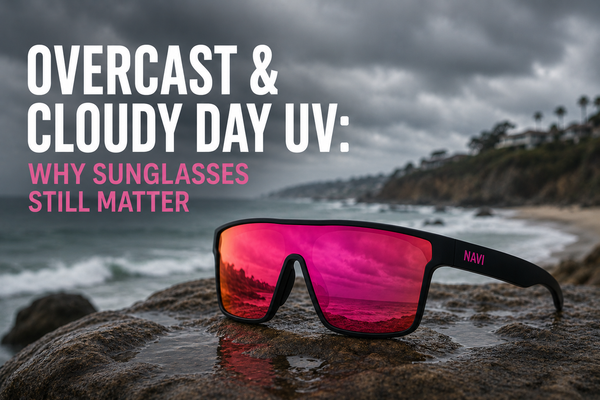

Overcast and Cloudy Day UV: Why Sunglasses Still Matter
Clouds transmit approximately 70–80% of UV radiation while blocking a much larger proportion of visible light — which is why overcast days feel less bright but still carry real UV risk. At UV index 8, an overcast sky still delivers UV index 5–6 to ground level: well above the WHO protection threshold. Sunglasses are appropriate and protective on cloudy days at any UV index above 3. The lens category shifts down on overcast days — Cat 1–2 instead of Cat 2–3 — but the UV400 specification and polarization remain fully relevant.
The single most common reason people skip sunglasses on a given day is cloud cover. The logic seems intuitive: it's not sunny, so there's no sun to protect against. This logic is wrong in a specific and quantifiable way — clouds attenuate visible light far more than they attenuate UV. The result is a systematic behavioral gap where overcast days produce real UV exposure to unprotected eyes while the visual conditions create no perceived need for protection. For the full seasonal context, see the year-round seasonal UV guide.

1. The Physics: Why Clouds Block Light but Not UV
Visible Light vs UV: Different Interactions With Cloud Matter
Visible light and UV radiation interact with cloud water droplets differently. Clouds are composed of tiny water droplets or ice crystals that scatter visible light very effectively — this scattering is what makes clouds appear bright white and why overcast skies appear uniformly gray rather than dark. The strong scattering of visible wavelengths means a significant proportion of visible light is redirected away from the ground, reducing overall brightness substantially.
UV radiation, particularly UV-A (315–400nm), interacts less efficiently with cloud water droplets at these wavelengths. A smaller proportion of UV-A is scattered or absorbed by cloud matter compared to visible light. The practical result: cloud cover creates a larger fractional reduction in visible light than in UV-A. On a heavily overcast day, visible light may be 20–30% of clear-sky levels while UV-A remains at 70–80% of clear-sky levels.
The UV-B vs UV-A Distinction
UV-B (280–315nm) — the shorter-wavelength, more biologically damaging UV — is somewhat more effectively scattered by clouds than UV-A. On very heavily overcast days with dense cloud cover, UV-B may be reduced to 50–60% of clear-sky values, compared to UV-A's 70–80% transmission. This partial additional UV-B reduction doesn't change the practical conclusion — meaningful UV-B still reaches ground level under overcast conditions, and UV400 sunglasses block both UV-A and UV-B regardless.
The Enhancement Effect: When Clouds Increase UV
A counterintuitive but documented phenomenon: partly cloudy conditions with broken cloud cover can produce higher ground-level UV than clear-sky conditions. When sunlight passes through gaps between clouds while other clouds act as reflectors, the combination of direct beam radiation plus reflected radiation from cloud surfaces can temporarily increase ground-level UV above clear-sky baseline. Studies have documented UV index values 10–25% above clear-sky predictions during these "cloud gap enhancement" periods.
The practical implication: partly cloudy days are not intermediate UV days — they are variable UV days where brief cloud-gap periods may produce higher UV than would occur under clear sky. People outdoors for extended periods on partly cloudy days encounter the full range from reduced-UV (heavy cloud) to above-baseline UV (cloud gap enhancement) within the same outdoor session.
2. What Cloudy-Day UV Actually Looks Like
The Numbers: Overcast UV at Different Base UV Indices
| Clear-Sky UV Index | Overcast Transmission | Effective Overcast UV | WHO Category | Protection Needed? |
|---|---|---|---|---|
| 2 | 70–80% | 1.4–1.6 | Low | Minimal — brief exposure |
| 4 | 70–80% | 2.8–3.2 | Moderate | Yes — approaching protection threshold |
| 6 | 70–80% | 4.2–4.8 | Moderate–High | Yes — meaningful protection needed |
| 8 | 70–80% | 5.6–6.4 | High | Yes — UV400 sunglasses appropriate |
| 10 | 70–80% | 7.0–8.0 | High–Very High | Yes — UV400 essential |
| 12 | 70–80% | 8.4–9.6 | Very High | Yes — UV400 essential; Cat 2 minimum |
The key insight from this table: at a clear-sky UV index of 8 — typical summer midday across much of the US — an overcast day still delivers effective UV of 5.6–6.4. That's a "high" UV category day requiring protection, delivered in conditions where most people have abandoned their sunglasses because "it's cloudy."
Seasonal Overcast UV: Spring and Fall Are Not Safe
The overcast UV problem is most acute in spring and fall, when UV index on clear days reaches 5–8 and overcast conditions are common. A cloudy April afternoon with base UV index 6 delivers effective UV of 4–5 to unprotected eyes — well above the WHO protection threshold, in conditions where UV awareness is already lower than summer. Spring overcast days are among the most systematically under-protected UV scenarios across the year. See spring UV risk and fall UV changes for the full seasonal context.
Overcast Winter UV: Still Not Zero
Winter overcast days at sea level in the northern US have clear-sky UV indices of 1–3 and overcast effective UV of 0.7–2.4. These values are genuinely low — the cumulative UV accumulation from brief winter overcast outdoor exposure is modest. However, for people spending extended outdoor time in winter (outdoor workers, winter sport participants, regular walkers and runners), even low UV index values accumulate meaningfully over a full day or week of outdoor exposure.
3. The Behavioral Gap: Why Cloudy Days Are Under-Protected
Visible Light as the Proxy for UV
Human UV protection behavior is triggered primarily by perceived brightness — how much visible light is present. Squinting, the discomfort of direct sunlight, and the subjective sense of "it's sunny" are all responses to visible light, not UV. Since clouds selectively reduce visible light more than UV, the perceptual cues that drive sun protection behavior are disproportionately suppressed on overcast days while actual UV risk remains substantially higher than perception suggests.
This creates a systematic behavioral gap: overcast conditions produce low visible-light perception (no squinting, no obvious brightness) while delivering 70–80% of UV. The person outdoors on an overcast day receives no behavioral signal to reach for sunglasses while receiving most of the UV they would receive in direct sun.
The "It Doesn't Feel Sunny" Trap
The subjective experience of an overcast day — diffuse gray light, no harsh shadows, no direct sun sensation on skin — creates a strong intuitive sense that UV protection is unnecessary. This intuition is accurate for visible light (you don't need sunglasses for the brightness) but wrong for UV (the UV is still there at 70–80% of clear-sky levels). The disconnect between the "it doesn't feel sunny" perception and the UV reality is the core of the behavioral gap.
Cumulative Damage From Overcast Exposure
The significance of overcast UV accumulation depends on frequency. In the Pacific Northwest, New England, and Midwest, overcast days represent a substantial proportion of the outdoor year — often more days than clear days through October–April. If UV protection habits are suspended on overcast days, a large fraction of total annual outdoor UV exposure accumulates without protection. For someone spending regular outdoor time in a cloudy climate, the overcast days may account for 30–40% of annual UV dose — dose that accumulates in the same eye tissue as clear-sky UV and contributes equally to lifetime cataract and macular degeneration risk.
4. Regional Overcast UV: The High-Cloud Climates
Pacific Northwest: The Cloud UV Capital
Seattle, Portland, and the broader Pacific Northwest coast experience an average of 150–200 overcast or heavily cloudy days per year. From October through April, clear days are the exception rather than the rule. The UV index on clear winter days in this region is 1–3; under overcast conditions, effective UV is 0.7–2.4. Through spring and summer, clear-sky UV index reaches 6–8 and overcast effective UV reaches 4–6.
The Pacific Northwest's cloud-dominant climate means that UV protection habits calibrated to "clear sunny days" protect against a minority of actual UV exposure time. Year-round UV habit regardless of cloud cover is the appropriate behavioral framework for this region.
Northeast and Great Lakes: Spring and Fall Overcast Risk
The Northeast and Great Lakes states have highly variable cloud cover across the year, with overcast conditions common in spring and fall — exactly the seasons where UV is rising or declining and protection habits are weakest. An overcast April day in Boston or Chicago with base UV index 5–6 delivers effective UV of 3.5–5.0 — meaningful UV delivered in conditions where virtually no one reaches for sunglasses.
Sun Belt: Lower Frequency, Still Relevant
Sun Belt states (Florida, Texas, Arizona) have fewer overcast days than northern states, but when overcast conditions occur — summer thunderstorm systems, winter frontal systems — the high base UV index of these locations means overcast effective UV remains high. An overcast August day in Phoenix with base UV index 10 delivers effective UV of 7–8 — high category UV in conditions where the absence of direct sun sensation suppresses protection behavior.
5. What Lens to Wear on Overcast Days
Cat 1: The Overcast Specialist
Cat 1 lenses (43–80% visible light transmission) are specifically appropriate for overcast and low-light conditions. They provide UV400 blocking for the UV that passes through cloud cover while maintaining visual comfort in the lower-light conditions of overcast days. A Cat 2 or Cat 3 lens on a heavily overcast day can feel unnecessarily dark, reducing optical clarity in conditions that are already lower in visible light. Cat 1 amber or gray polarized UV400 handles the UV protection case for overcast conditions while remaining comfortable in the diffuse low-contrast light of an overcast sky.
Cat 2: For Partly Cloudy and Variable Conditions
Partly cloudy conditions — where cloud cover alternates with sun gaps — are best served by Cat 2 rather than Cat 1. The cloud-gap UV enhancement effect means UV spikes during clear-sky periods, and Cat 2 handles the range from moderate-cloud to direct sun more effectively than Cat 1. For a day that will alternate between overcast and sunny throughout, Cat 2 polarized is the more versatile choice.
Why Polarization Remains Relevant Overcast
Polarization's value shifts somewhat on overcast days. On clear days, polarization primarily eliminates the strongly directional horizontal glare from reflective surfaces. On overcast days, light is more diffuse — less directional horizontal reflection — but polarization still addresses the scattered light that bounces off wet roads, puddles, wet leaves, and other surface reflectors that are common in the wet conditions that often accompany overcast weather. The polarization benefit is reduced but not eliminated on overcast days, and the UV400 protection benefit remains fully in effect.
Overcast Lens Recommendations by Condition
| Overcast Condition | Base UV Index | Category | Tint | Notes |
|---|---|---|---|---|
| Heavy overcast, gray sky | 3–6 | Cat 1 | Amber or gray polarized | UV400 essential; Cat 1 comfortable in low-light |
| Partly cloudy, variable sun | 5–9 | Cat 2 | Amber or gray polarized | Cloud gaps produce UV spikes; Cat 2 handles range |
| Thin cloud veil, bright overcast | 6–9 | Cat 2 | Gray or amber polarized | Thin cloud transmits high UV; feels diffuse but UV risk is high |
| Light morning mist, clearing | 2–4 | Cat 1 | Amber polarized | Mist ≠ no UV; amber improves contrast in diffuse early light |
| Rainy day with outdoor time | 1–3 | Cat 1 or clear | Clear UV400 polycarbonate | UV still present; rain reduces UV further but not to zero |
| Dense fog | < 1 | Clear UV400 | N/A | Dense fog absorbs most UV; clear polycarbonate for impact safety |
6. Building the Year-Round Habit Regardless of Cloud Cover
The Trigger That Works: Outdoor, Not Sunny
The behavioral fix for the cloudy-day UV gap is the same as the fix for the seasonal UV gap: changing the habit trigger from "it's sunny" to "I'm going outdoors." A habit triggered by outdoor exposure fires on overcast days as reliably as on clear days, because the trigger is context (going outside) rather than perception (it looks sunny). This single change in habit structure eliminates the cloudy-day behavioral gap completely.
Overcast as the Test of a Real Habit
Whether someone reaches for sunglasses on an overcast day is a reliable indicator of whether they have a genuine year-round UV protection habit or a conditional sunny-day behavior. The distinction matters: a conditional sunny-day behavior has gaps in spring, fall, winter, and on every overcast day throughout the year — gaps that collectively account for a substantial proportion of total annual UV exposure. A genuine outdoor-triggered habit has no such gaps.
Practical Storage: The Same Pocket as Always
People who wear sunglasses on overcast days have them in the same place as always — in their pocket, in their car, in their bag — because they've moved them there as part of their outdoor routine regardless of the weather forecast. The habit of checking the weather before deciding whether to bring sunglasses is the habit structure to replace. "Sunglasses go with me when I go outside" requires no weather check. Navi Eyewear's Buy 1, Get 3 Free offer — $119 for 4 pairs — provides the multi-location coverage (car, bag, home entry, office) that makes consistent carrying frictionless regardless of forecast.
Frequently Asked Questions
Do I need sunglasses on a cloudy day?
Yes, if the base UV index is 3 or above — which covers almost every overcast day from spring through fall across the continental US, and year-round in Sun Belt states. Clouds transmit approximately 70–80% of UV, so a summer overcast day with base UV index 8 still delivers effective UV of 5.6–6.4 to unprotected eyes. UV400 sunglasses in Cat 1 are appropriate and protective on overcast days with meaningful UV index.
Can you get sun damage on a cloudy day?
Yes — UV-related eye and skin damage accumulates from UV exposure regardless of whether that UV arrives through clear sky or through cloud cover. The biological processes that cause cataract formation, macular degeneration risk, and photokeratitis do not distinguish between clear-sky and cloud-transmitted UV. 70–80% of UV is still UV — it accumulates, damages, and contributes to lifetime dose identically to clear-sky UV.
Why does it feel less bright when it's cloudy if UV is still present?
Clouds scatter visible light more effectively than UV. The bright appearance of an overcast sky comes from visible light scattering, not UV scattering. UV wavelengths pass through cloud matter with much less interaction, meaning clouds create the visual impression of reduced sun while transmitting most of the UV. This is the core of the behavioral gap — visual perception of brightness tracks visible light, not UV.
What lens category should I wear on cloudy days?
Cat 1 for heavy overcast and consistently cloudy conditions — provides UV400 blocking while remaining comfortable in lower-light conditions. Cat 2 for partly cloudy and variable conditions where sun gaps occur. Never Cat 3 or 4 for driving in any conditions. Browse UV400 polarized options at navieyewear.com.
Is UV worse through thin clouds than thick clouds?
Yes — thin, high-altitude clouds (cirrus, thin stratus) transmit more UV than dense, low-altitude clouds (cumulonimbus, heavy stratus). Thin cloud cover can transmit 80–90% of UV while creating the visual impression of a "hazy" day rather than full sun. The bright, hazy overcast of a summer morning — when thin cloud diffuses the sun without obscuring it — is a particularly high UV transmission scenario that few people would spontaneously identify as requiring protection.
Can clouds ever increase UV?
Yes — partly cloudy conditions with broken cloud cover can produce a cloud-gap enhancement effect where UV briefly exceeds clear-sky baseline by 10–25%. This occurs when direct beam radiation through a cloud gap is supplemented by radiation reflected from adjacent cloud surfaces. This is why partly cloudy days are not simply intermediate UV days — they are variable UV days with occasional high-UV peaks during cloud gaps.
Do I need sunglasses if I'm only outside briefly on a cloudy day?
For very brief exposure (under 5 minutes) in low UV index conditions, the cumulative UV from a single brief outdoor period is genuinely modest. For people spending regular time outdoors on overcast days — commuting, walking, outdoor work, lunch breaks — the cumulative UV across multiple brief exposures per day adds up meaningfully. The habit answer is more practical than the dose calculation: "sunglasses when I go outside" is simpler to execute and more protective than calculating UV dose for each outing.
Does rain block UV?
Rainfall reduces UV somewhat more than cloud cover alone — the combination of cloud cover and rain droplets in the atmosphere attenuates UV further. In heavy rainfall, ground-level UV may be reduced to 20–40% of clear-sky values. In light rainfall or drizzle, the reduction is less dramatic — perhaps 50–70% of clear-sky values. UV is never zero in outdoor daytime conditions, but heavy rain during outdoor activity reduces UV to levels where brief exposure accumulates relatively little dose.
The Bottom Line
Clouds block visible light much more effectively than they block UV — approximately 70–80% of UV passes through typical cloud cover while visible light may be reduced by 70–80%. This creates a systematic behavioral gap where overcast days feel like no-UV days while delivering meaningful UV dose. The habit that closes this gap is the outdoor trigger rather than the sunny-day trigger: sunglasses on when going outside, regardless of weather forecast. Cat 1 amber or gray polarized UV400 for heavy overcast; Cat 2 for partly cloudy variable conditions. navieyewear.com/collections/polarized — Buy 1, Get 3 Free for $119.
Related Reading
- Sunglasses by Season: The Complete Year-Round UV Guide | Navi Eyewear
- Spring UV Risk: Why You Need Sunglasses Before Summer | Navi Eyewear
- Fall UV Changes: What Happens to UV Risk in Autumn | Navi Eyewear
- Summer Peak UV: Maximizing Eye Protection | Navi Eyewear
- Sunglasses for the Pacific Northwest: Cloudy UV Guide | Navi Eyewear
- UV and Eye Disease: Cataracts, Macular Degeneration and Prevention | Navi Eyewear
- Sunglasses as a Family Habit: Building Year-Round UV Protection | Navi Eyewear
- Shop Polarized UV400 Sunglasses | Navi Eyewear
Sources & Citations
[1] WHO. "Global solar UV index: a practical guide." World Health Organization, 2002. View source →
[2] Diffey BL. "Sources and measurement of ultraviolet radiation." Methods, 2002. View source →
[3] Sabburg J and Wong J. "The effect of clouds on enhancing UVB irradiance at the earth's surface." Geophysical Research Letters, 2000. View source →
[4] Taylor HR, et al. "Effect of ultraviolet radiation on cataract formation." New England Journal of Medicine, 1988. View source →
[5] Dain SJ. "Sunglasses and sunglass standards." Clinical and Experimental Optometry, 2003. View source →
[6] Sliney DH. "Ocular exposure to environmental light and ultraviolet." Journal of AAPOS, 2014. View source →