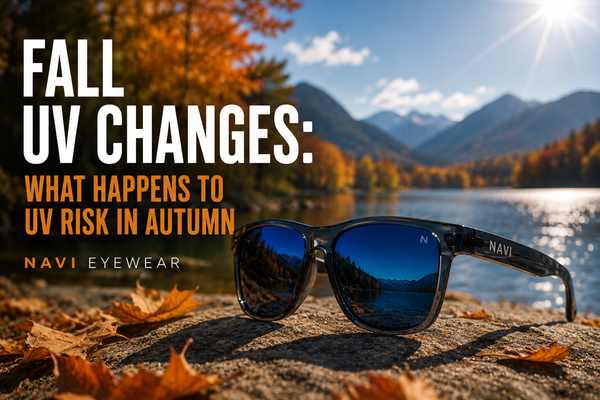

Fall UV Changes: What Happens to UV Risk in Autumn
Fall UV declines from summer peak but remains meaningful through October across most of the US — and introduces a new challenge: low-angle sun. As the sun arc drops in the sky through September–November, it spends more time near the horizon at angles that bypass the brow's natural shading and hit the eye directly. Combined with the behavioral reality that most people stop wearing sunglasses when it stops feeling like summer, fall is a season of real UV exposure and real glare with minimal protection. Cat 2 gray or amber polarized UV400 handles both the remaining UV and the low-angle glare that fall introduces.
Fall occupies an interesting position in seasonal UV protection: UV intensity is declining from summer peak, which most people correctly perceive — but it declines gradually, not suddenly, and introduces a new optical challenge (low-angle sun and glare) that summer doesn't produce. The behavioral pattern of stopping sunglasses use in September typically outpaces the actual decline in UV risk by 4–6 weeks, creating a protection gap in early fall that is as problematic, in different ways, as the spring gap going the other direction. For the full seasonal framework, see the year-round seasonal UV guide.

1. How UV Actually Changes in Fall
September: Still Summer UV Levels
September UV intensity is significantly closer to summer than to winter across the continental US. In the Sun Belt (Florida, Texas, Arizona, Southern California), September UV index on clear days ranges from 8–10 — values that overlap with summer peak conditions across much of the country. In the Northeast and Midwest, September UV index runs 5–7, comparable to May UV levels. The summer protection habits that were appropriate in August remain appropriate in September.
The solar elevation angle drops measurably in September compared to July but remains high enough through most of the month for peak UV to be well above the protection threshold. The cultural trigger — Labor Day as the psychological end of summer — typically causes sun protection behavior to drop in early September when UV values are still firmly in the high-to-very-high range across the South and moderate-to-high across the North.
October: The Transition Month
October marks a genuine transition in UV intensity for most US locations. UV index drops to 3–5 in the northeastern and midwestern states, 5–7 across the Southeast, and 6–8 in the Sun Belt and Southwest. These values are meaningfully lower than summer peak but still above the WHO's UV index 3 protection threshold across most of the country through most of October.
October also introduces the low-angle sun phenomenon that becomes one of fall's defining optical characteristics. As the sun's daily arc drops lower in the sky, it spends more time at elevation angles of 15–30 degrees — heights where the brow and hat brim provide little shading and where the sun enters the eye field directly on forward gaze. This is the configuration that produces the intense direct-glare situations familiar from fall commuting and late-afternoon outdoor activity.
November: Low UV, High Glare
By November, UV index across the northern half of the US drops to 1–3 — low enough that cumulative UV accumulation in brief outdoor periods is modest. Southern states maintain UV index 3–5 through November. The cumulative UV case for sunglasses weakens in November in the northern tier, but the glare case intensifies: the sun is now at its lowest arc position short of winter solstice, producing the most acute low-angle direct glare of any time of year at morning and evening commute angles.
2. The Low-Angle Sun Problem: Fall's Unique Optical Challenge
What Low-Angle Sun Does
In summer, the sun reaches its maximum elevation above the horizon — typically 60–75 degrees above horizontal at midday in the continental US. At these angles, the brow, hat brim, and natural facial structure provide meaningful shading of the orbital area. The sun is primarily overhead, and overhead blocking is effective.
In fall, the sun's maximum elevation drops progressively — to 40–50 degrees in September, 30–40 degrees in October, 20–30 degrees in November. At these lower angles, the sun spends much more time in the forward visual field rather than overhead. Forward-facing glare at 20–30 degrees elevation is not blocked by the brow or a hat brim — it enters the eye directly. This is the glare that produces the blinding direct-sun situations on fall morning and evening commutes, afternoon outdoor sport, and late-afternoon outdoor activity.
The Commuter's Fall Glare Window
The fall commuting glare problem is one of the most predictable and hazardous UV and glare scenarios of the year. It has two components that compound each other:
- Morning eastbound commute: sunrise occurs later in fall as daylight saving ends, aligning the morning commute with sunrise and early morning low-angle eastward sun. Drivers facing east on their morning commute encounter direct low-angle sun in their primary visual field, producing intense direct glare that standard car sun visors cannot fully manage.
- Evening westbound commute: the westward drive at end of day aligns with sunset — particularly acute after daylight saving ends in November, when the clock shift moves sunset to late afternoon coinciding with the bulk of evening commute traffic. The low autumn sun at 10–20 degrees above the horizon in the west is the most intense direct glare scenario of the year for drivers.
Polarized gray UV400 lenses specifically address this scenario. They eliminate the road surface reflection component of driving glare (polarization), reduce overall brightness (Cat 2 tint), and maintain color accuracy for traffic signal discrimination (gray). For the complete driving guide, see best sunglasses for driving.
Fall Outdoor Sport: Low Sun at Field Level
Fall outdoor sport — football, soccer, cross country, fall baseball and softball playoffs, golf — occurs as the sun arc drops to field-level angles that summer sport never experiences. A 4 PM fall soccer practice in late October has the sun at 15–20 degrees elevation — essentially at player eye level on the field. This creates direct forward-facing sun exposure during running, ball tracking, and player positioning that is more visually disruptive than summer overhead sun in many ways.
Polarized amber UV400 Cat 2 handles fall outdoor sport well. The amber contrast enhancement remains valuable for ball tracking; polarization eliminates field surface reflection; Cat 2 darkness is appropriate for the moderate UV index of fall afternoons while remaining comfortable as the sun drops to lower elevation.
3. Fall UV by Region
| Region | September UV | October UV | November UV | Fall Notes |
|---|---|---|---|---|
| Sun Belt (FL, AZ, TX, NM) | 8–10 | 6–8 | 4–6 | Year-round significant UV; fall UV still warrants consistent protection |
| Southeast (GA, SC, NC) | 7–9 | 5–7 | 3–5 | Fall UV meaningful through October; November still above zero |
| Mid-Atlantic / Northeast | 5–7 | 3–5 | 1–3 | September still summer-adjacent; October transition; November very low |
| Midwest / Upper Midwest | 5–7 | 3–5 | 1–2 | Sharp fall decline; low-angle glare intensifies as UV drops |
| Pacific Northwest | 4–6 | 2–4 | 1–2 | Heavy cloud cover reduces UV but not to zero; frequent overcast |
| Mountain West | 6–9 + altitude | 4–7 + altitude | 2–4 + altitude | Fall hiking UV still significant at altitude through October |
| Southern California | 8–10 | 6–8 | 4–6 | Mild seasonal variation; fall UV still meaningful; Santa Ana winds add glare |
| Hawaii | 9–11 | 8–10 | 7–9 | Minimal seasonal change; year-round Cat 2–3 appropriate |
4. Fall Eye Health: What the UV Is Still Doing
Cumulative Damage Continues Through Fall
UV eye damage is cumulative across the entire year. The UV accumulated during September and October — when protection rates drop dramatically after summer — contributes equally to lifetime UV dose as equivalent summer exposure. A September week with UV index 6–7 and no sunglasses use accumulates more UV than a June week at the same UV index with consistent Cat 3 protection.
The behavioral protection gap in fall is particularly consequential because fall outdoor activity often increases rather than decreases for many people — hiking peaks in fall foliage season, fall sports seasons are active, outdoor social time continues into September and October. More outdoor time combined with reduced protection produces a net UV accumulation that can match or exceed summer months for people whose summer habits were better than their fall habits.
Fall Foliage Hiking: Underprotected High-UV Activity
Fall foliage hiking — one of the most popular outdoor activities in the northeastern US — occurs in conditions where UV is still significant (UV index 4–6 in October at lower elevations, higher at altitude) and where protection awareness is low because the activity doesn't "feel like" a sun exposure event. The combination of extended outdoor duration, altitude UV amplification on higher trail sections, and the near-complete absence of UV protection awareness in the foliage hiking demographic creates meaningful UV accumulation in a population that would not identify this activity as a UV risk.
Fall Water Activities
Lake and coastal water activities continue through September and October in warmer regions. Water UV reflectance (25%+ at moderate sun angles) amplifies the direct UV of fall afternoons in ways that make September and early October water activity meaningfully higher UV than the UV index alone suggests. Polarized UV400 protection remains the appropriate specification for fall water activities.
5. Fall Lens Recommendations
Cat 2 as the Fall Default
Cat 2 polarized UV400 is the appropriate fall default for most conditions and most US locations. Cat 2 (18–43% light transmission) is appropriately dark for the UV index 4–7 conditions of September–October while remaining comfortable in the lower-light conditions of fall afternoons and overcast fall days. Cat 3 in low-light fall conditions can feel unnecessarily dark and restrict vision in the shade-to-sun transitions common in fall foliage environments.
Gray vs Amber for Fall
- Gray polarized: the fall driving and commuting standard — color neutral, eliminates road glare, appropriate for the low-angle sun that characterizes fall commuting. Gray's color accuracy is most important here, where traffic signal and road marking discrimination matters.
- Amber polarized: the fall outdoor sport and foliage hiking standard — contrast enhancement for object tracking and terrain definition in variable cloud-and-sun fall light. Amber's contrast enhancement is particularly valuable in the shifting light conditions of a partly cloudy fall afternoon.
When to Step Down to Cat 1 in Fall
Cat 1 (43–80% light transmission) is appropriate for late fall conditions in the northern tier — November outdoor activity in low UV index 1–2 conditions, overcast fall days, and early-morning or late-afternoon outdoor activity when the UV is low but the low-angle glare is still present. Cat 1 maintains visual comfort in low-light conditions while providing the polarization benefit for glare and the UV400 blocking for whatever UV remains.
Why Polarized Stays Relevant Even as UV Declines
Even as UV declines in late fall, the polarization benefit for low-angle sun scenarios remains fully in effect. Low-angle sun on road surfaces, wet fall leaves on pavement, and flat water surfaces produces horizontally polarized glare that is just as intense in November as in July — the glare is from the sun angle and surface geometry, not from the UV intensity. Polarized lenses address fall glare independently of UV protection, maintaining their performance benefit through the full fall and into winter regardless of the UV index.
6. Carrying UV Protection Through the Fall Transition
The Behavioral Drop-Off Problem
The most predictable UV protection failure in fall is the behavioral drop-off that follows Labor Day. Sun protection rates — sunscreen, sunglasses, hat wearing — decline sharply in September across all demographics, driven by the cultural end-of-summer signal. This drop-off is not matched by a corresponding drop in UV, which declines gradually over months rather than dropping suddenly in early September.
The result is a 4–6 week window from early September through mid-October where UV is still at moderate-to-high levels (3–8 depending on location) but protection rates have returned to near-winter levels. This is a systematic gap that contributes meaningfully to annual UV accumulation.
The Year-Round Habit Avoids the Gap
The most effective solution to the fall behavioral gap is a year-round habit that doesn't depend on summer/not-summer perception. A person who wears UV400 sunglasses consistently through summer because it's their year-round outdoor habit carries that habit through September and October without a seasonal trigger to stop. The habit avoids the gap because it doesn't have a seasonal off-switch.
Fall as the Last Easy Re-Establishment Window
For people who do experience the fall drop-off: re-establishing the habit in October, when the low-angle commute glare makes sunglasses immediately and obviously useful, is easier than trying to re-establish it in winter when the case is subtler. The fall commute glare problem provides a natural self-evident reason to reach for sunglasses that UV accumulation alone — invisible and long-term — does not. Navi Eyewear's Buy 1, Get 3 Free offer — $119 for 4 pairs — provides the multi-location coverage (car, bag, home) that removes friction from daily fall wearing.
Frequently Asked Questions
Do I still need sunglasses in fall?
Yes — through September and October across most of the US, UV index remains at levels that cause cumulative eye damage with regular unprotected exposure. The additional fall glare challenge (low-angle sun at commute hours and during outdoor sport) provides an immediate functional reason to wear sunglasses even as UV declines. November in the northern tier approaches low enough UV that cumulative risk per hour is modest, but the glare case for polarized sunglasses during commuting and outdoor activity remains fully valid.
When can I stop wearing sunglasses in fall?
There is no clean cutoff. UV transitions gradually from high summer values to low winter values across September–November depending on location. The practical answer for most people is: maintain the habit year-round and avoid the stop-and-restart cycle entirely. If you do reduce wearing in late fall, UV index 3 is the WHO threshold below which acute protection is least critical — which means late November in the northern tier and December–January in the South.
Why is fall glare worse than summer glare?
Because the sun is lower in the sky. Summer sun at midday is 60–75 degrees above the horizon — overhead rather than in your line of sight. Fall sun peaks at 30–50 degrees above the horizon and spends long morning and evening periods at 10–20 degrees — directly in forward-facing gaze direction. The brow and hat brim that manage overhead summer glare do nothing for forward-facing fall sun. Polarized lenses eliminate the reflected component of this low-angle glare from roads, wet leaves, and water surfaces.
What's the best lens for fall commuting?
Gray polarized UV400 Cat 2 — color neutral for traffic signal and road marking accuracy, polarized for road surface and windshield glare elimination, Cat 2 appropriate for the range of fall light conditions from bright afternoon to overcast. Gray specifically over amber for driving because amber shifts color rendering in ways that can affect traffic signal discrimination. See best sunglasses for driving for the complete driving guide.
Is fall hiking a UV risk?
Yes — particularly in the first half of fall and at altitude. October UV index 4–6 at lower elevations means several hours of fall hiking accumulates meaningful UV dose. At altitude (common northeastern and western fall hiking destinations), UV is 10–40% above sea-level baseline depending on elevation. Amber or gray polarized UV400 Cat 2 is appropriate for fall day hikes.
Does daylight saving time affect UV exposure?
Daylight saving time ends in November (first Sunday of November), shifting the clock back one hour. This moves the morning commute one hour later relative to solar time and moves the evening commute one hour earlier relative to solar time, aligning it more directly with afternoon low-angle sun. The weeks immediately after daylight saving ends are typically the most glare-intense commuting weeks of the year.
Should I wear different sunglasses in fall than summer?
Cat 2 is more appropriate for fall conditions than the Cat 3 appropriate for peak summer. Otherwise the specification is the same: UV400 polarized polycarbonate in a comfortable, well-fitting frame. If you have a single pair that you wear year-round, Cat 2 is the more versatile choice that handles both seasons adequately. Browse polarized UV400 options at navieyewear.com.
The Bottom Line
Fall UV declines from summer peak but stays meaningful through October across most of the US — and introduces a new challenge in low-angle sun and commuting glare that summer doesn't produce. The behavioral gap between when people stop wearing sunglasses (Labor Day) and when UV actually drops to low levels (late November in the North, later in the South) creates systematic UV accumulation in a population that has largely stopped protecting itself. Cat 2 gray polarized for fall commuting and everyday use, Cat 2 amber for outdoor sport and hiking — and the year-round habit that makes the seasonal transition irrelevant. navieyewear.com/collections/polarized — Buy 1, Get 3 Free for $119.
Related Reading
- Sunglasses by Season: The Complete Year-Round UV Guide | Navi Eyewear
- Spring UV Risk: Why You Need Sunglasses Before Summer | Navi Eyewear
- Summer Peak UV: Maximizing Eye Protection | Navi Eyewear
- Overcast and Cloudy Day UV: Why Sunglasses Still Matter | Navi Eyewear
- Best Sunglasses for Driving | Navi Eyewear
- Sunglasses for High-Altitude Mountain UV | Navi Eyewear
- Holiday and Winter Gift Sunglasses | Navi Eyewear
- Shop Polarized UV400 Sunglasses | Navi Eyewear
Sources & Citations
[1] WHO. "Global solar UV index: a practical guide." World Health Organization, 2002. View source →
[2] Diffey BL. "Sources and measurement of ultraviolet radiation." Methods, 2002. View source →
[3] Taylor HR, et al. "Effect of ultraviolet radiation on cataract formation." New England Journal of Medicine, 1988. View source →
[4] Sliney DH. "Ocular exposure to environmental light and ultraviolet." Journal of AAPOS, 2014. View source →
[5] Dain SJ. "Sunglasses and sunglass standards." Clinical and Experimental Optometry, 2003. View source →
[6] Rosenthal FS, et al. "The effect of sunglasses on ocular exposure to ultraviolet radiation." American Journal of Public Health, 1988. View source →