
The Complete Sunglass Buyer's Guide: How to Choose the Right Pair
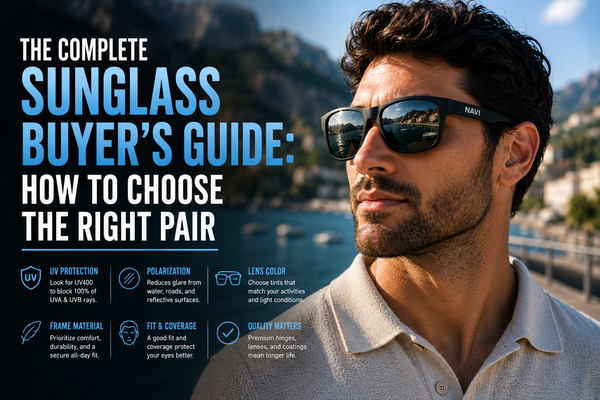
Choosing sunglasses well requires four sequential decisions: the right protective specification (UV400 polycarbonate polarized — non-negotiable), the right lens tint for your primary use (gray for driving and everyday, amber for outdoor sport, copper for water and beach), the right fit for your face (frame width, bridge fit, lens coverage), and the right frame for your activity (TR90 sport for active use, lifestyle frame for everyday). Everything else — brand, price, style — is secondary to these four. This guide covers each decision in order.
Contents
- 1. The Non-Negotiable Specification: UV400 Polarized Polycarbonate
- 2. Lens Tint: Choosing the Right Color for Your Use
- 3. Lens Category: How Dark Is Right?
- 4. Frame Fit: Getting the Geometry Right
- 5. Frame Style: Activity-Matching Your Frame Choice
- 6. Coatings: What to Require
- 7. Price vs Specification: What You're Actually Paying For
- 8. How Many Pairs Do You Need?
- 9. Buyer's Checklist
- 10. Frequently Asked Questions
- 11. Supporting Articles in This Cluster

1. The Non-Negotiable Specification: UV400 Polarized Polycarbonate
UV400: The Foundation
UV400 means the lens blocks all ultraviolet radiation up to 400 nanometers — 100% of UV-A and UV-B. This is the only UV specification that provides complete eye UV protection. "UV protection" without UV400 designation is an incomplete claim that may mean partial blocking. Dark lenses without UV400 are worse than no sunglasses — the darkness dilates the pupil while providing no UV protection.
In polycarbonate lenses, UV400 absorption is structural — built into the material, permanent, not a coating that degrades. Verify explicitly: look for "UV400" or "100% UVA and UVB blocking" in the specification. If neither appears, treat the UV claim as unverified.
Polycarbonate: Impact Safety and Optical Performance
Polycarbonate is the lens material that provides FDA-cleared impact resistance — the standard that prevents shattering under impact. Glass shatters into sharp fragments; polycarbonate absorbs impact energy without fragmenting. For any outdoor, sport, or active use where a lens could be hit by a ball, branch, gravel, or equipment, polycarbonate is the safety specification. It is also lighter than glass, contributing to all-day comfort. Verify explicitly: "polycarbonate" should be stated in the lens material specification. "Plastic" is not sufficient.
Polarized: The Performance Upgrade That Changes the Experience
Polarized lenses eliminate horizontally polarized reflected glare — the specific light component that causes blinding reflections from roads, water, and sand. Non-polarized UV400 lenses provide health protection; polarized UV400 lenses provide health protection plus the visual performance improvement that makes outdoor vision genuinely more comfortable. The difference is immediately perceptible on first use near water or on a road surface. Verify: look at an LCD screen through the lens and rotate — at 90 degrees, a genuinely polarized lens makes the screen go dark.
All three — UV400, polycarbonate, polarized — are the minimum specification for any sunglass worth buying for outdoor use. Browse UV400 polarized polycarbonate options at navieyewear.com.
2. Lens Tint: Choosing the Right Color for Your Use
The Three Primary Tints and What They Do
Tint choice determines the visual character of the lens — how it renders color, what it does to contrast, and which glare environments it handles best. Three tints cover the overwhelming majority of use cases:
- Gray polarized: color-neutral brightness reduction. The tint does not shift color rendering — what you see through a gray lens is the same colors as without a lens, just darker. Gray is the correct choice for driving (color accuracy for traffic signals and road markings), everyday use (general visual accuracy), city travel (navigation and sign reading), and any context where accurate color rendering matters more than contrast enhancement.
- Amber polarized: warm-spectrum contrast enhancement. Amber transmits warm wavelengths (red, orange, yellow) more than cool ones (blue, green), increasing the perceived contrast of objects against sky and natural backgrounds. The correct choice for outdoor sport (hiking, cycling, running, ball sports), where tracking objects and reading terrain benefits from contrast enhancement. Amber also handles variable light conditions — partly cloudy days with shifting light — better than gray by maintaining visual contrast as light levels change.
- Copper polarized: warm-red contrast enhancement, maximum glare elimination. Copper's slightly redder shift compared to amber provides the maximum polarization glare elimination effect at water and sand surfaces, and the best sub-surface water visibility for fishing. The correct choice for beach, fishing, boating, and any primary water and sand activity.
Tint by Primary Use Context
| Primary Use | Recommended Tint | Reason |
|---|---|---|
| Driving and commuting | Gray polarized | Color accuracy for signals and signs; road glare elimination |
| Hiking and trail running | Amber polarized | Terrain contrast; variable light conditions |
| Cycling | Amber polarized | Road hazard visibility; contrast in variable conditions |
| Ball sports (baseball, tennis, pickleball) | Amber polarized | Ball contrast against sky backgrounds |
| Beach and pool | Copper polarized | Maximum sand and water glare elimination |
| Fishing | Copper polarized | Sub-surface water visibility; maximum polarization effect |
| Skiing and snowboarding | Amber polarized | Snow terrain contrast; variable cloud and sun conditions |
| Everyday general use | Gray polarized | Versatile color-neutral lens for all conditions |
| Overcast and low-light outdoor | Amber polarized Cat 1 | Contrast enhancement in diffuse light; Cat 1 comfortable in low UV |
| Boating and open water | Copper polarized | Open water glare elimination; horizon and wake visibility |
If You're Buying One Pair for Everything
Gray Cat 2 polarized UV400 is the most versatile single-pair choice — handles driving, everyday use, travel, and moderate outdoor activity with appropriate color rendering for all of them. If your primary outdoor activity is sport or outdoor adventure rather than driving, amber Cat 2 polarized is the better single-pair choice. Neither is wrong — the choice depends on which use context dominates your wearing time.
3. Lens Category: How Dark Is Right?
Category Selection by Condition
- Cat 1 (43–80% light transmission): overcast days, dawn and dusk, low-light outdoor activity, indoor-outdoor transition environments. Appropriate when UV is present but conditions are low-light.
- Cat 2 (18–43% light transmission): everyday outdoor use, moderate sun, variable cloud and sun conditions, driving in mixed conditions. The most versatile category for year-round use across most conditions.
- Cat 3 (8–18% light transmission): peak summer sun, beach, ski slopes, prolonged high-UV outdoor activity. The standard for high-UV environments. Suitable for driving.
- Cat 4 (3–8% light transmission): glacier and extreme alpine only. Never for driving — dangerously dark for road use.
The Default Recommendation
For most buyers: Cat 2 as the year-round everyday lens, Cat 3 for summer beach and outdoor sport. If budget allows only one pair, Cat 2 polarized handles both contexts at adequate visual comfort — slightly less dark than ideal for peak summer but appropriate across the widest range of conditions.
4. Frame Fit: Getting the Geometry Right
The Three Fit Dimensions
Frame fit determines whether sunglasses stay in position, provide complete eye coverage, and remain comfortable across hours of wear. Three dimensions matter:
- Frame width vs face width: the frame front should be approximately as wide as the face at temple level — not significantly narrower (leaves peripheral UV exposure and looks too small) or significantly wider (slides down the nose and looks oversized). Most adult face widths are served by frames with lens widths of 50–56mm; look for the three-number size designation inside the temple arm (lens width-bridge width-temple length).
- Bridge fit: the nose bridge should sit flat against the nasal bridge without pinching or gaping. Most sunglasses use fixed nose contacts that are sized for average nasal bridge geometry — if you have a high or low nasal bridge, adjustable nose contact designs accommodate more variation. Rubber nose contacts conform somewhat to bridge geometry; rigid contacts do not.
- Lens coverage: lenses should cover the full orbital area — the eye socket including under-eye and lateral areas. Lens depth (vertical height of the lens) and frame wrap geometry determine coverage. Smaller lens designs that sit above the cheekbones and miss the lower orbital area leave the under-eye skin and lower cornea exposed to UV, particularly in reflective surface environments (beach, snow) where UV comes from below.
Temple Length and Retention
Temple length (the third number in the size designation) should bring the temple tip to behind the ear without excessive pressure or gap. Too short: the frame doesn't reach behind the ear and sits on top, creating instability. Too long: the temple arm bows away from the temporal bone, creating pressure points and instability. Standard temple lengths of 140–145mm fit most adult head sizes; sport frames with slightly longer temples (145–150mm) provide better retention for active use.
Fit for Sport and Active Use
Sport and active use add fit requirements beyond basic coverage: the frame must stay in position during vigorous movement, sweating, and physical contact. Close-fitting wraparound geometry, rubber grip nose contacts, rubber temple tips, and elastic retention straps (for high-intensity sport) address the fit security requirements of active use that standard lifestyle frames don't meet. A frame that fits perfectly at rest but slides during running or cycling is not the right frame for that use.
5. Frame Style: Activity-Matching Your Frame Choice
Sport and Outdoor Frames
Close-fitting wraparound designs in TR90 nylon with rubber grip contacts — the standard for outdoor sport, hiking, cycling, running, water sports, and any active context where fit security and peripheral UV coverage matter. The wraparound geometry reduces peripheral UV entry and wind-driven debris contact. TR90 flexibility handles the physical contact of sport without cracking or warping. Rubber contacts maintain grip under sweat. Close fit reduces air turbulence and glare entry around the frame edge during high-speed activity.
Everyday Lifestyle Frames
Classic frame shapes — aviator, wayfarer, rectangular, round — in TR90 or acetate, with standard lens geometry and conventional temple design. Appropriate for everyday use, driving, city travel, and any context where the frame needs to transition between outdoor and indoor environments without looking out of place. Less coverage at the periphery than sport frames, but appropriate for the moderate UV environments of daily life.
The Frame Style Decision Rule
Match the frame style to the most demanding use context the frame will regularly encounter. A frame that primarily sees driving, city walking, and casual outdoor time is a lifestyle frame. A frame that regularly sees sport, hiking, beach, and water is a sport frame. If a single frame needs to cover both, TR90 sport frame in a semi-wraparound design (less extreme than a full sport wrap, more coverage than a standard lifestyle frame) is the practical compromise.
6. Coatings: What to Require
The coating suite that matters for outdoor use — each explicitly named in the specification, not implied:
- Hard coat: scratch resistance on polycarbonate. Required — without it, polycarbonate scratches rapidly from normal handling.
- Oleophobic: oil, fingerprint, and sunscreen repellency. Highly practical for daily outdoor use involving sunscreen and hand contact.
- Hydrophobic: water beading and runoff. Maintains optical clarity in wet conditions without constant wiping.
- Anti-saltwater: salt resistance for coating durability in coastal and sweat-intensive use. Required for beach, coastal, and water sport use.
All Navi Eyewear lenses include this complete coating suite as standard. For a detailed breakdown of what each coating does, see sunglass lens coatings explained.
7. Price vs Specification: What You're Actually Paying For
What Price Buys in Sunglasses
Price in sunglasses buys several things — not all of which affect functional performance:
- Brand and heritage: significant price premium for established brand names. No functional performance impact.
- Materials and manufacturing quality: quality TR90 vs budget plastics, quality PVA polarization film vs lower-efficiency film, quality coating adhesion vs poor adhesion — these are real quality differences that affect performance and longevity.
- Fit and adjustment: premium frames offer more fit adjustment options, better nose contact designs, and more sizes. Real value for fit-sensitive buyers.
- Aesthetic execution: premium acetate patterns, hand polishing, and design differentiation. Aesthetic value, not performance value.
- Retail margin: a significant proportion of premium retail price reflects retail channel cost, not product cost.
The Specification-First Approach
Evaluate specifications before price. A pair that lists UV400, polycarbonate, polarized PVA film, TR90 frame, stainless 5-barrel hinges, and a complete coating suite at $30 per pair provides identical functional protection to a $300 pair with the same specifications. The $270 difference buys brand, aesthetic execution, retail packaging, and margin — not UV protection, impact resistance, or polarization performance.
Navi Eyewear's Buy 1, Get 3 Free offer — $119 for 4 pairs — provides the complete specification (UV400 polycarbonate polarized, TR90, stainless 5-barrel hinges, full coating suite) at approximately $30 per pair. The specification is the product; the price reflects that directly.
8. How Many Pairs Do You Need?
The Multi-Pair Case
The most common UV protection failure is not having sunglasses available when needed — left at home, left in the car, lost, or broken. Multiple pairs eliminate this failure by placing UV protection at every regular outdoor departure point: one in the car, one in the everyday bag, one at home near the door, one dedicated to sport or outdoor activity. The total UV protection delivered by four pairs worn consistently exceeds a single premium pair worn inconsistently by a large multiple.
Pair Allocation by Use Context
- Car pair: gray Cat 2 polarized — stays in the center console, always available for commuting and errands. Gray for driving accuracy.
- Daily bag pair: gray Cat 2 polarized — travels with you, handles everyday outdoor UV and the indoor-outdoor transitions of daily life.
- Sport/outdoor pair: amber Cat 3 polarized in a sport frame — stays in the gym bag or hiking pack, always with you for active outdoor sessions.
- Beach/water pair: copper Cat 3 polarized — stays in the beach bag or boat kit, handles the high-UV high-glare beach and water environment specifically.
Navi Eyewear's Buy 1, Get 3 Free at $119 provides exactly four pairs — the complete coverage set for every use context, or an individual gift set covering a family or household.
9. Buyer's Checklist
Before purchasing any sunglasses, verify:
- UV400 explicitly stated — not just "UV protection" ✓ / ✗
- Polycarbonate lens material explicitly stated ✓ / ✗
- FDA impact resistance claimed ✓ / ✗
- Polarization verifiable by test ✓ / ✗
- Lens category or transmission percentage stated ✓ / ✗
- Frame material explicitly named (TR90, titanium, acetate, etc.) ✓ / ✗
- Hinge specification stated (5-barrel stainless preferred) ✓ / ✗
- Hard coat explicitly stated ✓ / ✗
- Oleophobic coating explicitly stated ✓ / ✗
- Anti-saltwater coating explicitly stated (for coastal/sport use) ✓ / ✗
- Tint matches primary use context ✓ / ✗
- Category matches typical use conditions ✓ / ✗
- Frame width appropriate for face width ✓ / ✗
- Frame style matches activity demands ✓ / ✗
10. Frequently Asked Questions
What's the single most important thing to look for in sunglasses?
UV400 certification with polycarbonate lens material — these two together confirm that the lens blocks 100% of UV permanently (polycarbonate's inherent UV400 absorption doesn't degrade) and withstands impact safely. Everything else — polarization, tint, frame material, coatings — improves performance and comfort on top of this foundation. Without UV400 polycarbonate, the sunglasses are not adequately protective regardless of other features.
Does polarization matter if I'm not near water?
Yes — road surfaces, wet pavement, glass building facades, and car hoods all produce horizontally polarized glare that polarization specifically eliminates. Drivers in particular benefit from polarization every day regardless of proximity to water. The polarization benefit for driving — road surface glare and windshield dashboard reflection elimination — is as immediate and practically significant as the water surface benefit for beach use.
How do I choose between gray and amber?
Gray if your primary use is driving, city use, or everyday general outdoor activity where color accuracy matters. Amber if your primary use is outdoor sport, hiking, cycling, or ball sports where contrast enhancement for terrain and object tracking adds meaningful value. If you're buying one pair and split your time between driving and outdoor sport, gray is the more versatile choice for the driving context; amber is the more versatile choice for the outdoor sport context.
How important is frame fit?
Very — a frame that slides, pinches, or leaves peripheral gaps in coverage fails at the use case regardless of lens specification. Frame fit determines whether the lens actually stays in the correct position to provide its optical and UV protection benefits. For sport and active use, fit security is as important as lens specification. For everyday use, comfort and lens position are the primary fit concerns.
Are expensive sunglasses worth the premium?
For UV protection and optical performance: not necessarily. The UV400 protection of a $30 UV400 polycarbonate lens is identical to that of a $300 UV400 polycarbonate lens. Premium price buys brand, materials quality variability (real but not always significant), aesthetic execution, fit options, and retail margin. Verify specifications first — a complete specification at a lower price point is better than an incomplete specification at any price point.
How often should I replace sunglasses?
When lenses are scratched enough to impair optical clarity, when coatings have degraded to the point of visible performance reduction, or when frames have failed mechanically. UV400 protection in polycarbonate does not degrade — a polycarbonate lens provides the same UV protection when scratched as when new (scratches affect optical quality, not UV protection). The practical replacement trigger is optical quality degradation, not UV protection degradation.
Can I use the same sunglasses for driving and outdoor sport?
Gray polarized UV400 Cat 2 handles both adequately. The driving specification (color neutral for signals, polarized for road glare) and the outdoor sport specification (UV400, polarized, appropriate darkness) overlap at gray Cat 2. The compromise is that gray is not optimized for contrast enhancement in sport (amber would be better there) and the frame may not have the sport retention features of a dedicated sport design. For high-intensity sport, a dedicated sport frame is worth having separately.
11. Supporting Articles in This Cluster
- How to Read Sunglass Specs: A Buyer's Guide | Navi Eyewear
- Cheap vs Expensive Sunglasses: What You're Actually Paying For | Navi Eyewear
- Polarized vs Non-Polarized Sunglasses: Is It Worth It? | Navi Eyewear
- Sunglasses by Face Shape: The Complete Fit Guide | Navi Eyewear
- How Many Pairs of Sunglasses Do You Actually Need? | Navi Eyewear
- The Science of Lens Color: What Tint Does Your Vision Need? | Navi Eyewear
The Bottom Line
The right sunglasses decision is sequential: start with the specification (UV400 polycarbonate polarized — non-negotiable), choose the tint for your primary use (gray for driving and everyday, amber for outdoor sport, copper for water and beach), match the category to your typical conditions (Cat 2 for most uses, Cat 3 for peak summer and beach), get the fit right (frame width, bridge, coverage, temple length), choose the frame style to match your activity demands (sport wrap for active use, lifestyle frame for everyday), and verify the coating suite. Everything else is secondary. Navi Eyewear's Buy 1, Get 3 Free offer — $119 for 4 pairs — covers the full multi-pair strategy at the complete specification for approximately $30 per pair.
Related Reading
- Sunglass Frame Technology and Materials: The Complete Guide | Navi Eyewear
- The Science of Lens Color: What Tint Does Your Vision Need? | Navi Eyewear
- How Polarized Sunglasses Work | Navi Eyewear
- Sunglass Lens Coatings Explained | Navi Eyewear
- UV and Eye Disease: Cataracts, Macular Degeneration and Prevention | Navi Eyewear
- Sunglasses by Season: The Complete Year-Round UV Guide | Navi Eyewear
- The Traveler's Complete Sunglasses Guide | Navi Eyewear
- Shop Polarized UV400 Sunglasses | Navi Eyewear
Sources & Citations
[1] Dain SJ. "Sunglasses and sunglass standards." Clinical and Experimental Optometry, 2003. View source →
[2] ISO 12312-1:2013. "Eye and face protection — Sunglasses and related eyewear." International Organization for Standardization. View source →
[3] FDA. "Impact resistant lenses — 21 CFR Part 801.410." US Food and Drug Administration. View source →
[4] Taylor HR, et al. "Effect of ultraviolet radiation on cataract formation." New England Journal of Medicine, 1988. View source →
[5] WHO. "Global solar UV index: a practical guide." World Health Organization, 2002. View source →
[6] Sliney DH. "Ocular exposure to environmental light and ultraviolet." Journal of AAPOS, 2014. View source →