
How to Read Sunglass Specs: A Buyer's Guide to What Actually Matters
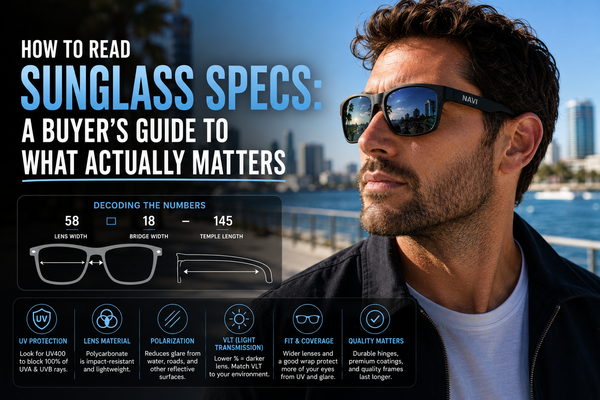
Most sunglass product listings mix functional specifications with marketing language in ways that make it hard to know what you're actually buying. The specs that matter: UV400 certification (explicitly stated, not implied), polycarbonate lens material (explicitly stated), lens category (1–4, per ISO 12312-1), polarization (verifiable, not just claimed), and coating suite (hard coat, oleophobic, hydrophobic, anti-saltwater — each named). The marketing language that doesn't tell you anything: "UV protection," "premium lenses," "advanced coating," "durable frames," "high quality." This guide covers how to read what matters and ignore what doesn't. For the complete material context, see the complete sunglass frame technology and materials guide.

1. UV Protection Claims: What's Real and What Isn't
UV400: The Specific Claim That Matters
UV400 means the lens blocks all ultraviolet radiation up to 400 nanometers — the complete UV spectrum including UV-A (315–400nm) and UV-B (280–315nm). It is a specific, verifiable claim with a defined wavelength threshold. When you see "UV400" on a lens or in a product specification, it means the lens meets this standard. This is the UV protection claim you want to see.
"100% UVA and UVB blocking" is equivalent language — the same protection expressed differently. Both UV400 and "100% UVA and UVB blocking" mean the same thing and are acceptable specifications.
Claims That Don't Confirm UV400 Protection
- "UV protection" — does not specify the level. A lens blocking 70% of UV has "UV protection." This claim means nothing without a specific percentage or UV400 designation.
- "UV resistant" — implies some resistance, not complete blocking. Not equivalent to UV400.
- "Protects against UV" — same issue. Partial protection is still "protection."
- "Dark lenses" — lens darkness is not correlated with UV protection. A very dark non-UV-blocking lens is more harmful than a clear UV400 lens because the darkness causes pupil dilation while providing no UV protection.
- "Polarized" — polarization and UV protection are independent properties. A polarized lens may or may not provide UV400 protection depending on the lens substrate. Polarization does not imply UV400.
How UV400 Is Delivered in Polycarbonate vs Other Materials
In polycarbonate lenses, UV400 absorption is structural — built into the material. It does not require a coating, does not degrade with use, and is present uniformly throughout the lens. In glass and CR-39 plastic lenses, UV400 requires a coating or additive. When evaluating non-polycarbonate lenses with UV400 claims, the longevity and integrity of the UV protection depends on the specific delivery method. Polycarbonate UV400 is inherently permanent; surface-applied UV coatings are subject to wear over time.
2. Lens Category Numbers: What They Mean
The ISO 12312-1 Lens Category System
The international standard ISO 12312-1 classifies sunglass lenses into five categories (0–4) based on visible light transmission — the percentage of visible light the lens allows through. The category system provides a standardized way to communicate lens darkness appropriate for different light conditions. Understanding this system lets you choose the right lens for your use context.
| Category | Light Transmission | Appropriate Conditions | Key Restrictions |
|---|---|---|---|
| Cat 0 | 80–100% | Fashion, minimal tint, indoor use | Not sun protective — fashion only |
| Cat 1 | 43–80% | Low light, overcast, dawn/dusk | Suitable for driving in most conditions |
| Cat 2 | 18–43% | Moderate sun, everyday outdoor use | Suitable for driving |
| Cat 3 | 8–18% | Bright sun, beach, sport, summer | Suitable for driving |
| Cat 4 | 3–8% | Extreme UV — glacier, high altitude | NOT suitable for driving — dangerously dark |
Why Category Matters for Your Use Case
A Cat 3 lens in overcast or low-light conditions is unnecessarily dark — it reduces vision comfort and visual detail without a UV benefit that justifies the darkness. A Cat 1 or Cat 2 lens in peak summer beach conditions provides inadequate brightness reduction and visual comfort despite offering the same UV400 protection as Cat 3. The category determines the visual experience; the UV400 specification determines the health protection. Both need to be right for the use context.
When Category Isn't Listed
Many consumer sunglass listings don't state lens category. The alternative is visible light transmission percentage — which maps directly to the category system. "85% light transmission" = Cat 0; "50% light transmission" = Cat 1; "25% light transmission" = Cat 2; "12% light transmission" = Cat 3. If neither category nor transmission percentage is stated, the listing is incomplete — you cannot evaluate whether the lens is appropriate for your use context without this information.
3. Lens Material: Why "Plastic" Isn't Good Enough
The Lens Material Claim That Matters
The lens material should be explicitly identified. "Polycarbonate" is the performance specification — it confirms impact resistance, inherent UV400 absorption, and appropriate weight. Other acceptable specifications for performance use: "NXT," "Trivex," or "Grilamid lens" (less common).
Claims that don't confirm polycarbonate:
- "Plastic lenses" — could be CR-39, polystyrene, ABS, polypropylene, or any other plastic. Does not confirm polycarbonate.
- "Lightweight lenses" — weight is relative and doesn't confirm material.
- "Premium lenses" — marketing language, not material specification.
- "Shatter-resistant lenses" — partial claim that doesn't confirm full polycarbonate impact resistance specification or FDA clearance.
- "Optical-quality lenses" — optical quality can apply to any lens material.
FDA Impact Resistance Claim
"FDA-cleared impact resistant" or "meets FDA impact resistance standards" (21 CFR 801.410) means the lens has passed the FDA drop-ball test — a 5/8-inch steel ball dropped from 50 inches without shattering the lens. This is a meaningful safety specification for any sunglass worn in outdoor activity, sport, or driving. Polycarbonate typically passes this standard with margin; glass must be designed to thickness; budget plastics often do not pass it at all. Look for explicit FDA impact resistance claim alongside lens material specification.
4. Frame Material: TR90 vs Vague Claims
Frame Material Claims That Mean Something
- "TR90" — explicitly the engineering nylon. Confirms flexibility with shape memory, temperature stability, chemical resistance.
- "Polyamide" or "nylon frame" — engineering nylon family, likely TR90 or equivalent. Acceptable specification.
- "Grilamid TR" or "Grilux" — brand names for the EMS-Chemie TR90-equivalent. Confirms the same material class.
- "Titanium" — confirms the specific metal and its properties (light, corrosion resistant, hypoallergenic).
- "Stainless steel" — confirms corrosion-resistant steel alloy.
- "Acetate" — confirms the cellulose acetate material with its aesthetic properties and performance trade-offs.
Frame Material Claims That Don't Tell You Enough
- "Lightweight frame" — relative, unverifiable, doesn't confirm material.
- "Durable frame" — subjective marketing claim.
- "Flexible frame" — true of TR90 but also claimed for many lesser materials.
- "Premium material" — no technical meaning.
- "Composite frame" — could mean anything. Not a material identification.
5. Hinge Specifications
What to Look For
Quality hinge specifications: "stainless steel 5-barrel hinge," "spring hinge with stainless barrel," or explicit statement of barrel count and material. Five-barrel hinges distribute stress better than 3-barrel designs and have longer wear life. Stainless steel resists sweat and saltwater corrosion that causes standard steel hinges to seize or rust in outdoor use contexts.
What doesn't tell you enough: "quality hinges," "durable hinges," "reinforced hinges" — none of these confirm barrel count, material, or spring mechanism. All Navi Eyewear frames use stainless 5-barrel hinges — the specification is explicitly stated and directly verifiable.
6. Coating Claims: Specific vs Vague
Coating Claims That Confirm Specific Properties
| Coating | Claims That Confirm It | Claims That Don't |
|---|---|---|
| Hard coat | "Hard coat," "scratch-resistant coating," "hardened lens" | "Durable lens," "long-lasting lens" |
| Oleophobic | "Oleophobic coating," "oil-resistant coating," "anti-fingerprint coating" | "Easy to clean," "smudge resistant" |
| Hydrophobic | "Hydrophobic coating," "water-repellent coating," "water-beading lens" | "Water resistant," "weatherproof" |
| Anti-saltwater | "Anti-saltwater coating," "salt-resistant coating," "marine coating" | "Outdoor coating," "all-weather lens" |
| Mirror | "Mirror coating," "mirrored lens," specific color mirror claim | "Reflective finish" (could be a surface property, not a coating) |
7. Polarization Claims: How to Verify
Polarization Can Be Verified
Unlike most sunglass specifications, polarization is one property you can verify before purchase or upon receipt. Three methods:
- Reflection test: look at a horizontal reflective surface (water, car hood, wet pavement) through the lens. Rotate the lens 90 degrees. Genuine polarization produces a significant change in reflection brightness — the glare visible at one orientation disappears at the perpendicular orientation.
- LCD screen test: look at an LCD phone or laptop screen through the lens. Rotate the lens — at 90 degrees to the screen's polarization axis, a genuinely polarized lens causes the screen to go dark or black. (OLED screens do not show this effect.)
- Two-lens test: hold two polarized lenses face to face and rotate one. At 90 degrees relative orientation, the combined lenses go nearly black — they are blocking each other's transmitted polarization. Non-polarized lenses don't show this effect.
What "Polarized" Doesn't Guarantee Without Additional Specs
Polarization alone — without UV400 and polycarbonate — is not a complete specification. A polarized lens without UV400 polycarbonate blocks glare but not UV. A polarized lens with poor-quality PVA film may have 85–90% polarization efficiency rather than 99%+, leaving residual glare at water surfaces. Verify polarization alongside UV400 and polycarbonate, not instead of them.
8. The Complete Spec Checklist
Use this checklist when evaluating any sunglass purchase:
- UV protection: "UV400" or "100% UVA and UVB blocking" — explicitly stated. ✓ / ✗
- Lens material: "polycarbonate" — explicitly stated. ✓ / ✗
- Impact resistance: "FDA-cleared impact resistant" or "meets ANSI Z87.1" — explicitly stated. ✓ / ✗
- Polarization: "polarized" — verifiable by test. ✓ / ✗
- Lens category: Cat 1, 2, 3, or 4 (or transmission percentage) stated. ✓ / ✗
- Frame material: TR90, polyamide, titanium, stainless, acetate — explicitly stated. ✓ / ✗
- Hinge: barrel count and material stated (5-barrel stainless preferred). ✓ / ✗
- Hard coat: scratch-resistant coating explicitly stated. ✓ / ✗
- Oleophobic: oil-resistant or anti-fingerprint coating explicitly stated. ✓ / ✗
- Hydrophobic: water-repellent coating explicitly stated. ✓ / ✗
- Anti-saltwater: explicitly stated (required for coastal/outdoor/sport use). ✓ / ✗
A complete specification covers all of these items explicitly. Missing items — particularly UV400, polycarbonate, and polarization — are meaningful gaps. Browse fully specified UV400 polarized options at navieyewear.com — all Navi Eyewear lenses meet every item on this checklist.
9. Red Flags in Sunglass Listings
Language That Should Prompt Skepticism
- "UV protection" without UV400 specification — the most common incomplete UV claim. Partial UV protection is being implied.
- "100% protection" without specifying what's being protected against — meaningless without specifying UV wavelength range.
- Dark lens tints presented as UV protection evidence — lens darkness and UV protection are independent. A very dark non-UV lens is worse than a clear UV400 lens.
- "Military grade" without specifying the standard — a common marketing phrase without a specific technical meaning in consumer eyewear.
- Price as a proxy for protection — expensive fashion sunglasses may have inferior UV protection to affordable performance sunglasses with explicit UV400 polycarbonate specs.
- Brand heritage as a protection claim — heritage and brand equity do not confirm UV400 polycarbonate polarized specifications. Verify specs regardless of brand.
The Dark Lens Warning
A dark non-UV lens is specifically more harmful than no sunglasses in bright conditions. Dark lenses cause the pupil to dilate — the eye opens up to collect more light in what it perceives as a darker environment. If the lens does not block UV, the dilated pupil allows more UV to enter the eye than would have entered through the naturally constricted pupil in bright conditions without any lens. Always verify UV400 regardless of lens darkness.
Frequently Asked Questions
What's the difference between UV400 and "100% UV protection"?
UV400 specifies a wavelength threshold — all UV up to 400nm blocked. "100% UV protection" should mean the same thing but is sometimes used loosely. If a listing says "100% UV protection" without UV400 designation, ask what the UV blocking range is. UV400 is the more precise and verifiable claim; it is what you want to see.
How do I know if a sunglass spec list is complete?
Check for: UV400 explicitly stated, polycarbonate lens material explicitly stated, lens category or transmission percentage stated, polarization verifiable, frame material named, coatings individually listed. A complete spec list is explicit on all of these. A list that says "premium lenses, durable frame, advanced coatings" without specific material and certification identification is a marketing list, not a specification list.
Do I need Cat 3 sunglasses or will Cat 2 work?
Cat 3 (8–18% light transmission) for peak summer sun, beach, ski slopes, and prolonged high-UV outdoor activity. Cat 2 (18–43%) for everyday outdoor use, moderate sun, variable conditions, and driving in mixed conditions. Cat 2 is more versatile for all-day use across varying light conditions; Cat 3 provides better brightness reduction in peak UV environments. Both provide equivalent UV400 protection when the UV400 specification is present — the category affects visual comfort, not UV health protection.
Does a higher price mean better UV protection?
No — price and UV protection are not correlated in sunglasses. A $25 pair of UV400 polycarbonate polarized sunglasses provides the same UV protection as a $500 pair with the same specification. Price reflects brand, materials, manufacturing quality, and aesthetic features — not UV protection level. Explicitly verify UV400 and polycarbonate regardless of price point. Many expensive fashion sunglasses have inferior UV specifications to moderately priced performance sunglasses.
What does "impact resistant" mean on sunglasses?
"Impact resistant" in the US context should mean the lens meets FDA 21 CFR 801.410 impact resistance requirements — the drop-ball test. If "FDA-cleared" is explicitly stated alongside "impact resistant," the claim is verified by the regulatory process. "Impact resistant" without FDA clearance reference is a manufacturer claim that may or may not correspond to the FDA standard. Polycarbonate lenses typically meet this standard inherently; it should be explicitly confirmed.
Is the lens category the same as UV protection level?
No — lens category describes visible light transmission (how dark the lens is), not UV protection level. A Cat 1 and Cat 3 lens with UV400 polycarbonate provide identical UV protection — the difference is how much visible light they allow through, not how much UV they block. UV400 means 100% UV blocked regardless of category. A Cat 0 (clear) UV400 polycarbonate lens provides full UV protection with zero tint — category and UV protection are independent.
How do I verify that polarization actually works?
Look at an LCD screen through the lens and rotate slowly. At 90 degrees to the screen's polarization axis, a genuinely polarized lens makes the screen go dark or black. Alternatively, look at a reflective water or road surface and rotate the lens — genuine polarization causes the reflection to dramatically increase or decrease at the 0-degree and 90-degree orientations. These tests work for any polarized lens and can be done before purchase if you can handle the lens.
The Bottom Line
Reading sunglass specs correctly means knowing the difference between functional specifications (UV400, polycarbonate, lens category, specific coating names, TR90, 5-barrel stainless hinge) and marketing language (premium, advanced, durable, high quality). The functional specifications tell you what the product actually does; the marketing language tells you how the brand wants you to feel about it. A complete sunglass spec covers UV400, polycarbonate, FDA impact resistance, polarization, lens category, frame material, hinge specification, and each coating by name. All Navi Eyewear lenses meet the complete specification — explicitly stated, not implied. navieyewear.com/collections/polarized — Buy 1, Get 3 Free for $119.
Related Reading
- Sunglass Frame Technology and Materials: The Complete Guide | Navi Eyewear
- Polycarbonate vs Glass Lenses | Navi Eyewear
- TR90 Nylon Frames: Why the Material Matters | Navi Eyewear
- How Polarized Sunglasses Work | Navi Eyewear
- Sunglass Lens Coatings Explained | Navi Eyewear
- UV400: What It Means and Why It Matters | Navi Eyewear
- The Science of Lens Color: What Tint Does Your Vision Need? | Navi Eyewear
- Shop Polarized UV400 Sunglasses | Navi Eyewear
Sources & Citations
[1] Dain SJ. "Sunglasses and sunglass standards." Clinical and Experimental Optometry, 2003. View source →
[2] ISO 12312-1:2013. "Eye and face protection — Sunglasses and related eyewear." International Organization for Standardization. View source →
[3] FDA. "Impact resistant lenses — 21 CFR Part 801.410." US Food and Drug Administration. View source →
[4] WHO. "Global solar UV index: a practical guide." World Health Organization, 2002. View source →
[5] Sliney DH. "Ocular exposure to environmental light and ultraviolet." Journal of AAPOS, 2014. View source →
[6] Taylor HR, et al. "Effect of ultraviolet radiation on cataract formation." New England Journal of Medicine, 1988. View source →