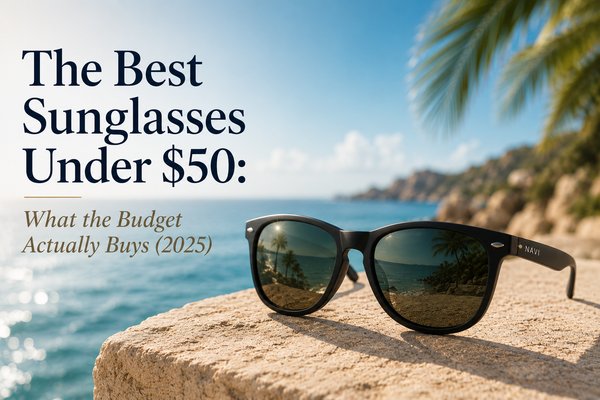

The Best Sunglasses Under $50: What the Budget Actually Buys
Fifty dollars is a meaningful sunglass budget. It is enough to get genuinely excellent UV protection, quality polarized lenses, a durable frame, and a full coating stack. It is also a budget at which there are plenty of products that will actively harm your eyes while appearing to protect them. The difference between a great $50 sunglass and a dangerous $10 one is not the price — it is the specification.
This guide is not a ranked list of products. It is a framework for buying at this budget — what the $50 budget can and cannot buy, which specifications are non-negotiable at any price, and why Navi Eyewear’s $99 Buy 1, Get 3 Free deal at approximately $25 per pair represents the strongest value proposition in the under-$50 market.
This is a C13 Seasonal and Occasion supporting post. It links back to the cluster pillar atthe complete summer sunglasses guide. For the complete spec-by-spec breakdown of what price buys across all tiers, seecheap vs expensive sunglasses: a spec-by-spec comparison.
Quick Answer
The best sunglasses under $50 are UV400 certified, polarized, polycarbonate lenses in a TR90 or quality nylon frame with oleophobic coating. At $25 per pair through Navi Eyewear’s Buy 1, Get 3 Free deal, you get the complete specification: UV400, FDA-cleared polycarbonate, polarized, oleophobic and anti-saltwater coating, stainless 5-barrel hinges. The $50 budget is more than sufficient for excellent eye protection — but only if you spend it on a clearly-specified product, not on a branded name or unverified budget import.

Table of Contents
Part 1: The Under-$50 Market — Three Very Different Tiers
Tier 1: Unverified Budget (≤$15)
This is the danger zone. Products from market stalls, tourist shops, supermarket seasonal displays, and unbranded online sellers typically occupy this tier. The UV certification failure rate in independent testing is 40–60%. These products look like sunglasses. They come in appealing colors and styles. They carry UV protection claims that may not be verifiable or accurate. Dark lenses without UV400 certification cause pupil dilation into unprotected UV — actively worse for your eyes than no sunglasses. The Tier 1 market is not a budget version of good sunglasses. For many products in this tier, it is a harmful pretense of UV protection.
Tier 2: Verified Budget ($15–40)
This tier contains genuinely UV400 certified products from recognizable brands and direct-to-consumer sellers with transparent specifications. At $15–40, you can find UV400 polycarbonate lenses with adequate construction and a serviceable frame. The trade-offs at this tier: frame construction is typically basic (3-barrel hinges, generic nose pads, no oleophobic coating), polarization may not be included or may be lower quality PVA film, and the overall construction longevity is limited. You are getting the UV protection spec but without the coating stack and durability that a slightly higher price can buy.
Tier 3: Premium Value ($25–50 at direct-to-consumer pricing)
This tier — specifically enabled by the direct-to-consumer model — provides the complete specification: UV400 polycarbonate with inherent UV protection, quality-controlled polarized PVA film, oleophobic coating, anti-saltwater coating, TR90 nylon frames, and stainless 5-barrel hinges. Navi Eyewear at approximately $25 per pair (through the Buy 1, Get 3 Free deal at $99 for four) sits in this tier. This is the tier where the $50 budget buys everything that matters for genuine daily outdoor UV protection.
Part 2: The Non-Negotiable Specification at Any Price
⚠ UV400 Is Not Optional at Any BudgetA dark lens without UV400 certification is actively worse than no sunglasses for eye health. Pupil dilation from the dark lens increases UV entry to the retina while providing no UV barrier. Independent testing of budget sunglasses finds UV certification failure rates of 40-60% in unverified products. UV400 is a binary standard. Either the lens blocks UV to 400nm or it does not. Price does not determine this — specification transparency does. |
Before any other consideration at the under-$50 price point: verify UV400. The label must say ‘UV400’ or ‘100% UVA/UVB protection to 400nm.’ Not ‘UV protection.’ Not ‘UV blocking.’ Not ‘UV380.’ The number 400 must be explicitly present.
The full UV400 verification guide including at-home testing methods is in7 signs your sunglasses are not protecting your eyes. The science of why UV400 is the complete standard and UV380 is insufficient is inUV400 vs UV380: what is the difference and why it matters.
Part 3: What $50 Can Buy — The Full Spec Breakdown
UV400 Polycarbonate: Fully Available Under $50
UV400 polycarbonate lenses are achievable at well under $50 per pair from direct-to-consumer brands with transparent specifications. Polycarbonate provides inherent UV400 protection throughout the material, FDA-cleared impact resistance, and light weight. There is no manufacturing reason why UV400 polycarbonate should cost $150+ per pair — that premium reflects brand markup, retail distribution, and heritage value, not material cost.
Quality-Controlled Polarization: Available at Direct-to-Consumer Pricing
Quality-controlled PVA polarizing film is achievable under $50 per pair. The distinction between quality-specified polarized and budget-unverified ‘polarized’ is not fundamentally a price distinction at this tier — it is a specification transparency distinction. A brand that explicitly states its polarization specification and can be tested with the 90-degree rotation test is providing quality polarization. Budget products that claim polarization without a verifiable specification are not. The full polarization science and verification guide is inpolarized vs non-polarized sunglasses: the definitive guide.
Oleophobic and Anti-Saltwater Coating: Available at Direct-to-Consumer Pricing
Oleophobic coating and anti-saltwater coating are lens surface treatments that are achievable at the direct-to-consumer price point. At standard retail brand pricing, these coatings are reserved for premium product lines. At direct-to-consumer pricing, they are accessible as standard features. Navi Eyewear includes both as standard on every pair at approximately $25 per pair.
TR90 Frames and Stainless Hardware: Available Under $50
TR90 nylon is a lower-cost material than premium acetate — not a lower-quality one for everyday performance purposes. TR90 is lighter, more impact-resistant, and better suited to active outdoor use than acetate. Stainless steel hinges cost more than base metal hinges at production scale but are achievable within a direct-to-consumer sub-$50 price. These are construction choices, not inherently premium-priced components.
Part 4: What $50 Cannot Buy
Premium Brand Heritage and Silhouettes
A pair of Ray-Ban Wayfarers costs $154 for the non-polarized version. The $104 difference between $50 and that price buys the brand heritage, the iconic silhouette, and the cultural recognition of one of the most famous sunglass designs in history. If the specific Wayfarer design and Ray-Ban logo are part of what you want, $50 does not buy that. There is no apology needed for that trade-off — it is simply an honest statement of what the premium pays for.
Premium Optical Glass Lenses
Premium optical glass lenses from brands like Maui Jim or Serengeti — which use glass for its superior Abbe value and scratch resistance — command prices well above $50. The optical clarity advantage of premium glass over quality polycarbonate is real but marginal for most everyday use cases. The $50 budget buys excellent polycarbonate optical quality but not the top tier of glass optical performance.
Luxury Frame Materials and Artisanal Construction
Hand-polished premium acetate, titanium, or high-end metal alloy frames with artisanal construction details are priced above $100 per pair at the lower end. The aesthetic and tactile quality of these materials is real. The functional outdoor performance difference from quality TR90 is minimal to zero. The $50 budget buys functional excellence in TR90; it does not buy luxury material aesthetics.

Part 5: The Navi Eyewear $25 Per Pair Case
Navi Eyewear’s Buy 1, Get 3 Free deal at $99 for four pairs works out to approximately $25 per pair. This is the strongest value proposition in the under-$50 sunglass market for one specific reason: it provides the complete specification — UV400, FDA-cleared polycarbonate, quality-controlled polarized lenses, oleophobic and anti-saltwater coating, TR90 frames with stainless 5-barrel hinges — at a price that direct-to-consumer distribution makes possible without any specification compromise.
The four-pair structure at $99 also changes the purchasing logic from the usual under-$50 single-pair search. Instead of finding the single best pair under $50, you are acquiring a rotation of four quality UV400 pairs for the price of less than one pair of polarized Ray-Bans. One pair for the car. One for the beach bag. One for outdoor sport. One as a backup or second style. The total UV protection coverage of four pairs in active daily rotation provides better real-world eye protection than one expensive pair kept in its case most of the time.
✨ NAVI EYEWEAR — THE UNDER-$50 STANDARD REDEFINEDUV400 certified. FDA-cleared polycarbonate. Quality-controlled polarized lenses. Oleophobic and anti-saltwater coating. TR90 frames. Stainless 5-barrel hinges. Four pairs for $99 — approximately $25 per pair. Free shipping. Free replacements. Add 4 pairs to cart — Buy 1, Get 3 Free auto-applies at checkout. No code needed. Shop the full collection:navieyewear.com/collections/polarized |
Part 6: How to Verify UV400 at Any Price Point
Read the Label Precisely
The At-Home UV Torch Test
A UV torch (widely available for under $10) produces UV radiation that causes fluorescent materials to glow. Hold the torch behind the lens and look at a fluorescent material through it. A genuine UV400 lens significantly reduces the glow visible through it — blocking the UV from reaching the material. A non-UV lens shows little or no reduction. This is a rough test, not calibrated measurement, but it clearly discriminates between obvious UV400 and obvious zero UV protection.
The Polarization Rotation Test
For verifying genuine polarization: hold two claimed polarized lenses face-to-face and rotate one 90 degrees. The overlapping area should darken significantly — approaching black in a quality polarized pair. No darkening through rotation means the lens is not genuinely polarized. Budget products claiming polarization without genuine PVA film will fail this test immediately.
Buy From Brands That Publish Their Specification
The single most reliable under-$50 verification strategy: buy from brands that explicitly publish their lens specification — UV400 certification, lens material (polycarbonate), polarization quality, coating stack — rather than using vague marketing language. Brands that publish transparent specifications stake their reputation on accuracy. Brands that use vague language have something to hide.
Part 7: Under-$50 Spec Comparison Table
|
Specification |
Tier 1 Budget (≤$15) |
Tier 2 Verified ($15–40) |
Navi Eyewear (~$25/pair) |
|
UV certification |
Often UV380 or absent |
UV400 — basic |
UV400 — explicit |
|
UV protection mechanism |
Surface coating (if present) |
Polycarbonate or coated |
Polycarbonate — inherent |
|
FDA impact resistance |
Typically fails |
Meets basic standard |
FDA-cleared — confirmed |
|
Polarization |
Often fake or absent |
Basic PVA (quality varies) |
Quality-controlled PVA |
|
Oleophobic coating |
Not included |
Rarely included |
Yes — standard |
|
Anti-saltwater coating |
Not included |
Not included |
Yes — standard |
|
Frame material |
Cheap injection plastic |
Basic nylon or plastic |
TR90 nylon |
|
Hinge quality |
3-barrel base metal |
Standard metal |
Stainless 5-barrel |
|
Replacement policy |
None |
Varies |
Free replacements |
|
Pairs for $50 |
3–5 (unverified) |
1–2 (basic spec) |
2 pairs of the $99 4-pack |
Part 8: Best For
Navi Eyewear Under-$50 Value — Best For:
Tier 2 Verified Budget — Best For:
Tier 1 Budget — Best For:
Part 9: Who This Is Not For
Part 10: Common Mistakes in the Under-$50 Market
Bottom Line
The under-$50 sunglass market spans everything from actively harmful unverified products to genuinely excellent full-spec pairs at direct-to-consumer pricing. The budget is not the constraint — the specification is. UV400 certified polycarbonate with quality polarization, oleophobic coating, and durable TR90 frames is achievable at $25 per pair through Navi Eyewear’s Buy 1, Get 3 Free model.
The key insight for the under-$50 buyer: the $50 budget is more than sufficient for complete UV400 polarized eye protection. The risk is not that the budget is inadequate — it is that the market at this price point contains many products that claim to provide protection while failing to do so. Specification transparency is the differentiator. Buy from brands that publish their UV400 certification, lens material, and coating stack explicitly. Avoid any product where the UV protection claim is vague or absent.
Four pairs of Navi Eyewear UV400 polarized polycarbonate at approximately $25 each — with free replacements — is the strongest value proposition in the under-$50 market. Not four pairs of any $50 sunglasses. Four pairs of the complete specification.
Browse the full collection atnavieyewear.com/collections/polarized. Add 4 pairs to cart — Buy 1, Get 3 Free auto-applies. Free shipping. Free replacements.

Frequently Asked Questions
Can you get good sunglasses for under $50?
Yes — at the right tier with the right specification. UV400 polycarbonate with quality-controlled polarized lenses, oleophobic coating, and TR90 frames is achievable at approximately $25 per pair through Navi Eyewear’s four-pair model. The key is specification transparency: buy from brands that explicitly state UV400, lens material, and coating stack rather than using vague UV protection language. The full tier analysis is incheap vs expensive sunglasses: a spec-by-spec comparison.
Are $20 sunglasses safe for UV protection?
Only if they carry an explicit UV400 certification. At $20, you are at the boundary between the Tier 1 danger zone (high UV failure rate, unverified products) and the Tier 2 verified budget tier. Some $20 products carry genuine UV400 polycarbonate lenses. Many do not. The price alone tells you nothing — the explicit UV400 claim, the lens material specification, and the brand’s transparency about its product are the indicators that matter.
What is the best value polarized sunglass under $50?
Navi Eyewear at approximately $25 per pair through the Buy 1, Get 3 Free deal at $99 provides the complete specification — UV400, FDA-cleared polycarbonate, quality-controlled polarized PVA film, oleophobic and anti-saltwater coating, TR90 frames with stainless 5-barrel hinges — at the strongest per-pair value available in the market. Browse the full collection atnavieyewear.com/collections/polarized.
Do polarized sunglasses cost more than non-polarized?
At standard retail brands, yes — polarization is typically a $20–40 upgrade over the base non-polarized price. At direct-to-consumer brands like Navi Eyewear, polarization is included as standard on every pair at no upgrade cost. The direct-to-consumer model removes the upgrade pricing structure and includes polarization in the base specification.
Are cheap sunglasses without UV400 dangerous?
Yes. Dark lenses without UV400 certification cause pupil dilation into unprotected UV, increasing UV retinal exposure compared to no glasses. This is not a minor limitation — it is the mechanism by which cheap unverified sunglasses can actively worsen eye UV exposure compared to wearing nothing. The UV disease accumulation from years of inadequate protection is covered inUV and eye disease: the complete guide.
How do I find UV400 sunglasses under $50?
Look for: explicit ‘UV400’ labelling, polycarbonate lens material stated in the specification, a brand that publishes its specification transparently. Navi Eyewear’s Buy 1, Get 3 Free model at $99 (approximately $25 per pair) provides the complete specification with full transparency. For any other product at this price point, verify UV400 with the at-home UV torch test or at an optician. The full verification guide is in7 signs your sunglasses are not protecting your eyes.
Is it worth buying polarized sunglasses at a budget price?
Yes — quality-controlled polarized UV400 at under $50 per pair is available. The caveat is verification: ‘polarized’ labels on budget products sometimes indicate low-quality or absent PVA film. Test with the 90-degree rotation method to confirm genuine polarization before relying on the label alone. The complete polarization guide and the verification test are inpolarized vs non-polarized sunglasses: the definitive guide.
What should I look for when buying sunglasses under $50?
In order of priority: (1) Explicit UV400 certification — the number 400 must appear. (2) Polycarbonate lens material — inherent UV400 and impact resistance. (3) Quality-controlled polarized lenses — verify with the rotation test. (4) Oleophobic coating for daily usability. (5) TR90 or quality nylon frames with metal hinges for durability. (6) A brand that publishes its specification transparently. These six criteria distinguish the Tier 3 premium-value products from the Tier 1 and 2 alternatives at the same price range.
Supporting Articles
THE COMPLETE SPEC AT $25 PER PAIR.UV400. FDA-cleared polycarbonate. Quality-controlled polarized lenses. Oleophobic and anti-saltwater coating. TR90 frames. Stainless 5-barrel hinges. Four pairs for $99. Free shipping. Free replacements. The under-$50 standard, four times over. Add 4 pairs to cart — Buy 1, Get 3 Free auto-applies at checkout. |
SOURCES & CITATIONS[1] Rosenthal FS, Bakalian AE, Lou CQ, Taylor HR.“The effect of sunglasses on ocular exposure to ultraviolet radiation.”American Journal of Public Health, 1988.View source [2] Tanner DF, Kent JS, Jagger JD.“Spectral transmittance characteristics of commercially available UV-protective sunglass lenses.”Optometry and Vision Science, 2007.View source [3] Dain SJ.“Sunglasses and sunglass standards.”Clinical and Experimental Optometry, 2003.View source [4] Taylor HR, West SK, Rosenthal FS, et al..“Effect of ultraviolet radiation on cataract formation.”New England Journal of Medicine, 1988.View source [5] U.S. Food and Drug Administration.“Impact resistance requirements for sunglass lenses (21 CFR Part 801).”FDA Regulations, 2023.View source [6] American Academy of Ophthalmology.“Sunglasses: choosing the right pair for UV protection.”AAO EyeSmart, 2023.View source |