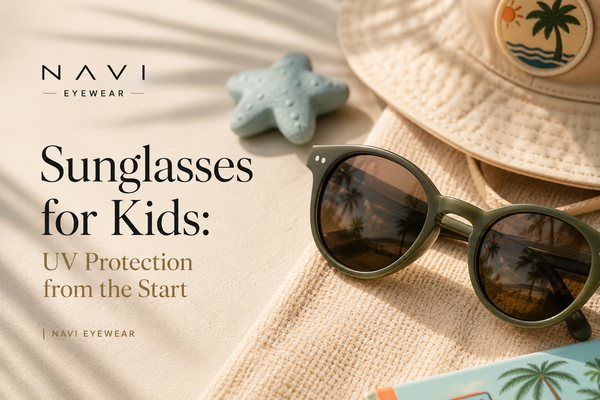

Sunglasses for Kids: UV Protection from the Start
Children spend significantly more time outdoors than most adults. They play outside for hours at a time, in the middle of the day, during the highest-UV seasons, often without hats or shade. And their eyes are anatomically more vulnerable to UV than adult eyes — a fact that makes childhood one of the most critical periods for ocular UV protection, and one of the most consistently unprotected.
This guide covers the biology of why children's eyes need protection more urgently than adults', what to look for in children's sunglasses at every age, what to avoid, and how to build UV protection as a normal habit from early childhood rather than an occasional holiday consideration.
This is a C7 Lifestyle and Travel supporting post. For the broader UV science that underpins the children's eye health case, seethe complete guide to UV eye protection. For adults over 40 where decades of cumulative exposure begin to show consequences, seesunglasses after 40: how your eye protection needs change with age.

Why Children's Eyes Are More UV-Vulnerable Than Adults'
The Transparent Lens Problem
The human crystalline lens — the flexible structure inside the eye that focuses light on the retina — becomes progressively more UV-absorbent with age. In adults over 25, the lens absorbs a significant proportion of UV before it reaches the retina, providing a degree of natural ocular UV protection. In children under 10, the crystalline lens is substantially more transparent, transmitting a much higher proportion of incident UV directly to the retina. Research by Boettner and Wolter (1962) established that the lens of a ten-year-old transmits approximately twice as much UV to the retina as the lens of a 25-year-old. This means that at the same outdoor UV exposure level, a child's retina receives a substantially higher UV dose than an adult's — a biological disadvantage that is entirely addressable through quality UV-certified sunglasses.
Cumulative Damage Begins Early
UV eye damage is cumulative and irreversible. Every hour of unprotected UV exposure in childhood adds to the lifetime burden that drives cataract formation and macular degeneration in later life. Research suggests that a significant proportion — some estimates place it above 50% — of lifetime ocular UV exposure occurs before the age of 18, because of the combination of higher outdoor time, higher UV transmission to the retina, and lower protection use during childhood. The UV habits established in childhood therefore have a disproportionate influence on long-term eye health outcomes.
Pupil Size
Children's pupils are on average larger than adults' in comparable light conditions, allowing more light — including UV — to enter the eye. Combined with the more transparent crystalline lens, this creates a compounding vulnerability: more UV enters the eye, and more of what enters reaches the retina. Quality UV400 certified sunglasses address this directly by blocking the UV before it enters the eye entirely.
Age-by-Age Guide: What Children Need at Each Stage
|
Infants and Toddlers (0–2 years) Frame spec: Flexible rubber frames with soft nose bridge; wraparound design; elasticated strap to keep on Lens spec: UV400 certified; polycarbonate lenses; no sharp edges Watch out for: Any lens or frame sharp enough to cause eye or facial injury if the child falls
Infant and toddler sunglasses face the unique challenge that the child will actively resist wearing them, will remove them immediately, and may damage them or injure themselves if the frames are rigid or have sharp components. Flexible rubber frames — designed to bend rather than break — are the safest material choice. Elasticated head straps keep the pair on during pram and buggy time. UV400 certification is essential but the priority is a pair the child will actually keep on — comfort and retention geometry matter as much as specification. At this age, reducing outdoor UV exposure through shade and timing (avoiding peak UV hours of 10am–4pm) supplements sunglasses use effectively. |
|
Preschool (3–5 years) Frame spec: Flexible but more structured frames; rubberised grip; child-specific sizing Lens spec: UV400 polycarbonate; polarized if available in suitable size; impact-resistant Watch out for: Adult-sized frames that slide down constantly; cheap fashion frames without UV certification
At preschool age, children are active enough outdoors that sunglasses need to stay in place during movement — running, climbing, playground use. Rubberised nose pads and temple tips provide grip that smooth plastic cannot. Child-specific sizing is important: adult frames that are too wide slide down, providing reduced coverage and constant annoyance. The most important specification remains UV400 certification — which must be explicitly verified, not assumed from darkness of tint. Polarization is beneficial at this age for reducing glare discomfort, though the available range in child sizes is more limited than in adult sizes. |
|
School Age (6–12 years) Frame spec: More choice available; quality TR90 or acetate; secure-fitting; sports wrap for active children Lens spec: UV400 polycarbonate; polarized recommended; scratch-resistant coating essential Watch out for: Fashion-only purchases without UV certification; very dark lenses without UV400
School-age children benefit from the same specification priorities as adults, applied to appropriately sized frames. UV400 polycarbonate is the lens specification, with polarization strongly recommended for outdoor sport and beach use. Scratch-resistant coating is particularly important for children's lenses given the handling they receive. At this age, children begin to have stronger aesthetic preferences — a pair they find cool or that matches a favourite colour is far more likely to actually be worn than a purely utilitarian pair. The protective outcome depends entirely on consistent wear, so a pair the child is genuinely enthusiastic about serves the health goal better than an optimal pair that sits unused. |
|
Teenagers (13–17 years) Frame spec: Adult-sized frames in smaller dimensions; trend-aware; style matters significantly Lens spec: UV400 polycarbonate polarized; same standard as adult pairs Watch out for: Fashion-first purchases without UV verification; treating style as incompatible with protection
Teenagers are both capable of adult-standard UV awareness and strongly motivated by peer aesthetics — a combination that creates an opportunity and a challenge. The opportunity: teenagers can understand the UV case in full and make genuinely informed decisions about eye protection. The challenge: a pair perceived as uncool will not be worn, regardless of specification quality. The practical approach is to treat the teenager's aesthetic preferences seriously and find pairs that meet both UV400 polarized certification and the style requirements that will make consistent wear likely. The face shape guide and style framework inthe ultimate sunglasses style guide applies to teenagers as fully as to adults. |
What to Look For: The Children's Sunglass Checklist
Non-Negotiable: UV400 Certification
UV400 certification must be explicitly stated on the lens, tag, or packaging — not inferred from lens darkness. The children's eyewear market has a particular problem with fashion-forward designs that prioritise colourful frames and mirror coatings without verifying or disclosing UV protection standards. A mirrored coloured lens on a cheap children's pair may provide no UV protection whatsoever while looking impressively dark and reflective. Verify the UV400 claim specifically before buying any children's sunglasses. The verification approach is the same as for adult pairs — the 7-sign checklist at7 signs your sunglasses are not protecting your eyes applies fully to children's pairs.
Lens Material: Polycarbonate Only
For children's sunglasses, polycarbonate is the only appropriate lens material. It is impact-resistant — it bends before shattering, unlike glass or some plastic formulations — and provides inherent UV protection throughout the lens material that is unaffected by scratching. Children's lenses receive far more physical abuse than adults', and a lens that can survive being dropped on hard surfaces and stepped on is a meaningful safety consideration alongside UV protection.
Frame Durability and Safety
Children's frames should be flexible rather than rigid — TR90 nylon or rubber-based materials that bend under impact rather than breaking into sharp fragments. Hinges should be spring-loaded or flexible to survive the repeated grabbing and twisting children apply to frames. Sharp metal temple tips are not appropriate for young children's eyewear. Safety certification standards for children's eyewear (EN ISO 12312-1 in Europe, ANSI Z80.3 in the US) are worth checking for any pair marketed to children.
Fit and Retention
Children's sunglasses must fit the child's face, not approximate an adult fit scaled down. Frames that are too wide slide off the nose, leaving the orbital area exposed and making the child less likely to wear them willingly. For active children, adjustable elastic straps at the temples provide much better retention than standard temple arms during running and playground use. Check that the frame covers the full orbital area — gaps above the frame or at the sides undermine protection in the same way they do for adult pairs.
Building the Habit: UV Protection From Childhood
The most effective single intervention for children's long-term ocular UV health is establishing sunglasses use as a normal, automatic outdoor habit from as early as possible — ideally from infancy. Children who grow up wearing sunglasses as a default outdoor behaviour treat it as natural rather than as an imposition. Children who are introduced to sunglasses later, particularly in the socially self-conscious teenage years, have a much lower adoption rate.
The Role of Parental Modelling
Children learn outdoor habits primarily from observation. Parents who consistently wear sunglasses outdoors normalise the behaviour for their children far more effectively than instruction alone. The most powerful intervention for establishing childhood UV protection habits is the parent wearing their own quality pair consistently — making it visible that sunglasses are what adults do outdoors, not just something occasionally applied at the beach.
Making It Appealing
For young children, letting them choose their own pair from an appropriate selection dramatically increases willingness to wear them. The pair they chose themselves is the pair they are most likely to keep on. For teenagers, the aesthetic case matters even more — a pair that aligns with their style identity will be worn; a pair that does not will be left at home regardless of quality.
For the gift perspective on children's sunglasses — how to choose a pair for a child whose specific preferences you may not know — seethe ultimate sunglasses gift guide, which includes a specific children's recipient card. Browse theNavi Eyewear UV400 polarized collectionfor pairs meeting the adult specification above — for teenagers who have reached adult face dimensions, these are appropriate choices.
Frequently Asked Questions
At what age should children start wearing sunglasses?
From as early as possible — ideally from infancy. There is no minimum age below which UV protection is unnecessary. Children's crystalline lenses are highly UV-transparent from birth, making UV exposure to the retina higher proportionally than at any other life stage. Flexible rubber infant frames with elasticated straps are available from most baby and children's eyewear specialists. The primary challenge with very young children is retention — finding a design that stays on during outdoor time.
How do I know if children's sunglasses are genuinely UV400?
The same way as for adult pairs: look for 'UV400' or '100% UVA/UVB protection to 400nm' explicitly stated on the lens, tag, or packaging. Do not assume UV protection from mirror coatings, tint darkness, or price. Children's fashion eyewear has a particularly poor track record on this — colourful mirrored designs often carry no UV certification despite looking impressively protective. If the UV claim is not explicit, treat the pair as uncertified. The full verification approach is in7 signs your sunglasses are not protecting your eyes.
Are children's eyes more sensitive to UV than adults'?
Yes — significantly so. The crystalline lens in children's eyes is substantially more transparent to UV than in adults, allowing more UV to reach the retina. Research indicates that a ten-year-old's lens transmits approximately twice as much UV to the retina as a 25-year-old's. Combined with larger average pupil size and more hours spent outdoors, children receive a higher effective UV dose per hour of outdoor exposure than adults in the same conditions.
What frame material is safest for children's sunglasses?
TR90 nylon or rubber-based flexible materials. These bend under impact rather than shattering into sharp fragments, which is the primary safety consideration for children's eyewear where falls, drops, and impact are routine. Avoid rigid metal frames with sharp temple tips for young children. Spring-loaded hinges that flex and return to position survive the twisting and grabbing that children routinely apply to frames far better than standard hinges.
Should children's sunglasses be polarized?
Recommended where available in appropriate child sizes. Polarized lenses reduce the glare that makes bright outdoor conditions uncomfortable for children, and children who are more comfortable visually are more likely to keep their sunglasses on. The available range of polarized lenses in children's sizes is more limited than in adult sizes, but is growing. If polarization is available in a pair that also meets the fit and UV400 requirements, it is worth choosing. The case for polarization in outdoor environments is inpolarized sunglasses: are they worth it.
How do I get my child to actually wear sunglasses?
Three approaches work best in combination: start early (children who have worn sunglasses from infancy treat them as normal outdoor equipment rather than an imposition), let them choose (a pair they selected themselves is far more likely to be worn willingly than one chosen entirely by a parent), and model the behaviour (children who consistently see their parents wearing sunglasses outdoors normalise the habit from observation). For reluctant children, framing sunglasses as protective gear like a helmet — something cool that protects you — rather than as medical equipment tends to be more effective.
How long should children's sunglasses last?
Typically one to two years in practice, driven by face growth requiring a larger size rather than product failure — though children's frames do receive significantly more physical abuse than adult frames. Buying at a moderate quality level rather than the cheapest available is worthwhile: a pair that survives a full active season and keeps its UV certification intact is worth more than a pair that loses structural integrity or coating quality within months. Annual checking of UV certification and frame condition at the start of each outdoor season is a sensible practice.
SOURCES & CITATIONS[1] Boettner EA, Wolter JR."Transmission of the ocular media."Investigative Ophthalmology and Visual Science, 1962.View source [2] Sliney DH."UV radiation ocular exposure dosimetry."Documenta Ophthalmologica, 1994.View source [3] Taylor HR, West SK, Rosenthal FS, et al.."Effect of ultraviolet radiation on cataract formation."New England Journal of Medicine, 1988.View source [4] Coroneo MT, Muller-Stolzenburg NW, Ho A."Peripheral light focusing by the anterior eye and the ophthalmohelioses."Ophthalmic Surgery, 1991.View source [5] World Health Organization."Protecting children from ultraviolet radiation."WHO Fact Sheet, 2022.View source [6] American Academy of Ophthalmology."Sunglasses: protecting your eyes from UV radiation."AAO EyeSmart, 2023.View source |