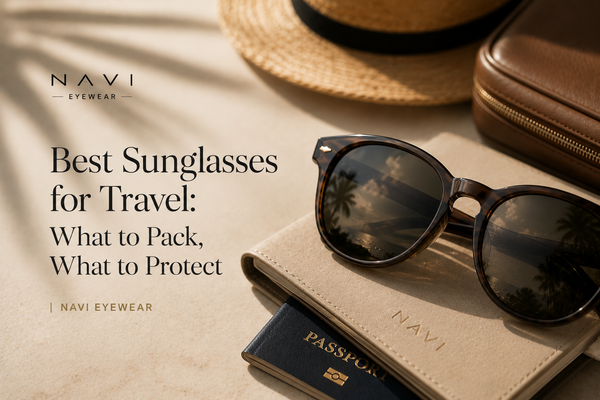

Best Sunglasses for Travel: What to Pack, What to Protect
Travel changes the sunglasses equation in ways most people do not fully account for. Your home environment has a UV profile you are roughly calibrated to. Travel introduces unfamiliar UV levels — higher latitudes, higher altitudes, reflective environments you do not encounter at home — often without the awareness that you are moving into a higher-risk environment. It also introduces practical complications: luggage handling, airport security, climate transitions, and the heightened consequences of losing or breaking a pair far from home.
This guide covers the destination-by-destination UV reality, how to pack and protect sunglasses for travel, the prescription traveller question, and the specific practical considerations that make travel eyewear different from everyday eyewear.
This is a C7 Lifestyle and Travel supporting post. For the complete lifestyle sunglasses framework, seethe complete lifestyle sunglasses guide. For the UV science that explains why different destinations require different protection, seethe complete guide to UV eye protection.

Why Travel UV Levels Are Often Higher Than You Expect
Latitude and UV Index
UV intensity varies significantly with latitude. At the equator, UV Index values regularly reach 11–13 (extreme) in summer. In northern Europe, the summer UV Index peaks at 6–8 (high). A traveller from the UK or northern Europe arriving in a tropical destination is moving from a UV level of 6 to a UV level of 11+ — an increase that is not subjectively obvious in the first day or two but that represents a meaningful jump in UV dose per hour of exposure.
Altitude
UV intensity increases by approximately 10–12% per 1,000 metres of elevation. A mountain city break at 1,500–2,500 metres — common in destinations across the Alps, Andes, Rockies, and Himalayas — delivers 15–30% higher UV than at sea level in the same latitude. This is before accounting for reflective surfaces. The altitude UV mechanism is explained in the context of hiking inbest sunglasses for hiking and outdoor adventures.
Reflective Surfaces at Destination
Beach destinations combine high UV Index with significant water reflection — up to 25% of UV reflected from the sea surface back toward the face. Ski destinations combine altitude UV with snow reflection of up to 80–90% of UV. Both environments amplify UV beyond what the direct-sky UV index suggests, creating effective UV exposure levels that can exceed the labelled UV Index by a significant factor.
Destination by Destination: What to Pack
|
Tropical Beach Holiday UV risk: Very High — UV Index 10–13, plus 15–25% water reflection Recommended tint: Gray polarized + mirror coating — maximum glare elimination and brightness reduction Key extra: Salt-resistant frame and hydrophobic coating
Tropical beach holidays represent the highest everyday UV environment most people encounter. Equatorial UV combined with open ocean reflection requires: UV400 certification as the absolute baseline, polarization for water surface glare, a mirror coating for additional brightness reduction in very high-intensity conditions, a salt-resistant frame (TR90 or marine-grade acetate) and hydrophobic lens coating. The specific beach specification including salt-resistance and hydrophobic coating importance is covered in depth inbest sunglasses for the beach: UV400, polarized and salt-resistant. |
|
Ski and Alpine Winter Holiday UV risk: Very High — altitude UV amplified by 80–90% snow reflection Recommended tint: Amber or brown polarized + mirror — Category 3; goggles for skiing, sunglasses for town Key extra: Wraparound coverage; goggles for on-slope use
Ski holidays deliver some of the highest UV doses of any recreational activity. The combination of altitude (typically 1,500–3,500 metres, adding 15–40% to UV intensity) and snow reflection (80–90% UV reflectance) creates a total UV environment that significantly exceeds the direct UV Index alone. For on-slope use, ski goggles with UV400 certification and appropriate lens category provide full coverage and impact protection. For use in ski villages and mountain restaurants, a quality wraparound polarized sunglass in amber or brown is appropriate — the amber tint enhances contrast for navigating snow terrain. Seewinter sunglasses: why UV protection does not stop in cold weather for the full winter UV picture. |
|
City Break — European or Mediterranean UV risk: Moderate to High — UV Index 5–9 depending on season and latitude Recommended tint: Gray polarized — all-round performance for sightseeing and driving Key extra: Versatility and style — city breaks involve mixed indoor-outdoor transitions
European city breaks present a more moderate UV environment than beach or alpine holidays, but still significantly higher than the home UV levels of northern European travellers. A quality gray polarized UV400 pair in a style you are comfortable wearing all day — on foot, in outdoor cafes, sightseeing — is the right specification. The city break context is also where style matters most alongside function: you will be wearing the pair in restaurants, markets, and cultural sites where the aesthetic dimension of the frame matters. The style framework for choosing a pair that works in both functional and social contexts is inthe ultimate sunglasses style guide. |
|
Long-Haul Flight UV risk: Very High at altitude — UV at cruising altitude (35,000 ft) is 2–3× surface level Recommended tint: Gray polarized — or remove for cabin comfort Key extra: Sunglasses in hand luggage; hard case essential for aircraft overhead bins
UV intensity at commercial aircraft cruising altitude is significantly higher than at sea level — approximately 2–3× the surface UV for the same latitude, because the atmosphere is thinner at altitude and provides less UV attenuation. Window seats expose the eye to direct sunlight and reflected cloud UV at intensities that can exceed typical surface UV levels. For window-seat travellers on long-haul routes, wearing sunglasses during daylight flight sections provides meaningful UV protection that is rarely considered. The practical priority for sunglasses during flight is protection in hand luggage: overhead bins subject items to pressure, movement, and other luggage, making a hard case non-negotiable for any pair worth protecting. |
Packing and Protecting Sunglasses for Travel
Always in Hand Luggage
Checked baggage subjects sunglasses to temperatures that can exceed 60°C in cargo holds, pressure changes, and physical impact from other bags. A quality pair of sunglasses should always travel in hand luggage in a hard case. The hard case protects against overhead bin compression and casual contact with other items in your bag. Never pack quality sunglasses in checked luggage without a rigid case, and even then the risk of thermal and physical damage is higher than in-cabin.
The Hard Case Is Not Optional
Travel is the context where the hard case's importance is most acute. At home, sunglasses can be placed carefully on a dedicated surface. In a bag moving through an airport, on a plane, in a car, and in a hotel room, that careful placement is impossible to maintain. A hard case takes one second to use and eliminates the risk of frame warping, lens scratching, and physical breakage from contact with keys, chargers, and other travel items. The full storage guidance is inthe complete sunglasses care and maintenance guide.
Airport Security
Sunglasses are a security-check-friendly item — they do not require removal during standard security screening. Place them in the hard case, which can go in your bag through the X-ray. If you prefer to wear them through security (in active-lens environments like very bright airports), they are typically fine to wear through the scanner. The risk of damage during security comes from placing them loose in a tray — always keep them in the case when they are not on your face in a security queue.
Climate Transitions
Rapid climate transitions — stepping from an air-conditioned aircraft into tropical heat, or from warm sunshine into a cold mountain cabin — create temporary fogging and condensation on lenses that is not a quality issue but an atmospheric one. Allow lenses to acclimatise before wiping them. Wiping condensed-moisture lenses immediately produces smearing that requires a proper clean to resolve. Give the lenses 30–60 seconds to stabilise before any cleaning attempt.
The Prescription Traveller: Managing Eyewear Abroad
Contact Lens Wearers
The most flexible solution for prescription travellers. Contact lens wearers can use any non-prescription sunglasses, giving them full access to the quality polarized UV400 range without prescription constraints. The only travel-specific consideration is adequate lens solution supply for the trip duration — airport restrictions on liquid volumes mean packing solution in checked luggage or buying at the destination.
Glasses Wearers: The Main Options
Prescription glasses wearers have several options for travel sun protection: prescription polarized sunglasses (the best-performing but most expensive option), high-quality clip-on polarized UV400 adapters for existing frames (a practical compromise), OTG (over-the-glasses) sunglasses that fit over prescription frames (functional but bulky), or switching to contact lenses specifically for the trip. For frequent travellers who wear glasses, prescription polarized sunglasses represent the best investment. The full options breakdown including the OTG and clip-on analysis is inhow to layer eyewear: sunglasses, goggles and prescription lenses.
The Lost Prescription Glasses Contingency
Losing prescription glasses abroad is a genuine travel emergency. For travellers who rely on glasses, packing a copy of the current prescription in a separate location from the glasses themselves allows emergency replacement abroad. Most destinations with decent optical services can produce basic prescription lenses within 24–48 hours from a written prescription. An up-to-date prescription stored digitally (photographed and saved to cloud storage) is accessible anywhere.
The Travel Pair vs the Everyday Pair
One practical consideration for regular travellers: whether to use your everyday pair for travel or to maintain a separate travel pair. Arguments for the same pair: you know the fit, it is already broken in, and you have one fewer thing to manage. Arguments for a separate travel pair: travel puts pairs through more physical risk (luggage, unfamiliar environments, salt water, sand) and the loss or breakage risk is higher than at home. A pragmatic approach: for high-risk beach or activity holidays, travel with a pair you would be less devastated to lose or damage. For city breaks and lower-risk travel, your everyday pair is fine. Thelost sunglasses replacement guide covers what to do when you lose a pair mid-trip.
Browse theNavi Eyewear UV400 polarized collection for travel-ready polarized sunglasses suited to the full range of travel environments above.
Frequently Asked Questions
What sunglasses should I bring on holiday?
UV400 polarized as the baseline — this applies regardless of destination. Beyond that: mirror coating if going to a tropical beach or ski destination; salt-resistant TR90 frame and hydrophobic coating for any beach holiday; amber or brown tint for alpine or ski destinations; gray polarized for city breaks and general travel. Always pack in a hard case in hand luggage. For the destination-specific breakdown, see the destination cards above or the complete lifestyle guide atthe complete lifestyle sunglasses guide.
Is UV stronger on holiday than at home?
Usually yes, often significantly so. Travel to lower latitudes (closer to the equator), higher altitudes, or environments with high reflective surfaces (beaches, snowfields) routinely delivers UV levels 2–5× higher than the traveller's home environment. Most people do not adjust their sun protection habits to account for this, which is why travel is a higher UV-exposure period than the UV index alone suggests.
Should I buy sunglasses at my destination or bring them from home?
Bring from home. Destination holiday eyewear — tourist kiosks, resort shops, airport outlets — is typically the worst-value combination available: premium location pricing for low-specification product. UV protection failure rates are high, optical quality is variable, and you have no meaningful way to verify specification at a beach kiosk. Bringing a quality pair from home eliminates all of these risks and typically costs less than destination purchases even at a quality price point.
Can I take sunglasses through airport security?
Yes — sunglasses do not require removal during standard airport security screening. Keep them in their hard case inside your bag through the X-ray scanner. Do not place them loose in a security tray where they are at risk of other items being placed on top of them and of physical impact during the process. If wearing them through the scanner, they typically pass through without issue.
What should I do if I lose my sunglasses on holiday?
Avoid buying from tourist kiosks or beach vendors — see above. If at a resort or major tourist destination, look for an optician (often present in larger towns and resort cities) who stocks quality polarized pairs. In a pinch, a pharmacy or supermarket may have better-specified pairs than tourist outlets. For the complete lost-sunglasses replacement protocol — what to look for, how to verify UV quickly in an unfamiliar store, and what to do for the rest of the trip — seelost your sunglasses? the replacement guide.
Are prescription sunglasses worth getting for travel?
For frequent travellers who wear glasses, yes — prescription polarized sunglasses are the most comfortable and highest-performing solution for travel sun protection. The investment is significant (typically £150–400 / $190–500 for quality prescription polarized lenses in a suitable frame) but amortises well across multiple trips. For occasional travellers, quality clip-on polarized adapters or contact lenses for the trip are more cost-effective alternatives.
Do I need different sunglasses for skiing versus beach holidays?
The ideal pair differs. Beach: gray or amber polarized, salt-resistant frame, hydrophobic coating, Category 3. Ski: amber or brown polarized with mirror, wraparound coverage, Category 3, and consider ski goggles for on-slope use. In practice, a single well-specified gray polarized pair serves adequately for both if you do not want to maintain two specialist pairs. On-slope skiing benefits from goggles regardless, so sunglasses for ski holidays are primarily for off-slope use where a standard sunglass format is more practical.
SOURCES & CITATIONS[1] Sliney DH."UV radiation ocular exposure dosimetry."Documenta Ophthalmologica, 1994.View source [2] Perugini P, Vettor M, Rona C, et al.."Efficacy of sunscreens in protecting the ocular area of mountaineers."Dermatology, 2002.View source [3] Moehrle M."Ultraviolet exposure in the Ironman triathlon."Medicine and Science in Sports and Exercise, 2001.View source [4] Rosenthal FS, Phoon C, Bakalian AE, Taylor HR."The ocular dose of ultraviolet radiation to outdoor workers."Investigative Ophthalmology and Visual Science, 1988.View source [5] World Health Organization."Solar ultraviolet radiation: global burden of disease from solar ultraviolet radiation."WHO Environmental Burden of Disease Series, 2006.View source [6] Dain SJ."Sunglasses and sunglass standards."Clinical and Experimental Optometry, 2003.View source |