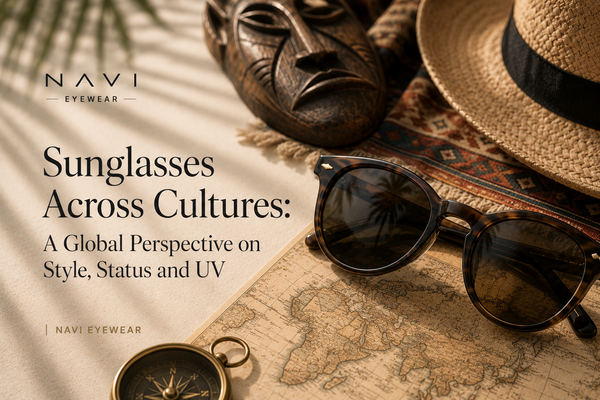

Sunglasses Across Cultures: A Global Perspective on Style, Status and UV
A pair of sunglasses means different things depending on where you wear them. In some cultures, they are a status signal — an object whose brand and style communicate social position as precisely as clothing. In others, they are a practical tool worn without self-consciousness by anyone who needs them. In others still, they carry social meanings around concealment, formality, and the appropriateness of hiding one's eyes in certain contexts. And in many places, the question of UV protection — so central to eyewear in the English-speaking world — barely registers as a consideration.
This post explores how sunglasses function as cultural objects across different regions — the style identities they carry, the UV environments they operate in, and what the global variation in sunglass culture reveals about how we use objects to communicate who we are.
This is a C7 Lifestyle and Travel supporting post. For the historical development of how sunglasses acquired their cultural weight, seea century of cool: the history of sunglasses and style evolution. For the psychology of why sunglasses function as identity signals, seethe psychology of sunglasses: why we love them beyond sun protection.

Italy and Southern Europe: The Birthplace of Modern Eyewear Culture
|
Italy Cultural identity signal: Craft heritage, la bella figura, understated luxury — eyewear as the definitive accessory UV context: High UV in the Mediterranean south; outdoor café culture creates year-round sunglass use
Italy is not just a major manufacturer of quality eyewear — it is the culture that most fully integrated sunglasses into everyday style as a non-negotiable element of personal presentation. The concept of la bella figura — the obligation to present oneself well in public — means that eyewear is approached with the same seriousness as clothing. In Italian culture, the sunglasses you wear communicate aesthetic sensibility and social awareness as legibly as the rest of your outfit. The Cadore region of northern Italy, centred on Belluno and Agordo, has been the geographic heart of Italian eyewear manufacturing since the early 20th century — a concentration of craft skill and material suppliers that produced the acetate frame traditions now considered definitive in premium eyewear globally. Italian sunglass style tends toward: quality acetate in classic shapes (oval, round, cat-eye), understated colour palettes, and minimal branding — the quiet confidence of a culture that invented the aesthetic rather than following it. |
|
France Cultural identity signal: Editorial fashion authority, intellectual chic — sunglasses as the punctuation mark of an outfit UV context: Moderate Mediterranean UV in the south; primarily aesthetic rather than functional sunglass culture in northern cities
French sunglass culture is shaped by Paris's role as the global capital of fashion editorial — the city where what is photographed becomes what is worn everywhere else. French style tends toward the intellectually credible rather than the obviously fashionable: small round frames in the Parisian intellectual tradition, cat-eye shapes referencing the 1950s and 60s French film aesthetic, and a general preference for frames that communicate considered choice rather than trend-following. The French tendency to treat fashion as a form of cultural statement — rather than purely personal expression or status signalling — produces a sunglass culture that is intensely style-conscious but in a way that values apparent effortlessness over visible effort. |
East Asia: Fashion Technology and the Luxury Brand Relationship
|
Japan Cultural identity signal: Precision craft, innovation, and category-defying avant-garde aesthetics alongside mainstream brand consciousness UV context: Significant UV exposure; UV protection awareness is high; cosmetic skin protection also drives sunglass adoption
Japan occupies a unique position in global eyewear culture. On one side: Japanese manufacturing — particularly in the Sabae region of Fukui Prefecture — produces some of the world's finest precision metal and acetate eyewear, valued by collectors and independent eyewear enthusiasts globally for extraordinary fit precision and finishing quality. On the other: Japanese mainstream fashion culture has a strong relationship with Western luxury brands, particularly Italian and French houses, whose frames carry significant status value in the Japanese market. Japanese consumers also have strong UV awareness driven in part by the beauty culture around sun protection for skin — the same motivation that makes Japan one of the highest per-capita sunscreen markets in the world extends to eye and skin UV protection. The aesthetic tendency in Japanese independent eyewear runs toward refined minimalism, precise engineering, and occasional radical geometric departures that influence global eyewear design years after their introduction. |
|
China and East Asia (broadly) Cultural identity signal: Luxury brand status signalling, increasingly sophisticated independent aesthetics in urban centres UV context: Highly variable UV across the vast geography; UV awareness growing alongside broader health consciousness
The Chinese luxury eyewear market has grown enormously over the past two decades, driven by rising incomes and the status signalling function of recognisable luxury brands. In this context, sunglasses function partly as portable status objects — the visible logo of a prestigious European brand communicates wealth and cultural alignment with global luxury culture in ways that are legible across social contexts. This dynamic is evolving: urban younger consumers in Shanghai, Beijing, and Shenzhen increasingly seek independent brands and non-logo aesthetics that communicate insider taste rather than mass-market luxury recognition — a trajectory that mirrors the quiet luxury shift happening in Western markets. UV awareness in China is growing alongside broader health consciousness, though the beauty-driven motivation of preventing skin darkening has historically been at least as significant as eye health concerns in driving sunglass adoption. |
The United States: Sport Heritage and the Democratisation of Eyewear
|
United States Cultural identity signal: Sport performance heritage, celebrity culture, democratised luxury — sunglasses as everyday necessity UV context: Highly variable UV across the continent; highest UV in the South, Southwest, and at altitude; outdoor culture drives functional adoption
American sunglass culture was shaped by two forces that operated simultaneously from the mid-20th century: Hollywood celebrity culture, which gave sunglasses their association with fame and glamour, and a strong outdoor sport and activity culture, which gave them their functional performance identity. The result is a culture where sunglasses are genuinely everyday objects — worn by almost everyone when outside — without the self-conscious style calculation that characterises European eyewear culture. American mainstream sunglass style tends toward larger, more casual frames with less concern for the precise style signalling that matters in Italian or French contexts. The premium end of the American market is heavily influenced by both the Hollywood association and by sport performance brands — wraparound sport designs have mainstream fashion presence in the US that they lack in many European markets. American UV awareness is among the highest globally, driven by decades of public health campaigns around sun exposure and skin cancer. The functional case for UV400 certification resonates strongly with American consumers in a way it does not in markets where protection awareness is lower. |
South and Southeast Asia: UV Intensity, Beauty Culture, and Evolving Style
|
India, Southeast Asia and the Tropics Cultural identity signal: Dual function — practical UV protection and beauty-driven skin protection; growing luxury aspirations in urban centres UV context: Among the highest UV environments on the planet; near-equatorial geography with year-round intense sun
The tropical regions of South and Southeast Asia have the strongest purely functional case for sunglasses of any region in the world. UV index values in equatorial Southeast Asia regularly exceed 11 — the maximum of the standard UV index scale — for extended periods on clear days. Eye UV accumulation rates in these environments are dramatically higher than in temperate climates, making consistent UV400 protection a genuine health priority rather than an optional consideration. Yet sunglass adoption in these regions has historically been lower than UV exposure levels would warrant — driven partly by cost barriers, partly by cultural norms around outdoor activities and beauty standards, and partly by the simple fact that growing up in a high-UV environment does not automatically generate awareness of UV's biological effects. Urban consumer culture in India, Vietnam, Thailand, and Indonesia is developing rapidly, and sunglasses are increasingly adopted as both style objects and as skin protection tools aligned with beauty culture preferences — particularly the association of sun protection with skin tone management that drives high sunscreen use in these markets. The UV science most relevant to equatorial environments is inthe complete guide to UV eye protection. |
Australia and New Zealand: The Highest UV Awareness Culture
|
Australia and New Zealand Cultural identity signal: Functional sun protection integrated into everyday culture; less style-conscious than European markets but with strong outdoor sport identity UV context: Among the highest UV environments outside the tropics; the ozone hole over Antarctica increases UV exposure in southern regions
Australia has the most developed public UV protection culture of any country in the world, driven by decades of highly effective Slip Slop Slap public health campaigns that achieved genuine mass behaviour change around sun protection. UV awareness in Australia is essentially universal — it is taught in schools, reinforced by employers in outdoor industries, and embedded in daily routine in a way that makes UV400 certification a basic expectation rather than a premium feature. The health consequences of inadequate UV protection are viscerally understood by Australians in a way they are not in most other markets: Australia has among the highest rates of skin cancer and melanoma in the world, creating a lived cultural awareness of UV risk that drives both sunscreen and sunglass adoption. Australian sunglass style reflects this functional orientation — practical, durable, sport-influenced designs are mainstream in a way that would read as specialist in European fashion capitals. The outdoor lifestyle — beach, surf, bush, cricket — creates genuine activity-specific demand for performance eyewear specifications. |
The Middle East and North Africa: Sun, Status, and Modesty
|
Middle East and North Africa Cultural identity signal: Luxury status signalling; brand visibility is explicit rather than understated; practical necessity in high-UV environments UV context: Among the highest UV environments outside the tropics; desert geography and high altitude in parts of the region amplify UV further
The Middle East presents a particular convergence of high UV necessity and luxury brand culture. The Gulf states — Saudi Arabia, UAE, Kuwait, Qatar — have among the world's highest per-capita luxury goods consumption, and sunglasses are an important category within this. Oversized luxury frames with visible brand identifiers are strongly preferred over the understated minimalism of Northern European aesthetic taste. This is partly a reflection of Gulf luxury culture broadly and partly a practical dimension — larger frames provide better coverage in very high UV environments. The practical and the aspirational align in a way that makes oversized, fully-covered luxury eyewear a genuinely sensible choice in this environment. North Africa presents a more varied picture — urban centres like Cairo, Casablanca, and Tunis have active fashion cultures with European influence, while rural and traditional contexts have different relationships with eyewear as a cultural object. |
The Universal UV Risk — and the Cultural Gap
One of the most striking observations across this global survey is the mismatch between UV risk and UV protection behaviour. The regions with the highest UV exposure — equatorial Southeast Asia, tropical South America, sub-Saharan Africa — are not the regions with the most developed UV protection cultures. Conversely, the regions with the most sophisticated sunglass cultures — Italy, France, Japan — have relatively modest UV environments compared to the tropics.
The gap is explained by wealth, awareness, and cultural norm formation. UV protection culture develops where public health infrastructure is strong enough to communicate the risk effectively, and where disposable income allows response to that communication. In many high-UV regions, neither condition has historically been met. This is changing — but it means that for most of the world's population in the highest UV environments, the eyewear protection behaviour that wealthy-country public health advocates treat as basic remains inconsistently adopted.
The UV science that makes this a genuine health issue — regardless of which country you are in — is inthe complete guide to UV eye protection. Browse theNavi Eyewear UV400 polarized collection for sunglasses that meet the UV protection standard that every environment in this post demands.
Frequently Asked Questions
Do people in different countries wear sunglasses differently?
Yes — significantly, in both style and function. In Italy and France, sunglasses are treated as precise style statements with careful aesthetic consideration. In Australia, they are a functional health necessity integrated into daily routine without strong style consciousness. In the Gulf states, they skew toward large, visible luxury brands. In Japan, there is a split between extraordinary craft quality in the independent segment and mainstream brand consciousness. In Southeast Asia and tropical regions, they are increasingly adopted but lagging behind the UV risk level that would justify universal use. The cultural and historical background of these differences is ina century of cool: the history of sunglasses and style evolution.
Which country has the best sunglasses style?
A genuinely contested question with no correct answer — though Italy has the strongest claim based on longevity of craft tradition, depth of manufacturing heritage, and the influence Italian aesthetic sensibility has had on global sunglass design. Japanese independent eyewear has a strong case for precision and innovation. French eyewear has the editorial authority of Paris behind it. The honest answer is that each culture has developed a distinctive aesthetic vocabulary that reflects its values, and the 'best' depends entirely on what you are looking for: Italian craft depth, Japanese precision, French intellectual chic, or American casual functionality.
Are sunglasses a status symbol in all cultures?
In many but not all. In cultures with strong luxury consumption traditions — Gulf states, China's urban centres, parts of Latin America — sunglasses function explicitly as status objects where brand visibility communicates wealth and aspiration. In cultures with strong functional or sport orientations — Australia, the United States — they are everyday objects without strong status signalling. In cultures with sophisticated but understated style values — Italy, France, Japan — quality and aesthetic judgment communicate status, but visible branding is considered unsophisticated. The status function exists across all these cultures but takes very different forms.
Why do some cultures cover the face with sunglasses more than others?
Larger, more covering sunglass frames are more prevalent in high-UV environments — the Gulf states, Mediterranean coasts, tropical regions — where more coverage is functionally appropriate. Cultural aesthetics around the visible face also play a role: some cultural contexts are more comfortable with greater facial concealment than others, which interacts with both practical UV needs and the social psychology of the eye-concealment effect that sunglasses produce. Frame size also tracks luxury signalling in some markets — oversized frames read as premium in Gulf and Asian luxury markets in a way they have not always in Northern European contexts.
Which country has the highest UV risk for eyes?
Countries near the equator with clear skies, high altitude, or ozone depletion effects face the highest UV risk. Australia and New Zealand face elevated UV from the southern ozone hole. Equatorial regions — Singapore, Indonesia, parts of India, sub-Saharan Africa, equatorial South America — face some of the highest sustained UV levels on Earth. Mountainous regions at any latitude face altitude amplification — UV increases approximately 10–12% per 1,000 metres of elevation. The UV environments most commonly encountered by travellers visiting these regions are significantly more intense than what Northern European or North American travellers may be accustomed to at home. The full science of UV intensity and its geographic variation is inthe complete guide to UV eye protection.
What should I know about wearing sunglasses when travelling abroad?
Three practical points. First, UV intensity in many popular travel destinations — the Mediterranean, Southeast Asia, the Middle East, the Caribbean, Australia — is significantly higher than in Northern Europe or northern North America. Your home-country eyewear habits may be inadequate for your destination's UV environment. Second, counterfeit and unprotected sunglasses are significantly more prevalent in tourist environments in developing countries than in home markets — the dark lens that looks protective may not be. Stick to a pair you trust from home rather than buying at the destination. Third, if your style preference at home does not include sunglasses, travelling to a high-UV destination is a genuine health reason to start. For the full travel eyewear guide, seebest sunglasses for travel.
Is UV protection awareness different in other countries?
Substantially. Australia has the most developed UV protection awareness globally, driven by decades of highly effective public health campaigns. The United States has strong awareness particularly around skin cancer. Northern Europe has moderate awareness. In high-UV regions of Southeast Asia, South Asia, and sub-Saharan Africa, UV protection awareness is often significantly lower than the UV risk level would justify — a public health gap that is gradually closing as health literacy and disposable income grow. The implication for travellers: do not assume that local sunglass options in high-UV developing-country destinations meet the same certification standards that you expect at home.
SOURCES & CITATIONS[1] Sliney DH."UV radiation ocular exposure dosimetry."Documenta Ophthalmologica, 1994.View source [2] World Health Organization."Solar ultraviolet radiation: global burden of disease from solar ultraviolet radiation."WHO Environmental Burden of Disease Series, 2006.View source [3] Gies P, Roy C, Javorniczky J, et al.."Global solar UV index: Australian measurements, forecasts and comparison with the UK."Photochemistry and Photobiology, 2004.View source [4] Simmel G."Fashion (originally published 1904)."American Journal of Sociology, 1957.View source [5] Dain SJ."Sunglasses and sunglass standards."Clinical and Experimental Optometry, 2003.View source [6] Coroneo MT, Muller-Stolzenburg NW, Ho A."Peripheral light focusing by the anterior eye and the ophthalmohelioses."Ophthalmic Surgery, 1991.View source |