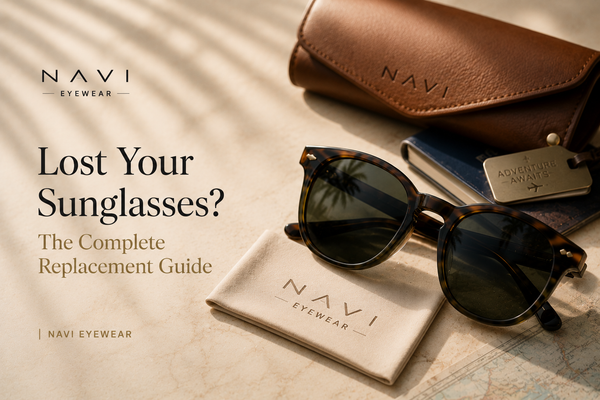

Lost Your Sunglasses? The Complete Replacement Guide
Losing a good pair of sunglasses is one of those minor losses that feels disproportionately bad. Partly because you noticed them on your face all day and now suddenly cannot find them. Partly because replacing them requires an actual decision rather than an automatic repurchase. And partly because, if they were a quality pair you had been wearing for years, there is a real sense that you have lost something you will not easily replicate.
This guide covers the full scenario: what to do immediately when you realise they are gone, how to retrace and locate them in the most common loss situations, what to buy if the search fails, how to use the loss as an opportunity to upgrade rather than just replace, and how to make sure you do not lose the next pair.
This is the final post in the C7 Lifestyle and Travel cluster. For the complete travel and lifestyle eyewear context, seethe complete lifestyle sunglasses guide. For deciding what to buy when replacing, seethe complete sunglasses buying guide.

Act First: The First 30 Minutes After You Notice They Are Gone
The moments immediately after noticing your sunglasses are missing are the most valuable for finding them. Memory is most accurate closest to the event, locations are still accessible, and other people who may have found them are still nearby. The instinct to search the immediate area thoroughly is correct — but a structured approach recovers more pairs than a panicked sweep.
Lost in Specific Situations: What to Do
|
Lost at the Beach or Pool Urgency: Moderate — likely still in the area if recent Strategy: Retrace your path; check the spot where you were sitting; ask at the nearest lifeguard station or beach concession
Beach and pool losses are among the most recoverable because the area is defined and most losses occur within a small zone. Check the exact spot where you were sitting or swimming — sunglasses left on a towel, knocked under a sun lounger, or buried slightly in sand are often exactly where you left them. Ask at any beach facility (lifeguard tower, beach bar, pool reception) — beachgoers regularly hand in found items. If lost in the water near shore, wait for calmer conditions; polarized lenses that eliminate surface glare also make sunglasses on a sandy bottom surprisingly visible with good light conditions. |
|
Lost on a Flight or at an Airport Urgency: Time-sensitive — claim immediately before items enter central storage Strategy: Report to the airline immediately after landing; check the seat pocket and overhead locker before disembarking; contact airport lost and found
Airlines have well-organised lost property systems, but they are time-sensitive. Items found on aircraft after a flight are typically handed to the airline's ground crew, logged, and transferred to a central lost property store at the departure or arrival airport within 24–48 hours. Report to the airline desk at your arrival airport before leaving the terminal — if the item has been found, it may still be on the aircraft or with the immediate ground crew before being centralised. Airlines typically hold unclaimed items for 30–90 days. Contact the airline's lost property service and the specific airport's lost property office — they operate independently and an item might be logged with one but not the other. |
|
Lost on Holiday or Abroad Urgency: Potentially high — replacement options may be limited or lower quality at destination Strategy: Report to your accommodation's front desk; check the tour operator or excursion provider; consider emergency replacement at the destination if high-UV environment
Losing sunglasses abroad presents a specific challenge: replacement options at tourist destinations are typically worse than at home, with counterfeit and uncertified products significantly more prevalent in tourist retail. If you are in a high-UV environment — the Mediterranean, tropical beach destinations, high-altitude locations — this matters immediately for eye health. Interim measures: use a hat brim, stay in shade during peak UV hours (10am–4pm), or buy the best available certified pair locally as a temporary measure. The counterfeit risk in tourist markets is real — a dark lens that looks protective may not be UV certified, and buying at a street market or unverified kiosk carries the same risks as at home but concentrated. For the full risk profile of tourist destination eyewear, seesunglasses across cultures: a global perspective. |
|
Lost During Sport or Outdoor Activity Urgency: Lower urgency for replacement search — higher urgency for UV protection if activity continues Strategy: Retrace the route or water entry point; check with activity centre or guide; address UV protection immediately if activity continues
Sunglasses lost during hiking, cycling, water sports, or outdoor activities are the hardest to recover — the search area is large and the environment is not monitored. For trail and outdoor losses, report to the relevant ranger station or guide service if applicable. For water sports losses, accept that recovery is unlikely unless in very shallow, clear water. The immediate priority if the activity continues is UV protection: a hat with a brim provides meaningful UV reduction for the eyes in its absence. For any activity where the UV environment is significant — open water, high altitude, snow — address protection before continuing. |
If They Are Gone: The Replacement Decision
Once you have accepted the loss, the replacement decision is actually an opportunity. Losing a pair you have worn for years forces the choice you might not otherwise make — and most people replace with something better than what they lost when they approach the decision deliberately rather than impulsively.
Do Not Replace Immediately Under Pressure
The worst replacement purchases happen when someone is standing in a shop, on holiday, needing sunglasses immediately. The options are limited, the decision is rushed, and the price sensitivity is lowered by the pressure of needing them now. If you can wait — even one day — you will make a significantly better choice. If you cannot wait, buy the cheapest UV400-certified pair available as a temporary measure and make the real replacement decision later.
Use the Loss as a Specification Review
Before buying like-for-like, consider whether your lost pair was actually the right pair for you. Did it fit your face well? Was the tint right for your primary environment? Did it have the right activity specification? The complete specification review is inthe complete sunglasses buying guide, and the tint matching guide is inthe science of lens color and what tint your vision actually needs. If the lost pair was adequate but not ideal, this is the moment to upgrade.
The Upgrade Map: From What You Lost to What You Should Buy
|
What You Lost |
Like-for-Like Replacement |
Upgrade Opportunity |
|
Cheap fashion pair |
UV400 certified quality pair |
Gray polarized UV400 — first time with genuine glare protection |
|
Non-polarized quality pair |
Same quality, add polarization |
Gray polarized — immediate improvement in glare performance |
|
Gray polarized everyday pair |
Same specification, refresh the frame |
Consider amber or brown polarized if outdoor activity is primary use |
|
Old acetate lifestyle pair |
New acetate in updated shape |
Quieter, more refined version of the same aesthetic direction |
|
Sport pair lost during activity |
Like-for-like sport frame, same spec |
Add amber tint if using gray — contrast benefit for trail and terrain |
|
Travel pair lost abroad |
UV400 certified — verify before buying locally |
Quality UV400 polarized ordered online for delivery home |
How to Avoid Losing the Next Pair
The Hard Case Habit
The most effective single habit for not losing sunglasses is the same one that protects them from damage: always storing in a hard case when not wearing. A pair in a case has a defined location and is not subject to being knocked off surfaces, left behind on tables, or dropped from bags. Pairs worn on top of the head, left on tables, or carried loose in bags are lost far more often than pairs stored in cases.
Retainer Straps for High-Risk Environments
For any environment where loss is a genuine risk — water sports, hiking, active sport, crowded venues — a retainer strap that connects the temples removes the most common loss mechanism (the pair falling off during physical activity). Retainer straps are particularly valuable for the specific use cases where loss is most likely: surfing, kayaking, beach sports, trail running. The activity-specific guidance on retainer straps is insunglasses for water sports: why polarization is non-negotiable andbest sunglasses for running: lightweight, secure and UV-ready.
The Designated Pocket Rule
In bags and pockets, sunglasses should always go in the same place — a designated outer pocket of a bag, or a shirt breast pocket — rather than wherever is convenient at the moment. Building a habitual location removes the uncertainty of 'where did I put them?' and reduces the unconscious leaving-behind that happens when you are focused on something else. The hard case helps here too: a case has a distinct feel and weight that registers differently from other bag contents, making it harder to overlook.
A Backup Pair for Genuinely High-Risk Trips
For travel to high-UV destinations, extended outdoor trips, or any context where losing your primary pair would leave you significantly exposed, a budget quality backup pair is worth including. This is not about carrying a spare you want to lose — it is about having UV protection continuity if the primary pair goes. A quality UV400 pair at £50–70 / $65–85 that lives in a checked bag or day pack, never worn unless the primary pair is lost, resolves the specific risk that losing your only pair in a high-UV environment creates. This fits naturally intothe guide to building the perfect sunglasses collection for every occasion — the backup pair is simply the lowest-priority pair in the collection, chosen to cover the gap rather than to optimise performance.
Browse theNavi Eyewear UV400 polarized collection for replacement and backup options — all pairs certified UV400 with genuine polarization as the baseline specification. If you are replacing a lost pair and want guidance on choosing the right spec for your primary environment,the complete sunglasses buying guide covers every decision in sequence.
Frequently Asked Questions
What should I do immediately after losing my sunglasses?
Stop and retrace mentally before moving — replay your last hour and identify when you last definitely had them on your face. Then check in order: your face, top of head, bag pockets, any surface you sat at, any vehicle you were in. Ask staff at any venue you visited in the last hour — lost property is routinely handed in at restaurants, cafes, hotels, and shops. Act within the first 30 minutes while locations are still accessible and memory is fresh.
Can I claim lost sunglasses on travel insurance?
Depends entirely on the policy. Many travel insurance policies cover personal possessions including sunglasses, typically subject to a per-item limit and a general excess. The common exclusions: items left unattended, items left in a vehicle, and gradual deterioration rather than sudden loss. If your sunglasses are genuinely lost or stolen rather than simply misplaced, it is worth checking your policy. You will typically need a receipt or proof of purchase for a claim and, in the case of theft, a police report from the location country.
How do I replace sunglasses that are no longer available?
Start with the specification rather than the model. Identify what worked about the pair you lost: frame shape, width, tint, polarization, material. These specifications are reproducible even if the exact model is discontinued. The frame shape and dimensions from your lost pair — typically stamped on the inside of one temple arm as three numbers (lens width, bridge width, temple length) — give you exact measurements to match. The specification guide inhow to tell if sunglasses actually fit covers how to use these measurements to find an equivalent fit.
Is it worth buying cheap sunglasses as an emergency replacement?
Only as a temporary measure with a clear plan to replace properly. In a high-UV environment without sunglasses, a verified UV400 pair at any price is better than nothing. The risk: cheap pairs at tourist locations may claim UV400 without delivering it — testing by independent labs finds UV protection failure rates of 30–50% in low-cost unverified pairs. If buying cheap for emergency use, try to find a chain optician or pharmacy that stocks certified pairs rather than a market stall or souvenir shop. The full cheap vs quality assessment is inthe environmental cost of cheap sunglasses.
What is the best way to prevent losing sunglasses?
Three habits in order of impact: always store in a hard case when not wearing (a case has a defined location and is not left behind on surfaces); use a retainer strap in any high-physical-activity or water environment; and designate a specific pocket or location in your bag where sunglasses always live — removing the unconscious 'wherever is convenient' habit that causes most losses.
Should I buy the same pair again or something different?
Use the loss as a specification review rather than defaulting to like-for-like. Ask: did that pair fit your face correctly? Was the tint right for your primary environment? Did it have the performance specification your activities actually need? If the answer to all three is yes, replace like-for-like or the nearest current equivalent. If there were gaps — the tint was not right, the fit slid, the pair was not polarized — this is the ideal moment to address them. The specification review checklist is inthe complete sunglasses buying guide, and the upgrade map above shows the most common replacement improvements.
How can I find lost sunglasses more easily in future?
A few practical measures that help significantly: use a distinctive case that is easy to spot in a bag and hard to leave behind without noticing; keep the case in the same specific pocket every time; attach a small bright luggage tag to the case for visibility; and consider a Bluetooth tracker tile attached to the case — several tile-sized trackers are available that fit inside a hard case and allow location tracking via smartphone app within Bluetooth range, and can alert you when you move out of range of the case. The tracker does not help if you left them at the restaurant, but it immediately tells you whether you are still within range.
SOURCES & CITATIONS[1] Dain SJ."Sunglasses and sunglass standards."Clinical and Experimental Optometry, 2003.View source [2] Tanner DF, Kent JS, Jagger JD."Spectral transmittance characteristics of commercially available UV-protective sunglass lenses."Optometry and Vision Science, 2007.View source [3] Rosenthal FS, Bakalian AE, Lou CQ, Taylor HR."The effect of sunglasses on ocular exposure to ultraviolet radiation."American Journal of Public Health, 1988.View source [4] American Academy of Ophthalmology."Sunglasses: protecting your eyes from UV radiation."AAO EyeSmart, 2023.View source |