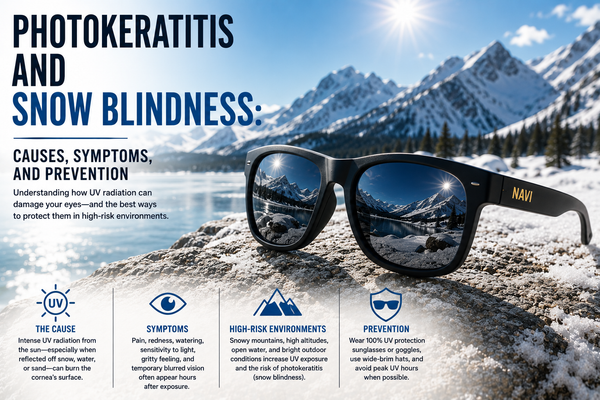

Photokeratitis and Snow Blindness: Causes, Symptoms, and Prevention
Photokeratitis is UV sunburn of the cornea — caused by UV-B exposure above the damage threshold for sufficient duration. It produces severe eye pain, extreme light sensitivity, temporary vision impairment, and tearing that appears 6–12 hours after exposure. Snow blindness is its most severe form, caused by the 80% UV reflectance of fresh snow combined with altitude UV amplification. Photokeratitis is completely prevented by UV400 eye protection — no UV-B reaches the cornea through UV400 lenses, and the photokeratitis mechanism cannot operate. For the full UV eye disease context, see the complete guide to UV and eye disease.

1. What Photokeratitis Is
The Cornea and UV-B Absorption
The cornea is the transparent dome-shaped structure at the front of the eye that provides the majority of the eye's refractive power. It is composed of five layers, the outermost being the corneal epithelium — a thin layer of rapidly renewing cells that forms the eye's protective surface. The corneal epithelium absorbs UV-B (280–315nm) efficiently, protecting the deeper ocular structures from UV-B damage. This protective absorption comes at a cost: when UV-B dose exceeds the corneal epithelium's repair capacity, photochemical damage accumulates faster than it can be repaired, producing the inflammatory response that characterizes photokeratitis.
The Photochemical Mechanism
UV-B absorbed by corneal epithelial cells triggers direct photochemical damage to DNA — specifically thymine dimer formation, where adjacent thymine bases in the DNA strand become covalently linked. This DNA damage triggers the cellular stress response: damaged cells signal inflammatory mediators (prostaglandins, cytokines) that produce the characteristic pain, swelling, and light sensitivity of photokeratitis. The inflammatory response peaks 6–12 hours after UV exposure — which is why photokeratitis presents hours after the exposure event rather than during it.
The corneal epithelium is a rapidly renewing tissue — epithelial cells turn over every 7–10 days under normal conditions and can regenerate from limbal stem cells after damage. This regenerative capacity means photokeratitis typically resolves within 24–72 hours as the damaged epithelial cells are replaced. The resolution is complete in most cases — photokeratitis does not cause permanent corneal damage from typical solar exposure events, though repeated or very severe episodes may carry some cumulative risk.
2. Symptoms: What Photokeratitis Actually Feels Like
The Delayed Onset
The defining feature of photokeratitis that most catches people off guard is the delayed symptom onset. During the UV exposure — a day of skiing without goggles, a beach day with no eye protection, extended outdoor time at high altitude — there is typically no immediate discomfort. The eye feels normal. Hours later, typically 6–12 hours after exposure, symptoms begin to appear and progress over several hours to maximum intensity:
The Symptom Progression
- Eye pain: the characteristic symptom — described as a severe gritty, burning, or scratching sensation, as if sand or broken glass is in the eye. The pain results from the inflammatory response in the corneal epithelium and the stimulation of corneal nociceptors (pain receptors). In severe cases, the pain is genuinely incapacitating — sufferers describe being unable to open their eyes.
- Photophobia: extreme sensitivity to light — even dim room light produces intense discomfort in the affected eyes. Photophobia results from the inflamed cornea's amplified response to light stimulation of corneal nociceptors. Affected individuals typically remain in dark rooms with eyes closed.
- Tearing and lacrimation: excessive tearing is a reflex response to corneal irritation and inflammation. The eyes water continuously.
- Vision blur: temporary reduction in visual acuity from corneal epithelial swelling, inflammatory exudate on the corneal surface, and the tearing that disrupts the precorneal tear film.
- Eyelid swelling: periorbital swelling from the inflammatory response extending to surrounding tissue.
- Foreign body sensation: the gritty sensation of sand or debris, even though nothing is present — from corneal nociceptor stimulation.
Duration and Resolution
Typical photokeratitis from solar UV exposure resolves within 24–72 hours as the corneal epithelium regenerates. The acute pain phase peaks at 12–24 hours post-exposure and typically begins to resolve within 24 hours. Complete epithelial healing usually occurs within 48–72 hours. During this period, treatment is supportive: cool compresses, artificial tears, topical anesthetic drops (prescribed by an ophthalmologist or emergency physician for severe cases), and pain medication for systemic pain management. No intervention accelerates healing — the resolution is determined by epithelial regeneration rate.
3. Snow Blindness: The Most Severe Form
Why Snow Produces the Worst Photokeratitis
Snow blindness — photokeratitis caused by UV reflected from snow — is the most severe form of solar photokeratitis and historically the most medically significant, being a genuine operational hazard in polar expeditions, alpine climbing, and military operations in winter environments. Several factors make snow environments the highest photokeratitis risk:
- Snow UV reflectance: fresh snow reflects approximately 80% of UV radiation — the highest reflectance of any common surface. A person standing on a snow field is receiving UV from above (direct sky UV) and from below (80% of that UV reflected upward from the snow), essentially doubling their UV exposure compared to the same UV index on a non-reflective surface.
- Altitude amplification: ski resorts, alpine passes, and winter mountain environments are typically at 1,500–3,500+ meters elevation. UV intensity increases approximately 10–12% per 1,000 meters — at 3,000 meters, UV is 30–40% higher than at sea level. The combination of snow reflectance and altitude produces UV intensities comparable to the most intense tropical beach conditions.
- Extended duration: ski days, alpine hikes, and polar travel involve extended outdoor duration — often 6–8 hours of continuous UV exposure — in the most UV-intense environment most people encounter. Even at lower UV index values (winter UV index at altitude may be 3–5 at sea-level equivalent), the snow reflectance and altitude amplification and duration combine to produce photokeratitis-level UV doses.
- Cold temperature masking: cold temperatures suppress the skin's and eye's sense of sun intensity. Cold prevents the perception of heat on the skin surface that normally signals UV exposure. People feel comfortably cool rather than overheated, and there is no physical sensation alerting them to the UV accumulation occurring.
Historical Accounts of Snow Blindness
Snow blindness has been documented throughout human history in polar exploration, mountaineering, and military winter operations. Antarctic and Arctic expedition accounts consistently include photokeratitis episodes in parties who lost, damaged, or failed to wear eye protection. Himalayan climbing expeditions at extreme altitude (5,000–8,000+ meters) without appropriate eye protection can produce photokeratitis within 15–30 minutes of exposure in bright clear conditions — the combination of extreme altitude UV and snow reflectance creates UV intensities that reach the photokeratitis threshold extremely rapidly. Modern mountaineering and ski resort culture has largely addressed this with widespread use of ski goggles and wrap sunglasses, but the underlying physics remain unchanged.
4. High-Risk Contexts Beyond Snow
Beach and Open Water
Beach environments combine direct overhead UV with sand reflectance (15–25% UV) and ocean water reflection (25%+ at moderate sun angles). At tropical beach locations with UV index 10–13, the effective UV reaching unprotected eyes — including reflected UV from below — can approach photokeratitis-threshold levels during extended beach days without eye protection. Beach photokeratitis is less severe than snow blindness (lower reflectance, lower base UV at most beach locations) but is a genuine risk at tropical beach destinations over extended unprotected exposure.
High Altitude Summer Hiking
Summer hiking at high altitude — Colorado 14ers, Sierra Nevada high routes, Cascades, European Alps above 3,000m — combines peak-season UV with altitude amplification, often on trail sections with exposed rock and patches of snow. UV index at 3,500m on a clear summer day can exceed 13. Extended high-altitude hiking days without UV protection accumulate photokeratitis-risk UV doses over hours of exposure.
Welding and Industrial UV
Welding arcs produce intense UV-B — photokeratitis from welding without appropriate eye protection ("welder's flash" or "arc eye") was historically a common occupational injury and remains a risk in environments where welding safety protocols are inadequate. Welding-induced photokeratitis can occur from brief exposure — even from watching a welding arc without eye protection for seconds — because the arc UV intensity far exceeds solar UV. Welding safety is addressed by welding-specific shaded face shields, not sunglasses.
Tanning Beds
Tanning beds emit intense UV-A and UV-B at intensities many times higher than solar UV. Eye protection (tanning goggle covers) is required during tanning bed use — standard tanning salon protocol — because tanning bed UV can cause photokeratitis within the duration of a typical tanning session without eye protection.
5. Complete Prevention With UV400 Protection
Why UV400 Completely Prevents Photokeratitis
Photokeratitis is caused specifically by UV-B (280–315nm) absorption in the corneal epithelium. UV400 polycarbonate lenses block 100% of UV radiation up to 400nm — including the complete UV-B range responsible for photokeratitis. When UV400 lenses are worn, zero UV-B reaches the cornea. The photochemical mechanism that produces photokeratitis cannot operate with zero UV-B input. This is the clearest and most absolute benefit of UV400 eye protection: a specific acute condition is completely prevented, with no residual risk at any UV intensity or exposure duration through properly worn UV400 lenses.
Coverage Matters: Wraparound for Snow and High-Reflectance Environments
In snow environments and other high-reflectance contexts, UV reaches the eye from multiple directions — from above through the sky, from below through snow reflection, and from the sides through lateral reflection. Standard flat-lens sunglass designs that fit close to the face but have gaps at the sides and bottom allow reflected UV to enter around the frame. For snow environments, ski goggles or wraparound frame designs that seal completely around the orbital area provide more complete protection against the multi-directional UV of high-reflectance environments.
For beach and outdoor sport contexts, close-fitting wraparound designs (common in sport sunglasses) reduce peripheral UV entry compared to standard lifestyle frames. All Navi Eyewear polarized UV400 options block 100% of UV through the lens — frame wrap geometry determines lateral and peripheral coverage.
Contact Lenses and UV Protection
UV-blocking contact lenses are available that provide some UV protection to the cornea and a portion of the conjunctiva covered by the contact lens. However, contact lenses do not cover the entire corneal surface, do not protect the conjunctiva beyond the lens edge, and provide no protection to the periorbital skin. UV-blocking contact lenses are not a substitute for UV400 sunglasses — they may provide supplemental UV reduction when worn simultaneously with sunglasses, but sunglasses remain the primary eye UV protection method.
6. Treatment When Photokeratitis Occurs
Immediate Steps
- Get out of UV exposure immediately: removing from the UV environment stops further UV damage accumulation. Go indoors or into shade.
- Remove contact lenses: contact lenses increase discomfort in the inflamed corneal environment and should be removed.
- Cool compresses: cool, damp cloths applied to closed eyelids reduce inflammation-driven heat and provide comfort. Do not rub the eyes.
- Artificial tears: lubricating eye drops provide comfort and support the tear film over the damaged corneal surface.
- Oral pain relief: ibuprofen or acetaminophen for pain management during the acute phase.
- Dark room rest: minimize light exposure during the acute photophobic phase.
When to Seek Medical Care
Seek ophthalmological or emergency care for: severe pain not controlled by oral analgesia, symptoms that worsen after 24 hours rather than improving, vision changes that persist beyond 48 hours, chemical or foreign body entry alongside UV exposure, or any situation where photokeratitis severity is concerning. A physician can prescribe topical anesthetic drops and cycloplegic agents that significantly reduce acute pain and discomfort. Do not use topical anesthetic drops for extended self-treatment — they impair epithelial healing and are appropriate only for short-term professional use.
Frequently Asked Questions
What does photokeratitis feel like?
Severe gritty or burning pain in the eyes — described as having sand or broken glass in the eye — that appears 6–12 hours after UV exposure. Accompanied by extreme light sensitivity (photophobia), tearing, vision blur, and eyelid swelling. The pain can be genuinely incapacitating at its peak, typically 12–24 hours post-exposure, and resolves over 24–72 hours as the cornea heals.
How long does photokeratitis last?
Typically 24–72 hours from onset of symptoms. The acute pain phase peaks at 12–24 hours and begins to resolve as the corneal epithelium regenerates. Most cases of solar photokeratitis resolve completely within 48–72 hours without permanent corneal damage. Severe cases or those with complications may require longer recovery.
Can you go permanently blind from snow blindness?
Typically no — solar photokeratitis (including snow blindness) from UV exposure causes temporary, self-limiting corneal epithelial damage that heals within 48–72 hours. Permanent corneal damage from solar photokeratitis is uncommon with isolated exposures. However, extremely severe or repeated episodes of photokeratitis may carry some cumulative risk of corneal changes. The risk of blindness from photokeratitis is primarily the temporary functional blindness during the acute phase — the severe pain and photophobia that make it impossible to open the eyes — rather than permanent vision loss.
How do I know if I have photokeratitis or just dry eyes?
The distinguishing features of photokeratitis: delayed onset (symptoms appear 6–12 hours after UV exposure, not during), history of significant UV exposure (snow day, beach day, high-altitude hike without eye protection), severity (photokeratitis is typically much more painful than dry eye), and bilateral presentation (both eyes affected). Dry eye produces chronic discomfort, foreign body sensation, and fluctuating vision, but not the acute severe pain, extreme photophobia, and tearing onset pattern of photokeratitis. If you suspect photokeratitis, seek ophthalmological evaluation.
Can sunglasses prevent snow blindness?
Yes — UV400 sunglasses completely prevent photokeratitis including snow blindness by blocking 100% of the UV-B that causes corneal photodamage. For snow environments specifically, wraparound designs or ski goggles that seal the orbital area are preferable to standard frames that may allow UV to enter from below and the sides, where snow reflection is most intense. All Navi Eyewear UV400 polarized lenses block 100% of UV-B through the lens.
Is photokeratitis the same as a corneal abrasion?
No — a corneal abrasion is physical damage to the corneal epithelium from mechanical contact (foreign body, fingernail, contact lens). Photokeratitis is photochemical damage from UV-B absorption. Both produce corneal epithelial damage with similar symptom profiles (pain, photophobia, tearing, vision blur), which is why they can be confused. The distinguishing feature is the cause: physical contact vs UV exposure history. Both conditions heal through corneal epithelial regeneration; treatment is similar (supportive care, topical treatment, avoiding further damage).
Why do symptoms start hours after UV exposure and not during?
Photokeratitis symptoms are driven by the inflammatory response to UV-damaged cells — not by direct UV stimulation of corneal pain receptors. The photochemical damage (DNA damage, protein modification) occurs during UV exposure, but the inflammatory cascade — prostaglandin release, cytokine signaling, nociceptor sensitization — takes hours to develop. By analogy, skin sunburn doesn't sting during sun exposure but develops hours later as the inflammatory response to UV damage peaks. The delayed onset is a feature of photochemical injury biology, not a sign that the exposure was benign.
The Bottom Line
Photokeratitis is an acutely painful, temporarily debilitating condition that is completely preventable with UV400 eye protection. Snow blindness — its most severe form — results from the extraordinary UV environment of snow-covered terrain at altitude, where 80% UV reflectance from snow combined with altitude amplification can produce photokeratitis within a single unprotected ski day. UV400 polycarbonate sunglasses or ski goggles block 100% of the UV-B that causes photokeratitis — the photokeratitis mechanism cannot operate when the UV reaching the cornea is zero. For high-reflectance environments, wraparound designs or goggles that seal the full orbital area provide the most complete protection. There is no more immediate or complete benefit from UV400 eye protection than the complete prevention of an acutely painful acute condition. navieyewear.com/collections/polarized — Buy 1, Get 3 Free for $119.
Related Reading
- UV and Eye Disease: The Complete Guide | Navi Eyewear
- UV and Cataracts: Prevention, Risk Factors, and Research | Navi Eyewear
- Sunglasses for High-Altitude Mountain UV | Navi Eyewear
- Sunglasses by Season: The Complete Year-Round UV Guide | Navi Eyewear
- Best Sunglasses for Beach Volleyball | Navi Eyewear
- The Traveler's Complete Sunglasses Guide | Navi Eyewear
- UV Protection for Children: The Complete Family Eye Health Guide | Navi Eyewear
- Shop Polarized UV400 Sunglasses | Navi Eyewear
Sources & Citations
[1] Sliney DH. "Ocular exposure to environmental light and ultraviolet." Journal of AAPOS, 2014. View source →
[2] WHO. "Global solar UV index: a practical guide." World Health Organization, 2002. View source →
[3] Dain SJ. "Sunglasses and sunglass standards." Clinical and Experimental Optometry, 2003. View source →
[4] Cullen AP. "Photokeratitis and other phototoxic effects on the cornea and conjunctiva." International Journal of Toxicology, 2002. View source →
[5] Taylor HR, et al. "Effect of ultraviolet radiation on cataract formation." New England Journal of Medicine, 1988. View source →
[6] Diffey BL. "Sources and measurement of ultraviolet radiation." Methods, 2002. View source →