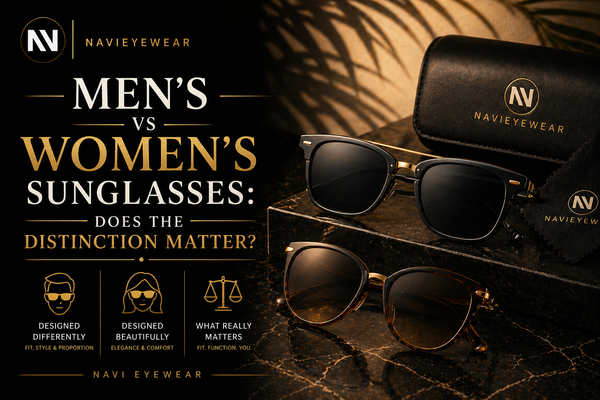
Walk into any eyewear retailer and you'll find the floor divided: men's on one side, women's on the other. Different frames, different colors, different price tags — occasionally on identical hardware. It's a retail convention that's been standard for decades. But is the distinction actually meaningful from a fit, function, or design standpoint? And in 2025, does it still hold?

The short answer is: the distinction is largely commercial, not scientific. Understanding what actually differentiates frames — and what doesn't — helps you find the pair that truly fits, regardless of which side of the display it came from.
The History of Gendered Eyewear
The segmentation of eyewear into men's and women's categories developed in earnest through the mid-20th century, driven more by marketing strategy than structural necessity.As documented by the Eyewear Heritage Foundation, early sunglasses were largely unisex — functional eye protection worn by aviators, military personnel, and outdoor workers long before they became fashion accessories.
The gendered marketing that emerged in the postwar consumer boom created the categories we're still shopping within today. The irony, asEuromonitor International's apparel research notes, is that those categories are now actively retreating — particularly among consumers under 40, who show a marked preference for design quality over gender designation.
What Actually Differs Between 'Men's' and 'Women's' Frames
There are real anatomical considerations that affect frame fit — but they're not binary, and they don't map neatly onto gender categories:
Temple Length
The distance from the front of the frame to the ear varies by head size. Longer temples are often found in 'men's' frames and shorter in 'women's' — but this corresponds to head circumference variation, which distributes across all genders. Finding the right temple length is a fit issue, not a gender issue.
Lens Width and Bridge Width
Wider frames are conventionally sold as 'men's.' The actual measurement that matters is whether the frame is as wide as the widest part of your face — a proportion check that has nothing to do with gender and everything to do with individual facial anatomy.
Color and Detail Design
The most significant practical difference between gendered eyewear categories is often just color palette and decorative detail — lighter tones and embellishments in 'women's,' darker neutrals and cleaner lines in 'men's.' These are aesthetic choices, not functional requirements.
The Case for Unisex Design
The most compelling argument for unisex eyewear isn't ideological — it's practical. When a frame is designed to look and fit well across a range of faces without a gendered brief, the design process focuses entirely on proportion, balance, and quality. The result is typically cleaner, more versatile, and better-engineered than a frame developed within a constrained demographic framework.
This is precisely the design philosophy behind every frame in theNavi collection. No men's section. No women's section. Every style is built around proportion and quality first —Cool Breeze (Vibes),Trevi (Golden),Sand,Magnolia — each designed and sized to work across different faces, head shapes, and personal aesthetics.
How to Find the Right Fit Without the Gender Label
Focus on these three measurements instead of the 'men's / women's' designation:
Frame Width
Measure the widest part of your face (usually cheekbone to cheekbone). Your frame should match or very slightly exceed this measurement. Most frame widths are listed on the inner temple arm — look for the 'A' measurement (lens width) and 'DBL' (bridge width), which together indicate total front width.
Bridge Width
The bridge — the section that crosses your nose — should rest flat across the bridge of your nose without pinching or creating gaps. A bridge that's too narrow pinches. One that's too wide lets the glasses slide forward. TR90's slight flex means Navi frames self-adjust to a wider range of bridge geometries than rigid frame materials.
Temple Fit
The temples should rest lightly on your ears without hooking too tightly or leaving gaps at the skull. They should hold the frame at a consistent height without you having to push them up.
The Style Angle: Breaking the Binary
Some of the most striking eyewear looks of the past decade have come from wearing frames across conventional gender lines.Vogue's ongoing coverage of runway eyewearconsistently highlights oversized, architectural frames worn by people of all genders as a defining aesthetic of contemporary fashion.
TheThirst (Melrose) — with its lavender lens and tie-dye tortoise frame — is a pair that the conventional retail system might label 'women's' and set aside on a different shelf. In practice, it's one of the most photographed pairs in the Navi collection across all demographics, because striking design reads well on anyone willing to wear it with confidence.
The Price Disparity Problem
It's worth acknowledging that gendered eyewear markets often come with a parallel pricing inequity. A2023 analysis by the American Association of University Womenon the 'pink tax' — the documented tendency for products marketed to women to cost more than equivalent products marketed to men — found that eyewear was among the product categories with the most consistent price gaps.
Unisex pricing eliminates this disparity entirely. In Navi's model, every frame in the collection is priced identically — and every customer gets the sameBuy 1, Get 4 Free offer. The pair you want costs the same regardless of who it's 'for.'
Building a Collection Across the Full Range
The most stylish, well-outfitted approach to eyewear isn't to find 'the men's pair' or 'the women's pair' — it's to build a small collection of frames that work for different contexts, moods, and looks.
A strong Navi starting rotation might pair the architectural confidence ofTrevi (Venue) with the coastal energy ofCabana and the bold individuality ofThirst — three frames, three aesthetics, zero concern about which shelf they came from.
— — —
Great eyewear transcends the men's / women's binary.Explore the full Navi collection — designed for faces, not demographics.