There's a particular kind of light on the trail that doesn't exist anywhere else. It shifts from open alpine glare to deep forest shadow in the span of a few steps. It bounces off snowfields, lake surfaces, and granite slabs with an intensity that non-hikers rarely encounter. It comes at you from every angle — above, below, and sideways — and it does so for six, eight, sometimes twelve consecutive hours.

The sunglasses you wear on a hike need to handle all of that. Not just look good for the summit photo. According tothe American Academy of Ophthalmology, UV intensity increases approximately 10% for every 1,000 feet of elevation gain — meaning a day on a 10,000-foot ridge delivers roughly twice the UV load of the same hours spent at sea level. Eye protection in the mountains isn't optional; it's fundamental to how you perform and how you feel at the end of the day.
Here's everything you need to know to choose the right pair for life on the trail — and the specificNavi Eyewearstyles built for it.
UV Protection at Altitude: Why the Numbers Are Alarming
Most outdoor enthusiasts understand sun exposure as a summer-day concern. The reality is significantly more complex.The Skin Cancer Foundation reports that UV radiation intensity increases by approximately 4–5% per 1,000 feet of elevation gain due to reduced atmospheric filtration. At 8,000 feet — a typical trailhead in the Rockies or Sierra Nevada — UV exposure is 30–40% higher than at sea level. At 14,000 feet, it can approach double.
Snow compounds this exponentially. Fresh snow reflects up to 80% of UV radiation, according tothe World Health Organization, meaning high-altitude hikers in late spring — when snowfields persist — are being hit from above by direct UV and from below by near-equal reflected UV simultaneously. This is the mechanism behind photokeratitis, the painful corneal sunburn that snow hikers and mountaineers call 'snow blindness.'
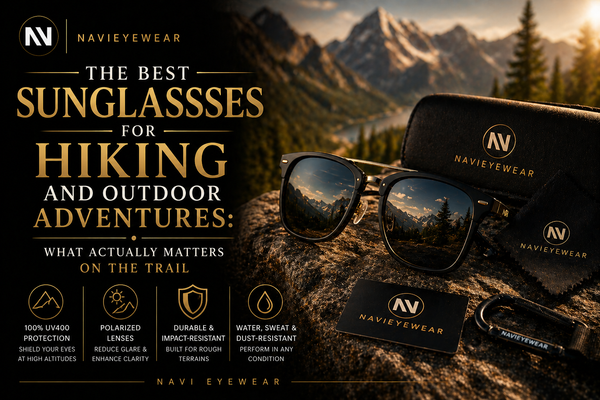
UV400 protection — the standard across the entireNavi collection — blocks 100% of radiation up to 400 nanometers across both UVA and UVB spectra. On the trail, this isn't a specification to consider; it's a baseline requirement.
Polarization on the Trail: When It Helps and When It Doesn't
Polarized lenses are the gold standard for water and driving environments, where reflective glare off flat horizontal surfaces is the primary visual challenge. On the trail, polarization delivers meaningful benefits in several specific scenarios:
The nuance: in deep forest and variable-light trail environments, polarized lenses can slightly reduce the contrast cues that help identify root systems, trail edges, and terrain changes underfoot. For most hikers on mixed terrain, the benefits of polarization significantly outweigh this tradeoff. For technical scrambling in low-light canyon environments, a non-polarized high-contrast lens is occasionally preferred by experienced climbers.
EveryNavi frame comes with polarized lenses as standard — the correct default for the vast majority of outdoor hiking environments.
Frame Materials: What Survives the Trail
A hiking frame takes abuse that no urban pair ever encounters: dropped on rock, sat on in a pack, exposed to rain, altitude temperature swings, and hours of sweat contact. The material it's built from determines whether it survives.
TR90 Thermoplastic: The Hiker's Material
TR90 — the frame material used across the Navi lineup — was originally developed for demanding technical and medical applications precisely because of its combination of properties that matter most in the field: it'sfeatherlight,memory-flexible (meaning it returns to shape after bending, rather than cracking or deforming permanently),resistant to temperature extremes, andnon-porous (unaffected by sweat, rain, or humidity). On a multi-day trail, where temperature can swing from below freezing at altitude to 85°F in a canyon, TR90 maintains its fit and shape throughout.
Stainless Steel Barrel Hinges: The Joint That Holds
Hinge failure is the most common way a frame dies in the backcountry. Cheap 2-barrel hinges concentrate stress across minimal contact points and eventually strip or crack. Navi's upgraded3- and 5-barrel stainless steel hinges distribute mechanical load across multiple pivot points, dramatically extending the hinge life under the repeated opening, closing, and accidental torquing that trail use demands.
Lens Color for Trail Environments
Different trail environments call for different lens tints. Here's how to match lens color to terrain, based onREI's expert lens guide:
Gray / Neutral: Open Alpine and High Desert
Neutral gray reduces overall brightness without color distortion — ideal for bright, open terrain where accurate color rendering matters for reading the landscape. Best for above-treeline alpine hiking, coastal trails, and open desert environments.
Amber / Brown: Forest, Mixed Terrain, and Variable Light
Amber tints enhance depth perception and contrast, making roots, rocks, and trail edges more readable in variable light conditions. The go-to for forest hiking and trails that alternate between open sun and forest shade.
Yellow / Gold: Low Light and Dawn/Dusk
Maximum contrast enhancement in minimal light. Essential for early starts, late finishes, and the flat, difficult light of heavily overcast days. Not suitable for intense direct sun — brightness reduction is insufficient.
Fit Priorities for Active Trail Use
A pair that works beautifully in the car can be intolerable on a six-hour hike. Fit factors that matter most for active outdoor use:
The Best Navi Styles for the Outdoors
For mountain and alpine environments:Aspen (Sun Kissed collection) — purpose-engineered for altitude. High contrast, full UV400 polarized lenses, TR90 construction that handles temperature swings from summit to valley without warping or cracking.
For trail running, hiking, and high-output days:Vibes (Cool Breeze) — the 5-barrel hinge and secure temple fit are built for movement. Clean, aerodynamic profile that stays in place through technical terrain and high-effort climbs.
For coastal and water-adjacent trails:Sand — the anti-saltwater process and oleophobic coating make it equally suited to salt marsh trails, cliffside paths, and beach approaches where UV reflection off water is the dominant challenge.
For the hiker who wants one pair for everything:Trevi (Golden) — the balanced geometry, neutral polarized lens, and TR90 construction make it a genuinely versatile all-terrain performer that transitions from the trail to the post-hike meal without visual conflict.
Building a Trail Kit With Multiple Pairs
The most prepared outdoor enthusiasts don't rely on a single pair. A trail kit might include one pair for alpine and open conditions, one for forest and variable light, and a dedicated water-specific pair for fishing, paddling, and coastal trail days. With Navi'sBuy 1, Get 4 Free offer, building a complete outdoor eyewear kit for every environment costs less than a single pair from most premium outdoor brands.
What Happens When You Don't Protect Your Eyes on the Trail
Photokeratitis — the corneal sunburn referenced earlier — is acutely painful and typically sidelines the affected hiker for 24–48 hours. It heals on its own but leaves permanent subthreshold cellular damage. Repeated incidents accumulate toward the cataract and macular degeneration risk documented bythe National Eye Institute in long-term high UV exposure populations.
The outdoor enthusiast who spends 100 days per year on the trail without UV400 protection accumulates UV eye exposure at a rate that indoor populations simply don't experience. The gear investment to prevent those consequences is, by any reasonable calculation, one of the highest-ROI decisions in an outdoor kit.
— — —
The trail demands the best from your body and your gear. Give your eyes what they need.Shop Navi's outdoor-ready collection at NaviEyewear.com.