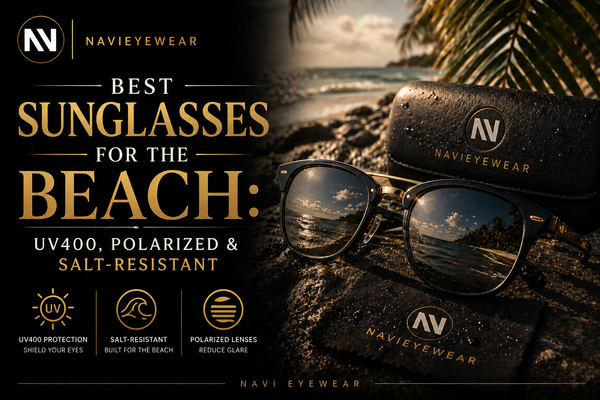
The beach is the most demanding environment you'll ever put sunglasses through. UV intensity is roughly25% higher off the surface of water than off dry land, according tothe Skin Cancer Foundation. Salt spray is corrosive to lenses and hardware. Sand is a fine abrasive. And the sun's angle shifts constantly as you move between open shore, shaded canopy, and water — demanding a lens that performs across the full range of light conditions.

The sunglasses you grab off a rack at the beach shop aren't built for this. Here's what a proper beach pair looks like — and exactly whatNavi's ocean-ready collection delivers.
The UV Problem at the Beach Is Worse Than You Think
Most people apply sunscreen carefully before heading to the beach and forget entirely about their eyes. YetJohns Hopkins Medicine notes that the eyes are among the most UV-sensitive tissues in the body, and that cumulative sun exposure accelerates cataract formation, macular degeneration, and pterygium — the 'surfer's eye' growth that affects anyone with extended coastal UV exposure.
Water reflects up to100% of UV radiation at low sun angles, essentially doubling your eye's UV load compared to a typical urban environment. Sand reflects an additional 15–25%. If you're spending a full day at the beach — 8 hours of combined UV from above and reflected from below — your eyes are absorbing the equivalent of several days of typical UV exposure. Only UV400 lenses block the full spectrum of that radiation.
Why Polarization Is Non-Negotiable at the Beach
The glare off water at the beach isn't just uncomfortable — it makes it effectively impossible to see below the surface, gauge wave timing if you're surfing or swimming, or read the terrain safely.The American Optometric Associationspecifically recommends polarized lenses for any water-adjacent activity, noting the dramatic difference in visual clarity and safety that polarization provides in reflective environments.
Every pair in theNavi collection is polarized. On the water, the difference is immediate and unmistakable — the mirror-bright surface of the ocean resolves into depth, color, and movement that non-polarized lenses simply can't reveal.
The Saltwater Problem: Why Regular Lenses Fail at the Coast
Saltwater is one of the most corrosive natural substances your sunglasses will encounter. Dissolved sodium chloride — the component that makes seawater salty — reacts with metal hardware, degrades unprotected lens coatings, and leaves crystalline deposits that act as micro-abrasives when you wipe the lens.
The damage is cumulative and irreversible: what starts as slightly degraded optical clarity progressively worsens over a season of beach use until the lens is visually compromised. Even frames marketed as 'water-resistant' often lack the specific anti-saltwater treatment that properly protects lens coatings.
Navi'sAnti-Saltwater Process treats the lens surface with a barrier coating specifically engineered for marine environments — protecting both the optical coating and the UV-filtering layer from saline degradation. It's a standard specification across ocean-focused models like theSand andPool Side — not an optional upgrade.
Oleophobic Coating: The Feature You Didn't Know You Needed
At the beach, your lenses are constantly exposed to sunscreen, sea spray, skin oils, and condensation. Anoleophobic coating — which repels oils and water from the lens surface — is the difference between a lens that self-cleans in a rinse and one that smears every time you touch it.
Without it, sunscreen residue in particular creates a persistent, oily film that's nearly impossible to remove cleanly without scratching the lens. With it, most contaminants bead off or wipe clean with a single pass of the included microfiber cloth. All Navi lenses carry upgraded oleophobic coating as a standard specification.
Frame Material: Why TR90 Is the Right Choice for the Water
Acetate frames — the most common material in fashion eyewear — absorb moisture and can warp with repeated wet-dry cycling. Metal frames corrode with salt exposure. Neither is the right material for a beach environment.
TR90 thermoplastic — used across the Navi collection — is inherently non-porous and unaffected by water, salt, or humidity. It won't absorb or expand with moisture, won't corrode, and maintains its precise shape through seasons of coastal use. Paired with stainless steel hardware treated for marine environments, it's the correct material choice for any sunglasses you plan to wear near or in the water.
Impact Resistance: Essential for Active Beach Use
Between volleyball, paddleboarding, children running into you, and sunglasses being dropped on rock or concrete, the beach tests impact resistance relentlessly. Navi'sFDA-approved, impact-resistant lenses meet federal impact standards — they're not just optically clear, they're structurally engineered to survive active outdoor use without shattering.
According tothe FDA's eyewear safety standards, impact-resistant lenses must withstand a defined drop-ball test that standard fashion lenses routinely fail. For beach environments where physical impacts are frequent, this certification matters.
The Best Navi Styles for the Beach
For the ocean purist:Sand — warm neutral tones that mirror the colors of the shore, anti-saltwater process, oleophobic coating, and TR90 construction purpose-built for the beach. This is the pair that lives in your beach bag.
For pool, resort, and waterfront living:Pool Side (Blown) — rubberized coating provides extra grip during physical activity and the stainless steel 5-barrel hinge stays secure through repeated movement. Swim up bars, cabanas, and floating sessions all day.
For the coastal style statement:Cabana (Blown) — the Pacific coast at golden hour, captured in a frame. For those who want the performance of a water-ready lens in a silhouette you'd also wear to a rooftop dinner.
Beach Sunglasses Care: The Quick Habits That Make Them Last
Even with anti-saltwater coatings, basic maintenance habits extend the life of any beach pair significantly:
— — —
The beach deserves sunglasses that are actually built for it.Shop Navi's ocean-ready collection — UV400 polarized lenses, anti-saltwater coatings, and TR90 construction that handles everything the coast throws at it.