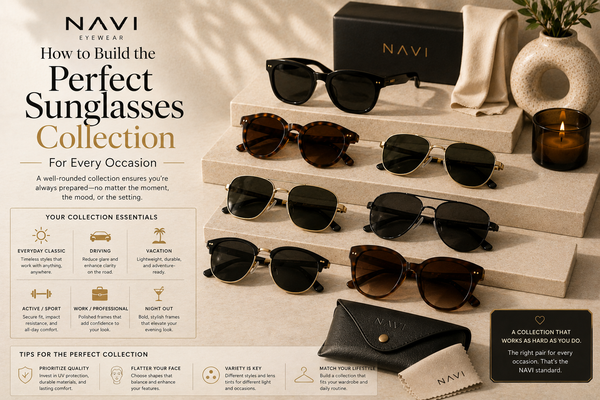

How to Build the Perfect Sunglasses Collection for Every Occasion
The single-pair approach to sunglasses always involves compromise. The pair that is optimal for driving is not the same pair that is optimal for fishing. The pair that works best for a beach holiday in direct sun is a different specification from the pair that handles overcast trail running. Trying to cover every situation with one pair means accepting sub-optimal performance in most of them.
A small, well-chosen collection of two to five pairs eliminates these compromises without requiring an eyewear obsession or an unreasonable budget. The key is building systematically — starting from your highest-frequency need, adding pairs that cover genuine gaps, and stopping before you start duplicating what you already have. This guide covers the logic and the specific pairs.
This is a C5 Buying Guides supporting post. For the specification details behind each pair described here, seethe complete sunglasses buying guide. For the lens technology that explains why different tints and specifications serve different environments, seethe complete guide to sunglass lens technology.

The Core Principle: Gaps, Not Duplicates
The mistake most people make when building a collection is buying pairs they like the look of rather than pairs that cover genuine functional gaps. The result is three pairs that all perform similarly — all gray polarized everyday pairs in slightly different frames — while certain high-UV or specific-activity needs remain unaddressed.
The right approach is gap analysis: identify your highest-frequency use case first and buy the best pair you can for that. Then identify the environment or activity where that first pair performs least well, and buy a second pair that covers it. Continue until every significant gap is filled. Stop when the next pair would duplicate coverage you already have.
The most common gap patterns: a good everyday/driving pair but nothing suitable for water; a good outdoor pair but nothing that handles the contrast demands of hiking specifically; a style pair that does not provide adequate UV protection for extended outdoor use. Identifying which gap applies to your life determines what the second and third pairs should be. The activity-specific performance requirements that define each gap are covered inthe complete outdoor and sport sunglasses guide.
Collection Tiers: Two Pairs, Three Pairs, Five Pairs
|
The Two-Pair Collection — Maximum Coverage, Minimum Investment Pairs needed: 2 Approx. budget: £80–200 / $100–250 total Pair 1 — Everyday and Driving: UV400 polarized gray, Category 2–3 darkness, medium oval or aviator shape, quality acetate or lightweight frame. This pair covers the highest-frequency daily use case — commuting, errands, casual outdoor time — and driving. Gray tint preserves color accuracy for traffic signals. Polarization handles road and pedestrian surface glare. This is the pair you reach for nine days out of ten, and it should represent your highest per-pair investment since it gets the most use. |
Pair 2 — Activity or Specialist: choose based on your second-most-common outdoor context. If you drive frequently but spend significant time near water, choose UV400 polarized copper or brown for water visibility. If you hike, trail run, or cycle, choose UV400 polarized amber or rose in a TR90 sport frame. If beach use is your second environment, choose UV400 polarized gray with a mirror coating for maximum brightness. Two pairs covering everyday use and your primary activity addresses the most significant performance gap most people have. For the specific specifications for each activity, see the relevant guides inthe complete outdoor and sport sunglasses guide.
|
The Three-Pair Collection — The Sweet Spot for Most People Pairs needed: 3 Approx. budget: £150–350 / $190–440 total Three pairs covers everyday/driving, a primary sport or activity, and either a specialist environment (water, snow, high-altitude) or a style pair for occasions where performance specification matters less than aesthetic. The three-pair collection is the sweet spot for most people who lead active lives with varied outdoor contexts — it eliminates virtually all meaningful coverage gaps without requiring the granular specialisation of a five-pair collection. |
The typical three-pair build: 1) Gray polarized UV400 for everyday and driving 2) Amber or brown polarized UV400 in TR90 for outdoor activity (hiking, running, cycling) 3) Either copper polarized for water/fishing, mirrored gray for beach/sailing, or a quality lifestyle pair in a style-forward frame with UV400 certification. The third pair is where individual lifestyle diverges most — the activity that fills this slot depends entirely on whether your third-most-common high-UV environment is a ski slope, a fishing boat, a trail, or an urban environment where aesthetic matters more than performance specification.
|
The Five-Pair Collection — Full Coverage Across All Environments Pairs needed: 5 Approx. budget: £300–600 / $380–750 total Five pairs provides genuinely complete coverage: one pair optimised for each major environment and a style pair for occasions that demand aesthetic over performance. Beyond five pairs, most additions are duplicates rather than genuine gap-fillers for the vast majority of people. The fifth pair is typically either a winter/snow specialist (Category 3 amber or mirrored for skiing) or a style statement pair. |
The Five-Pair Master Collection: A Complete Reference
|
Pair |
Primary Use |
Tint |
Key Spec |
Budget Range |
|
Pair 1 |
Daily / driving |
Gray polarized |
UV400, Category 2–3 |
£60–120 |
|
Pair 2 |
Outdoor sport / hiking |
Amber or rose polarized |
TR90, UV400, grippy |
£50–100 |
|
Pair 3 |
Water / beach |
Copper or mirrored gray |
UV400, hydrophobic coat |
£60–120 |
|
Pair 4 |
Winter / alpine |
Amber + mirror Cat 3 |
UV400, wraparound/goggle |
£70–150 |
|
Pair 5 |
Style / lifestyle |
Tint of choice |
UV400 essential |
£60–150 |
Prices shown in GBP. USD approximate equivalents: multiply by 1.25.
How to Sequence Your Purchases
Start with the pair you use most
Invest most per-pair in whichever pair will see the most use. For most people this is the everyday and driving pair — it gets worn hundreds of days per year. This is the pair where optical quality, coating durability, and frame comfort matter most, because any deficiency will be experienced repeatedly. A quality pair at £80–120 / $100–150 in this slot will serve well for several years.
Add the pair that addresses your biggest gap
After the everyday pair, identify your second-most-common high-UV exposure context and buy for that. The lens tint decision for this pair — and why different environments call for different tints — is fully covered inthe science of lens color and what tint your vision actually needs. The activity-specific frame requirements are in the relevant sport guides inthe complete outdoor and sport sunglasses guide.
Add seasonal or specialist pairs as needed
Winter alpine use, fishing, or sailing are specialist enough that a dedicated pair makes sense if you do them regularly. These pairs can be more focused and can often be bought at a slightly lower price point than the everyday pair since they see less total use. A good pair of polarized copper fishing glasses at £60–80 / $75–100 is appropriate investment for a regular angler; you do not need to spend the same as on your everyday pair. For winter specifically, the UV intensity case for dedicated alpine eyewear is inwinter sunglasses: why UV protection does not stop in cold weather.
Add style pairs last
The style pair — the one chosen primarily for aesthetic reasons rather than functional specification — should be bought last, after functional gaps are covered. The priority: confirm UV400 certification regardless of how fashion-forward the tint or frame is. A style pair without UV400 has a specific and significant failure mode — it dilates pupils into unprotected UV — that no amount of visual appeal compensates for.
What Makes a Collection Coherent
A well-built collection has two qualities beyond coverage: no redundancy and internal complementarity. No redundancy means each pair addresses a distinct gap — not three pairs that all perform similarly in similar conditions. Internal complementarity means the pairs work together as a system — they cover the full range of conditions you encounter without requiring a seventh choice between pairs that are too similar to justify the distinction.
The style coherence of a collection is also worth considering. A collection of pairs that all reflect different aspects of your aesthetic identity — rather than random accumulated purchases — feels more intentional and is more likely to be used consistently. The psychology of why this matters — why sunglasses function as identity signals and why consistent use of quality eye protection requires that the pair also feels right to wear — is inthe psychology of sunglasses: why we love them beyond sun protection.
Browse theNavi Eyewear UV400 polarized collection with the collection framework above in mind. For the buying decision on any individual pair within the collection — how to evaluate UV certification, polarization, fit, and coatings —the complete sunglasses buying guide is the reference for each purchase.
Frequently Asked Questions
How many pairs of sunglasses do I need?
Two pairs covers most people's needs adequately — one everyday and driving pair, one activity or specialist pair for your primary outdoor context. Three pairs is the sweet spot for active people with varied outdoor environments, covering everyday use, a primary sport or activity, and a specialist or style pair. Beyond three, each additional pair should address a genuine gap — a specific environment or activity where your existing pairs perform significantly less well. Five pairs covers virtually all environments without redundancy for most lifestyles.
What is the best first pair to buy?
A UV400 polarized gray pair in a timeless shape — classic aviator or medium oval — in a comfortable, lightweight frame. Gray polarized handles the widest range of conditions adequately: driving, casual outdoor, beach, everyday urban use. It is the most versatile single specification and the best foundation for a growing collection. Once you have this pair, the second purchase is determined by where it performs least well for your specific lifestyle. The specification details for the ideal first pair are inthe complete sunglasses buying guide.
Should all my sunglasses be the same brand?
No — there is no functional reason for brand consistency within a collection, and different brands excel at different categories. A sport-specialist brand may produce the best TR90 running frames; a lifestyle brand may produce the best quality acetate everyday pair; a marine brand may produce the best salt-resistant water sports frames. Buy the best-specified pair for each role, regardless of brand, and focus collection coherence on specification quality rather than brand uniformity.
Is it worth buying different tints for different activities?
Yes, meaningfully so. The performance difference between gray (color accuracy, everyday use) and amber/brown (contrast enhancement, terrain and water) is real and immediately perceptible. A person who hikes and fishes will get genuinely better visual performance from amber for hiking and copper for fishing than from trying to cover both with the same gray pair. The full tint science and activity-matching guide is inthe science of lens color and what tint your vision actually needs.
How do I avoid buying duplicate pairs?
Before any new purchase, ask: which specific condition does my current collection handle poorly? If the honest answer is 'none that I regularly encounter', you do not need another pair. If there is a specific activity, environment, or season where you consistently reach for whichever pair happens to be closest because none of your existing pairs is right for it, that is the gap the new pair should address.
What should I spend per pair in a collection?
Allocate budget proportionally to frequency of use. The everyday and driving pair sees the most use and justifies the highest per-pair investment — £80–120 / $100–150 is appropriate for a quality pair that will last several years. Activity and specialist pairs can be slightly lower since they see less total use. The style pair last — confirm UV400 regardless of price, but this is where aesthetic value justifies a wider budget range depending on personal preference.
Should I keep old sunglasses as backups?
Only if they pass the current checks: UV400 certification confirmed, no significant optical distortion, no degraded or delaminated coatings (which can compromise UV protection if it was coating-delivered rather than material-inherent), and adequate fit. A pair that fails any of these checks should not be relied upon as a backup for UV protection. The7-sign checklist for whether sunglasses are still protecting youapplies to old pairs just as to new ones.
SOURCES & CITATIONS[1] Dain SJ."Sunglasses and sunglass standards."Clinical and Experimental Optometry, 2003.View source [2] Sliney DH."Ocular exposure to environmental light and ultraviolet: the impact of spectacles and sunglasses."Journal of AAPOS, 2014.View source [3] Rosenthal FS, Phoon C, Bakalian AE, Taylor HR."The ocular dose of ultraviolet radiation to outdoor workers."Investigative Ophthalmology and Visual Science, 1988.View source [4] De Faber JT, Naeser K, Kessing SV."Polarized light and contrast sensitivity under glare conditions."Ophthalmic Research, 2013.View source [5] Tanner DF, Kent JS, Jagger JD."Spectral transmittance characteristics of commercially available UV-protective sunglass lenses."Optometry and Vision Science, 2007.View source |