
The Environmental Cost of Cheap Sunglasses: Why Quality Matters
The global sunglasses market produces billions of pairs every year. A significant proportion of those pairs — sold at the lowest price points through fast-fashion retailers, tourist shops, market stalls, and unverified online sellers — are worn for a single season or less before being discarded. The environmental, health, and financial costs of this cycle are rarely discussed in the context of eyewear, where the conversation tends to focus on style and UV protection rather than the lifecycle of the product itself.
This post makes the full case: the environmental cost of cheap sunglasses, the health cost that makes them a false economy, and the financial arithmetic that shows quality once is cheaper than cheap repeatedly. None of this is abstract — it is a practical argument for how to approach a purchase most people make without much thought.
This is a C5 Buying Guides supporting post. For the specification guide that defines what quality actually means in a sunglass lens, seethe complete sunglasses buying guide. For the direct comparison of what different price points actually deliver, seepremium vs budget sunglasses: what do you actually get for the money.

The Scale of the Problem
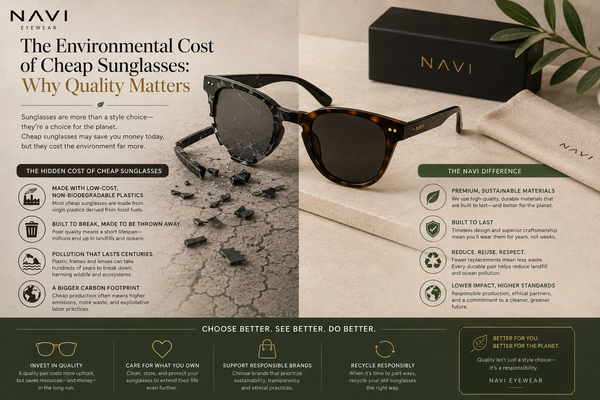
The global sunglasses market produces approximately 1.5 billion pairs annually. A significant fraction of this volume — concentrated in the sub-£15 / sub-$20 price tier — is effectively disposable: designed, priced, and purchased with an implicit expectation of short lifespan. These are not quality products that happen to break; they are products whose economics assume replacement rather than maintenance.
The disposal chain for cheap sunglasses is not efficient. Frames are typically composite materials — acetate or mixed plastics in the frame, polycarbonate or CR-39 in the lens, metal alloys in the hinges and screws — that are difficult to separate for recycling. Most end up in general waste streams, eventually in landfill or incineration. The lens materials are not biodegradable on any relevant timescale. The metal hardware may leach. The cumulative waste volume of the global fast-fashion eyewear market is substantial and rarely discussed.
Four Costs of Cheap Sunglasses
|
The Health Cost: UV Protection Failure Key figure: 30–50% UV protection failure rate in tested low-cost sunglasses despite labelling claims Studies testing low-cost sunglasses from unverified sources — tourist kiosks, market stalls, fast-fashion retailers — find that 30–50% of tested pairs fail UV transmission testing despite claiming UV protection on the label. The specific failure is not merely inadequate protection — it is protection that is actively worse than wearing nothing. A dark-tinted lens without UV400 certification dilates the pupil while providing no UV barrier, increasing the UV dose reaching the retina relative to going bare-eyed in the same conditions. The cumulative health cost of years of wearing unprotected lenses with dilated pupils is an accelerated UV burden driving cataract formation and macular degeneration — two of the leading causes of vision loss globally. The full UV science is inthe complete guide to UV eye protection, and the specific warning signs are in7 signs your sunglasses are not protecting your eyes. |
|
The Financial Cost: The Replacement Cycle Key figure: 5–7 cheap pairs at £10–15 each = £60–100 spent for worse cumulative performance than one quality pair The false economy of cheap sunglasses is clearest in the replacement cycle arithmetic. A £12 / $15 pair typically lasts one season before coating degradation, lens scratching, frame warping, or hinge failure ends its useful life. Five such pairs over five years represents a cumulative spend of £60 / $75 — with five disposal events, five rounds of packaging waste, and continuously sub-optimal UV protection throughout. A single quality pair at £80–100 / $100–125, maintained with the correct cleaning and storage protocol, will serve for five or more years. The per-year cost is lower, the UV protection is reliable throughout, and the disposal events number one rather than five. The financial analysis at different price tiers is fully detailed inpremium vs budget sunglasses: what do you actually get for the money. |
|
The Optical Cost: Distortion and Performance Key figure: Optical distortion detected in a significant proportion of low-cost lenses in independent testing Beyond UV protection, cheap sunglass lenses frequently fail basic optical quality standards. Optical distortion — visible as a bending or swimming of straight lines when the lens is swept across a reference line — indicates lens manufacturing imprecision that forces the visual system to compensate continuously. The result is visual fatigue over extended wear that degrades both comfort and performance. For drivers, the fatigue from processing a distorted visual field across a long journey is a safety issue. For athletes, the constant subconscious correction degrades reaction time and accuracy. Optical distortion is a quality failure that cannot be retrofitted or corrected after purchase — it is a fundamental property of the lens material and manufacturing process. |
|
The Environmental Cost: Material Lifecycle and Waste Key figure: Average lifespan of a fast-fashion sunglass: under 12 months before disposal The material composition of cheap sunglasses — mixed plastics, metal alloys, and laminated lens materials — makes them extremely difficult to recycle through standard waste streams. Most cheap sunglass frames are made from generic injection-moulded polystyrene or ABS plastic rather than the cellulose acetate used in quality frames, making them even harder to break down biodegradably. The metal hardware — nickel alloys in hinges and screws — can leach heavy metals in landfill conditions. UV photodegradation of plastic frames in landfill produces microplastic fragments rather than biodegradation. Quality frames, by contrast, are built from materials chosen for durability and in some cases biodegradability — cellulose acetate is derived from natural plant cellulose and is technically biodegradable under the right conditions, while TR90 nylon frames are built to last years rather than one season. |
The Lifecycle Comparison: Cheap vs Quality
|
Factor |
Cheap Pair (£12 / $15) |
Quality Pair (£90 / $115) |
|
Expected lifespan |
6–12 months |
3–7 years with proper care |
|
UV protection reliability |
30–50% failure rate in testing |
Verifiable UV400 — brand reputation at stake |
|
Optical quality |
Often has detectable distortion |
No distortion — verified optics |
|
Coating durability |
Degrades within months |
Hydrophobic, scratch-resistant, lasting |
|
5-year financial cost |
5 pairs × £12 = £60 |
1 pair = £90 |
|
5-year disposal events |
5 pairs discarded |
1 pair replaced (if at all) |
|
Waste volume |
5× frames + lenses + packaging |
1× frame + lens + packaging |
|
UV protection days |
Variable — often failing |
Consistent — every day worn |
The Sustainability of Quality Eyewear
Buy Once, Maintain, Replace When Genuinely Needed
The most sustainable approach to eyewear is straightforward: buy the best quality pair you can justify, maintain it correctly, and replace it only when it genuinely fails the performance checks. A quality pair maintained with the correct protocol — the full cleaning and care guide is inhow to clean and care for sunglasses: the complete guide— will outlast multiple cheap pairs while providing consistent UV protection and optical quality throughout its life.
Bio-Acetate and Sustainable Frame Materials
Several quality eyewear brands now use bio-acetate — cellulose acetate derived from wood pulp or cotton rather than petroleum-based plastics — which is more biodegradable than standard synthetic frames under composting conditions. Bio-acetate shares the optical and aesthetic properties of conventional acetate while reducing the petroleum dependency and end-of-life environmental impact. For buyers who prioritise material sustainability specifically, bio-acetate is the quality-tier choice with the strongest environmental credentials.
Recycling and End-of-Life
When a quality pair does reach end of life, some brands offer take-back and recycling programmes. Frame materials — particularly acetate and TR90 — are more amenable to material recovery than the mixed-plastic construction of cheap fashion frames. The metal hardware in quality frames (stainless steel, titanium) is more valuable as a recyclable material than the nickel alloys common in cheap frames. Disposing of a quality pair responsibly produces less waste and more recoverable material than disposing of five cheap ones.
The Argument in Summary
The case against cheap sunglasses is not snobbery — it is arithmetic. They cost more over time than quality equivalents. They provide unreliable or absent UV protection that contributes to cumulative health risk. They perform poorly optically, producing fatigue that cheap dark lenses cannot compensate for. And they produce substantially more waste per year of use than a quality pair maintained and used for its full lifespan. The combination of health cost, financial cost, and environmental cost makes cheap sunglasses a consistently poor choice for anyone who wears them regularly outdoors.
The threshold for meaningful quality is not as high as it might seem. As outlined inpremium vs budget sunglasses: what do you actually get for the money, the £40–60 / $50–75 tier represents the meaningful quality jump — above this, UV protection is reliably verifiable, optical quality is consistent, and coating durability is sufficient for multi-year use. Browse theNavi Eyewear UV400 polarized collectionfor quality eyewear at accessible price points — the specification foundation that makes the arithmetic work: certified UV400, genuine polarization, polycarbonate lenses, and durable coatings.
Frequently Asked Questions
Are cheap sunglasses bad for your eyes?
Potentially yes, in a specific way. Dark-tinted lenses without UV400 certification are worse than wearing nothing in bright conditions — the tint dilates the pupil while providing no UV barrier, increasing UV dose to the retina. Studies testing low-cost sunglasses from unverified sources find UV protection failure rates of 30–50% despite labelling claims. The health consequences — accelerated cataract formation, increased macular degeneration risk — are cumulative and silent. The full picture is inthe complete guide to UV eye protection.
How much waste do cheap sunglasses create?
Each discarded pair represents a frame (mixed plastic and metal), lenses (polycarbonate or CR-39 plastic), and packaging. At the sub-£15 price tier, where pairs are replaced seasonally, a single person buying cheap sunglasses produces 5–10 pairs of eyewear waste per decade. Globally, the fast-fashion sunglasses market contributes hundreds of millions of pairs to waste streams annually. The materials — mixed plastics, laminated lenses, nickel alloy hardware — are difficult to separate and recycle through standard waste streams.
Is it more sustainable to buy expensive sunglasses?
Yes — per year of use and per UV-protection-day delivered. A quality pair maintained correctly and used for five or more years produces a fraction of the waste, packaging, and disposal events of five cheap pairs covering the same period. The material quality also matters: cellulose acetate and TR90 nylon are more recyclable and, in the case of bio-acetate, more biodegradable than the generic injection-moulded plastics of cheap frames. The sustainability argument and the financial argument for quality converge at the same conclusion.
What is bio-acetate and is it better for the environment?
Bio-acetate is cellulose acetate derived from natural plant sources — wood pulp or cotton — rather than petroleum-based plastics. It shares the optical clarity, workability, and aesthetic qualities of conventional acetate while being partially renewable in origin and more biodegradable under composting conditions than petroleum plastics. It is the most environmentally sound frame material available at quality tier pricing. Not all acetate is bio-acetate — if this matters to you, look specifically for brands that specify the bio-acetate source in their materials information.
How long should a quality pair of sunglasses last?
With proper care, a quality pair of sunglasses should last three to seven years before any specification-relevant degradation occurs. The main end-of-life triggers for quality pairs are: physical breakage of the frame (rare with TR90 or quality acetate); significant lens scratching that degrades optical clarity (preventable with correct storage and cleaning — seehow to clean and care for sunglasses: the complete guide); or coating delamination (rare in quality lenses, common in cheap ones). UV protection in polycarbonate lenses is material-inherent and does not degrade with age or surface wear.
How do I know if cheap sunglasses are actually UV400?
The most reliable method beyond the label is professional UV transmission testing — most opticians can test any pair in under a minute at no cost. The label claim alone is insufficient for cheap pairs from unverified sources given the documented failure rates in testing. The7-sign checklist for whether any pair is actually protecting youcovers all the verification approaches including what to look for on the lens, tag, and packaging.
What should I do with old sunglasses I no longer use?
Options in order of preference: donate to a vision charity or glasses recycling programme if the lenses are optically sound — several international organisations collect donated eyewear for communities with limited access to vision care; recycle through a specialist eyewear recycling programme if available in your area; or dispose in general waste as a last resort. Before donating, confirm the pair still passes UV400 verification — donating unprotected lenses as 'sunglasses' does more harm than good.
SOURCES & CITATIONS[1] Tanner DF, Kent JS, Jagger JD."Spectral transmittance characteristics of commercially available UV-protective sunglass lenses."Optometry and Vision Science, 2007.View source [2] Dain SJ."Sunglasses and sunglass standards."Clinical and Experimental Optometry, 2003.View source [3] Taylor HR, West SK, Rosenthal FS, et al.."Effect of ultraviolet radiation on cataract formation."New England Journal of Medicine, 1988.View source [4] West SK, Rosenthal FS, Bressler NM, et al.."Exposure to sunlight and other risk factors for age-related macular degeneration."Archives of Ophthalmology, 1989.View source [5] World Health Organization."Solar ultraviolet radiation: global burden of disease from solar ultraviolet radiation."WHO Environmental Burden of Disease Series, 2006.View source [6] Ellen MacArthur Foundation."A new textiles economy: redesigning fashion's future."Ellen MacArthur Foundation, 2017.View source [7] Rosenthal FS, Bakalian AE, Lou CQ, Taylor HR."The effect of sunglasses on ocular exposure to ultraviolet radiation."American Journal of Public Health, 1988.View source |