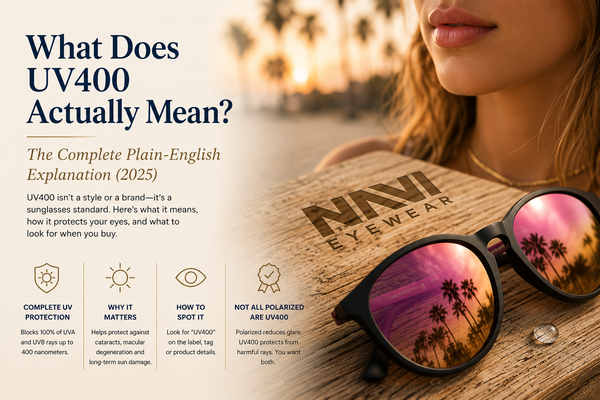

What Does UV400 Actually Mean? The Complete Plain-English Explanation
UV400 appears on sunglasses labels everywhere. It sounds authoritative. It sounds like the number you want to see. Most people who buy sunglasses with UV400 labels have some sense that it is the right thing to look for — but far fewer know what the 400 refers to, what UV radiation actually is, what the label guarantees, or what happens in the absence of it.
This guide explains UV400 completely and plainly. The physics of ultraviolet radiation. What 400 nanometres means on the electromagnetic spectrum. What UVA and UVB are and how they differently affect the eye. Why UV400 is the complete standard and not just the marketing version of a partial standard. And what the label should and should not be taken to mean when you see it on a product.
This is a C14 Brand and Trust supporting post. It links back to the cluster pillar atwhy Navi Eyewear: our approach to UV400 and polarization. For how to verify UV400 on any pair you already own or are considering buying, seehow to verify UV400 certification on any pair of sunglasses.

Quick Answer
UV400 means a sunglass lens blocks all ultraviolet radiation up to 400 nanometres in wavelength — covering 100% of UVA (315–400nm) and 100% of UVB (280–315nm) that reaches the Earth’s surface. The 400 refers to the wavelength cutoff in nanometres. Above 400nm, electromagnetic radiation transitions from ultraviolet into visible light. UV400 is the complete standard because it blocks every UV wavelength that reaches the eye under real-world outdoor conditions. Nothing above it is needed; anything below it leaves some UV reaching your eyes.
Table of Contents
Part 1: What Ultraviolet Radiation Is
The Electromagnetic Spectrum
All light — visible and invisible — is electromagnetic radiation. Electromagnetic radiation travels as waves, and those waves have different lengths depending on their energy. Longer wavelengths carry less energy per photon. Shorter wavelengths carry more. The wavelength of light is measured in nanometres (nm). One nanometre is one billionth of a metre.
The electromagnetic spectrum spans an enormous range, from radio waves with wavelengths measured in metres, through microwaves, infrared, visible light, ultraviolet, X-rays, and gamma rays at wavelengths measured in fractions of a nanometre. Human eyes can detect a narrow band of this spectrum — approximately 380–700nm — which is what we experience as visible light. Violet is at the short-wavelength end (around 380nm), red is at the long-wavelength end (around 700nm).
What Ultraviolet Is
Ultraviolet radiation occupies the range just below visible light on the spectrum: approximately 10–400nm. It is ‘ultra’ violet because it is beyond the violet end of what the human eye can see. We cannot perceive UV directly, but our bodies and eyes respond to it biologically. UV drives the photochemical reactions that produce sunburn in skin and UV damage in ocular tissue — not because it is perceived, but because it carries enough energy per photon to break chemical bonds and trigger oxidative processes in biological molecules.
Part 2: What 400 Nanometres Means
400 nanometres is the boundary between ultraviolet radiation and visible light. Below 400nm: ultraviolet — invisible, biologically active, capable of causing photochemical damage to the eye and skin. Above 400nm: visible light begins with violet, progressing through blue, green, yellow, orange, and red to approximately 700nm.
When a sunglass lens is labelled UV400, it means the lens blocks all radiation below 400nm — the complete ultraviolet range that reaches the Earth’s surface. Above 400nm, the lens transmits visible light at a level determined by its tint darkness (lens category).
The significance of 400nm as the cutoff: it is not an arbitrary number. It is the physical boundary of the ultraviolet spectrum. A lens that blocks to 400nm blocks all UV that reaches the eye. A lens that blocks to 380nm leaves 20nm of upper-band UVA — real UV with real biological activity — passing through. A lens that blocks to 350nm leaves even more.
Part 3: UVA, UVB, and UVC — The Three UV Bands
UVC: 100–280nm
UVC is the highest-energy UV band and the most biologically damaging per unit of exposure. Fortunately, UVC is almost entirely absorbed by the ozone layer and oxygen in the upper atmosphere before it reaches the Earth’s surface. Under normal atmospheric conditions, essentially no UVC reaches ground level. UV400 sunglasses block UVC, but this is not the principal reason for their value — the atmosphere has already dealt with it.
UVB: 280–315nm
UVB is partially absorbed by the ozone layer but reaches the Earth’s surface in significant quantities, particularly at high altitude and at low latitudes where the atmospheric path length is shorter. UVB is the radiation responsible for sunburn and plays the primary role in vitamin D synthesis in skin. For the eye, UVB is absorbed predominantly by the cornea and the front surface of the crystalline lens. It is the primary driver of photokeratitis — UV sunburn of the cornea — and is a major contributor to cortical cataract formation in the lens over cumulative lifetime exposure. UV400 lenses block 100% of UVB.
UVA: 315–400nm
UVA is the most abundant UV at the Earth’s surface. It is not significantly attenuated by the ozone layer and reaches ground level throughout the day, including during overcast conditions (when it penetrates cloud cover significantly more effectively than UVB). UVA penetrates deeper into the eye than UVB, reaching the crystalline lens and in younger eyes with more UV-transparent lenses, reaching the retina. UVA is associated with nuclear cataract formation through oxidative damage to lens proteins, and with retinal pigment epithelium damage that drives age-related macular degeneration. UV400 lenses block 100% of UVA across the full 315–400nm range. UV380 lenses leave the 380–400nm portion of UVA unblocked.
Part 4: How UV Affects the Eye
The Cornea
The cornea is the transparent outer surface of the eye. It absorbs the majority of UVB that reaches the eye. Short-term high-dose UVB exposure — from snow reflection, welding arcs, or high-altitude sun without eye protection — produces photokeratitis: UV sunburn of the corneal surface. Photokeratitis is intensely painful, temporarily debilitating, and analogous to a sunburn on the skin. It resolves within 24–72 hours but represents significant UV damage to the corneal epithelium.
The Crystalline Lens
The crystalline lens sits behind the pupil and is responsible for fine focus adjustment (accommodation). It absorbs UVA that passes through the cornea and accumulates oxidative damage to its crystallin proteins over a lifetime of UV exposure. The progressive clouding of these proteins is the physical mechanism of cataract formation. Research published in the New England Journal of Medicine by Taylor et al. established UV radiation as a primary environmental risk factor for both nuclear and cortical cataracts, with a dose-dependent relationship: more cumulative UV exposure produces more cataract risk.
The Retina
The retina — specifically the macula, the high-acuity central region — is vulnerable to UVA that penetrates through the cornea and lens to reach the back of the eye. The retinal pigment epithelium (RPE) beneath the photoreceptors absorbs light and provides metabolic support to the retina. Cumulative UV exposure contributes to oxidative stress in the RPE, and RPE failure is the mechanism of age-related macular degeneration. The Beaver Dam Eye Study documented the relationship between sunlight exposure and AMD risk, finding that higher cumulative sun exposure correlated with increased AMD incidence. The full disease science is inUV and eye disease: the complete guide to cataracts, macular degeneration and more.
Children and UV Vulnerability
Children’s crystalline lenses are significantly more UV-transparent than adults’. A child’s lens transmits more UVA to the retina for the same ambient UV exposure than an adult’s more yellowed, more UV-absorbing lens. The WHO estimates that up to 80% of a person’s lifetime UV dose may be accumulated before age 18. This makes UV400 protection during childhood disproportionately important for long-term eye health.
Part 5: Why 400nm Is the Right Cutoff
UV400 is not an arbitrary marketing standard. It is the physical boundary of the ultraviolet spectrum. Above 400nm, electromagnetic radiation is no longer UV — it is visible light. The UV400 standard blocks every wavelength that qualifies as ultraviolet radiation under real-world outdoor exposure conditions.
There is no meaningful UV protection standard above UV400 for outdoor use. Some specialist applications (military, extreme altitude) discuss UV filtering above 400nm into the violet-blue visible range, but for everyday outdoor sunglass use, UV400 represents the complete ultraviolet protective standard.
There is, however, a meaningful standard below UV400: UV380. UV380 blocks UV to 380nm but leaves the 380–400nm UVA window open. This 20nm window is real UVA — not a rounding error. It reaches the crystalline lens and retina, contributes to cataract and AMD risk, and is present in significant quantities throughout the day and year. Choosing UV380 over UV400 is choosing incomplete UV protection for a reason that benefits manufacturers (cheaper material or coating) at the cost of buyer eye health.

Part 6: How UV400 Lenses Block UV
Polycarbonate: Inherent UV400
Polycarbonate — the lens material Navi Eyewear uses — blocks UV inherently throughout the lens material. The polymer chains that make up polycarbonate absorb UV radiation chemically across the full UV spectrum below 400nm. This is not a surface coating that can be scratched off or degraded. It is a structural property of the material. A polycarbonate lens provides UV400 protection from the day it is manufactured to the end of its useful life, regardless of surface wear.
CR-39 with UV Coating
CR-39, the most common optical plastic, does not inherently block UV400. It requires a UV-absorbing surface coating applied during manufacture. When correctly applied and maintained, this coating provides effective UV400 protection. The limitation relative to polycarbonate: heavy surface scratching or chemical exposure can theoretically degrade the UV surface coating over time, since it sits on the lens surface rather than being embedded throughout the material. In practice, quality-applied UV coatings are durable, but the inherent protection of polycarbonate is more permanent.
Glass with UV Additives
Standard optical glass does not inherently block UV400. Glass sunglass lenses require UV-absorbing dopants mixed into the glass melt during manufacturing or applied as surface treatments post-production. When correctly specified, glass UV400 lenses are effective. Verification of UV400 status is particularly important for glass lenses, where it cannot be assumed from the material alone.
The full lens material comparison — polycarbonate vs glass vs CR-39 — with the UV protection mechanism and durability implications of each is inpolycarbonate vs glass sunglass lenses: which is actually better.
Part 7: UV400 vs UV380 — The Gap That Matters
|
Feature |
UV400 |
UV380 |
|
UV blocked |
100–400nm: all UVC, UVB, full UVA |
100–380nm: all UVC, UVB, most UVA |
|
380–400nm UVA window |
Fully blocked |
Unblocked — reaches lens and retina |
|
Standard recommended by |
AAO, WHO, major optometric authorities |
Not recommended as sufficient |
|
Polycarbonate lenses |
Meets UV400 inherently |
Polycarbonate exceeds UV380 (blocks to 400nm+) |
|
Biological consequence of gap |
None — complete protection |
UVA contributing to cataract and AMD risk |
|
Label language |
UV400 explicitly stated |
Sometimes marketed as ‘UV protection’ |
The full comparison of UV400 vs UV380 including the specific biological consequences of the 20nm gap and how to identify UV380 products is inUV400 vs UV380: what is the difference and why it matters.
Part 8: What UV400 Does Not Mean
UV400 Does Not Mean the Lens Is Polarized
Polarization and UV protection are completely independent lens properties. A UV400 lens blocks ultraviolet radiation. A polarized lens eliminates horizontally reflected surface glare. These are different physical mechanisms achieved by different lens features. A UV400 lens can be polarized or non-polarized. A polarized lens may or may not be UV400 certified. Always verify both independently if both properties are important to you. The full polarization explanation is inpolarized vs non-polarized sunglasses: the definitive guide.
UV400 Does Not Mean the Lens Is Impact-Resistant
UV400 certification addresses UV transmittance only. It says nothing about whether the lens will withstand impact without fracturing. Impact resistance is a separate property, governed by the lens material (polycarbonate is impact-resistant; glass is not) and separately certified by the FDA impact resistance standard in the United States. A lens can be UV400 certified and not impact-resistant, and vice versa. Navi Eyewear’s lenses are both UV400 certified and FDA-cleared for impact resistance, but these are two separate certifications.
UV400 Does Not Mean the Lens Blocks Blue Light
Blue light — high-energy visible light in the 400–500nm range — is above the UV spectrum. UV400 certification covers 100–400nm only. Blue light blocking, which has become a separate lens feature marketed for screen use and sleep protection, is not part of UV400 certification. Standard UV400 lenses do not specifically block visible blue light above 400nm.
UV400 Does Not Say Anything About Lens Darkness
UV400 certification is independent of how dark the lens is. A very dark (Category 3) UV400 lens and a very light (Category 1) UV400 lens both block UV to 400nm equally. A clear UV400 polycarbonate lens — with no tint at all — provides UV400 protection. Lens darkness affects visible light transmission; it does not affect UV protection above or below the UV400 threshold.
Part 9: UV400 and Lens Darkness — Two Separate Things
This is the most persistent misunderstanding in sunglass purchasing. Buyers associate dark lenses with UV protection and assume that darker equals more protected. The association comes from the fact that quality sunglasses are typically both dark and UV400 — but the darkness and the UV protection are two independent product properties.
Visible light transmission (VLT) — the property that determines how dark the lens appears — is measured as a percentage. A Category 3 lens (8–18% VLT) transmits 8–18% of visible light. A Category 1 lens (43–80% VLT) transmits 43–80%. Both can be UV400. Both should be, if they are quality outdoor lenses. The UV blocking is separate from the visible light blocking.
The dangerous manifestation of this confusion: a buyer choosing very dark lenses from an unverified source assumes the darkness implies UV protection. The dark lens causes the pupil to dilate, reducing the natural constriction that normally limits UV entry. Meanwhile, the uncertified dark lens provides no UV barrier. The result is greater UV exposure to the retina than would occur with no glasses at all. This is why UV400 certification — not lens darkness — is the relevant specification for eye protection.
Part 10: UV400 and Polarization — Two Separate Things
A polarized lens contains a polyvinyl alcohol (PVA) film that blocks horizontally oscillating light — the light that creates surface glare from roads, water, and reflective surfaces. This is a completely different mechanism from UV400 protection, which blocks UV radiation through the material’s UV-absorbing properties.
A lens can have one without the other. A non-polarized UV400 lens protects from UV but does not eliminate surface glare. A polarized non-UV400 lens eliminates surface glare but does not protect from UV. The highest-performing everyday outdoor lens has both: UV400 protection for the health dimension and polarization for the visual performance dimension. Navi Eyewear includes both as standard.
✨ NAVI EYEWEAR — UV400 + POLARIZED, STANDARD ON EVERY PAIRUV400 polycarbonate. Polarized PVA film. Both — not one or the other. FDA-cleared impact resistance. Oleophobic and anti-saltwater coating. TR90 frames. Buy 1, Get 3 Free — $99 for four pairs. Free shipping. Free replacements. Shop the full collection:navieyewear.com/collections/polarized |
Part 11: UV400 — What It Is and Isn’t
|
Feature |
Is UV400 a guarantee of this? |
Notes |
|
Blocks all UVA (315–400nm) |
Yes |
Complete UVA coverage including 380–400nm window |
|
Blocks all UVB (280–315nm) |
Yes |
Complete UVB coverage |
|
Blocks all UVC (100–280nm) |
Yes |
Academic — atmosphere deals with UVC anyway |
|
Polarized lenses |
No |
Independent property — verify separately |
|
Impact-resistant lenses |
No |
Independent property — verify FDA certification |
|
Specific lens darkness |
No |
Lens category (0–4) is separate from UV400 |
|
Blue light blocking |
No |
Blue light is above 400nm — outside UV spectrum |
|
Scratch-resistant lenses |
No |
Separate coating property |
|
Lens optical quality |
No |
Separate from UV certification |
Part 12: Best For
UV400 Lenses Are Best For:
UV380 or Unverified — Not Adequate For:
Part 13: Common Mistakes
Bottom Line
UV400 means a sunglass lens blocks all ultraviolet radiation from 100 to 400 nanometres — covering 100% of UVA and 100% of UVB that reaches the Earth’s surface under real-world outdoor conditions. The 400 is the physical boundary of the ultraviolet spectrum, where UV ends and visible light begins.
The standard matters because UV accumulates in the eye over a lifetime and drives the formation of cataracts and macular degeneration decades later. UV400 is the complete intervention. UV380 is an incomplete one that leaves real UVA reaching the eye. Lens darkness is irrelevant to the UV question. Polarization is a separate and independent lens property.
When you see UV400 on a label from a transparent brand that can substantiate the claim — from polycarbonate that provides inherent UV400 throughout the material, or from a glass or plastic lens with a verified UV coating — it means what it says: complete UV protection across the full ultraviolet spectrum that matters for human eye health outdoors.
Browse verified UV400 polarized sunglasses atnavieyewear.com/collections/polarized. Four pairs for $99 — Buy 1 Get 3 Free auto-applies at checkout. Free shipping. Free replacements.

Frequently Asked Questions
What does the 400 in UV400 mean?
400 refers to 400 nanometres — the wavelength at which the ultraviolet spectrum ends and visible light begins. A UV400 lens blocks all electromagnetic radiation below 400nm, which covers the complete ultraviolet spectrum that reaches Earth’s surface: all UVA (315–400nm), all UVB (280–315nm), and all UVC (100–280nm). Above 400nm, visible light passes through the lens at a level determined by the lens tint category.
What is the difference between UVA and UVB?
UVB (280–315nm) is partially filtered by the atmosphere and is primarily responsible for sunburn and corneal UV damage (photokeratitis). It is the principal driver of cortical cataract formation. UVA (315–400nm) reaches the Earth’s surface in larger quantities with less atmospheric attenuation. It penetrates deeper into the eye, reaching the crystalline lens and retina, and contributes to nuclear cataract formation and age-related macular degeneration. UV400 sunglasses block both completely.
Is UV400 the same as 100% UV protection?
It should be — but the language matters. ‘100% UV protection’ without a wavelength specification could mean 100% blocking of UV to 380nm, which is not the same as UV400. When a product states ‘100% UV protection to 400nm’ or ‘UV400’ explicitly, that is the complete standard. When it states ‘100% UV protection’ without a wavelength, ask for the specific cutoff or verify with a UV torch test.
Do UV400 sunglasses protect against all UV radiation?
Yes — UV400 blocks all UV radiation that reaches the Earth’s surface under normal conditions. UVC (100–280nm) is largely absorbed by the atmosphere before reaching ground level. UVB (280–315nm) reaches the surface partially. UVA (315–400nm) reaches the surface in full. UV400 lenses block all three bands. There is no UV wavelength relevant to outdoor human exposure that UV400 lenses fail to block.
Why do some sunglasses say UV380 instead of UV400?
UV380 lenses block UV to 380nm, leaving the 380–400nm UVA band open. Products carry a UV380 specification either because they are made from materials or coatings that cannot achieve UV400, or because UV380 is a cheaper specification to manufacture. UV380 is below the UV400 standard recommended by the American Academy of Ophthalmology and the WHO. It is not adequate for complete UV eye protection. The full comparison with the biological consequences of the gap is inUV400 vs UV380: what is the difference and why it matters.
Do darker sunglasses provide more UV protection?
No. Lens darkness (visible light transmission) and UV protection are completely independent properties. A clear UV400 polycarbonate lens provides complete UV400 protection. A very dark lens without UV certification provides no meaningful UV protection and actively increases UV retinal exposure through pupil dilation. Always verify UV400 explicitly — lens darkness is not a UV indicator.
Do UV400 sunglasses also block blue light?
Not as a standard feature. UV400 covers 100–400nm. Blue light occupies approximately 400–500nm — the low end of the visible spectrum, immediately above UV. Standard UV400 lenses do not specifically block visible blue light. Some specialist lenses include blue-light filtering coatings that extend blocking beyond 400nm into the violet-blue visible range, but these are separate features, not part of UV400 certification.
How do I know if my sunglasses are actually UV400?
Four methods: (1) Read the label for explicit ‘UV400’ or ‘100% UVA/UVB to 400nm’. (2) UV torch test — hold the lens between a UV torch and a fluorescent material; UV400 lenses significantly reduce the fluorescence. (3) Visit an optician for spectrophotometer measurement — definitive and takes 60 seconds. (4) Buy from brands that explicitly publish their UV400 certification and lens material specification. The full verification guide is inhow to verify UV400 certification on any pair of sunglasses.
Supporting Articles
UV400. BOTH BANDS. EVERY PAIR.Every Navi lens blocks 100% of UVA and 100% of UVB to 400nm — the complete standard. Polycarbonate: inherent UV400 throughout the material. Not a surface coating. Not degradable. Four pairs for $99. Free shipping. Free replacements. Buy 1, Get 3 Free auto-applies at checkout. |
SOURCES & CITATIONS[1] Taylor HR, West SK, Rosenthal FS, et al..“Effect of ultraviolet radiation on cataract formation.”New England Journal of Medicine, 1988.View source [2] Cruickshanks KJ, Klein R, Klein BE.“Sunlight and age-related macular degeneration: the Beaver Dam Eye Study.”Archives of Ophthalmology, 1993.View source [3] Sliney DH.“UV radiation ocular exposure dosimetry.”Documenta Ophthalmologica, 1994.View source [4] Dain SJ.“Sunglasses and sunglass standards.”Clinical and Experimental Optometry, 2003.View source [5] World Health Organization.“Solar ultraviolet radiation: global burden of disease from solar ultraviolet radiation.”WHO Environmental Burden of Disease Series, 2006.View source [6] American Academy of Ophthalmology.“Sunglasses: choosing the right pair for UV protection.”AAO EyeSmart, 2023.View source [7] Rosenthal FS, Bakalian AE, Lou CQ, Taylor HR.“The effect of sunglasses on ocular exposure to ultraviolet radiation.”American Journal of Public Health, 1988.View source |