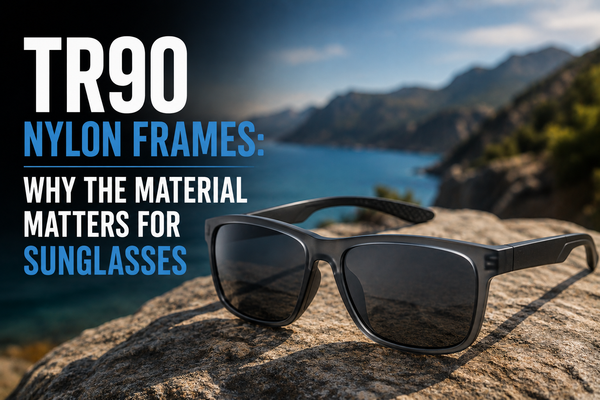

TR90 Nylon Frames: Why the Material Matters for Sunglasses
TR90 is a thermoplastic polyamide — an engineering nylon — developed specifically for performance eyewear frames. It is the frame material used in quality sport and outdoor sunglasses because it combines the properties that active outdoor use demands: flexibility with shape memory (it springs back after stress rather than creasing), temperature stability from ski conditions to desert heat, chemical resistance to sweat and sunscreen, light weight for all-day comfort, and grip-compatible surface texture for secure nose and temple contact. No other single frame material matches this combination for performance use. For the full material context, see the complete sunglass frame technology and materials guide.

1. What TR90 Actually Is
The Material Classification
TR90 is a registered designation for a specific thermoplastic polyamide resin — commonly categorized as an engineering nylon. "TR" stands for thermoplastic rubber in some manufacturer designations, though the material is more precisely a semi-crystalline polyamide with elastomeric properties. It was developed as a material for optical frames in the 1990s and has become the dominant frame material for performance sunglasses and sport eyewear globally.
The material is processed through injection molding — heated to a liquid state and injected into molds that define the frame geometry. Injection molding allows precise, repeatable frame geometry at scale, with consistent material properties throughout the frame. Unlike acetate, which is cut and polished from extruded sheets, TR90 frames are net-shape manufactured — they emerge from the mold at final dimensions, requiring only minimal finishing.
How It Differs From Standard Nylon and Plastic
TR90 is not generic nylon or generic plastic. Its specific formulation produces properties that standard nylons and commodity plastics don't provide:
- Elastic memory: standard nylons deform under stress and retain the deformation. TR90 returns to its original shape after elastic deformation — a property that requires specific polymer chain architecture and crystallinity balance.
- Temperature window: TR90 maintains its mechanical properties across a wider temperature range than most thermoplastics — from approximately -40°C to +130°C without significant property change. Standard plastics soften at lower temperatures or become brittle at cold extremes that TR90 handles without issue.
- Chemical resistance suite: TR90's resistance to specific chemicals — particularly sweat (sodium chloride, lactic acid, urea), sunscreen (organic UV filters, emollients), and saltwater — is engineered into the formulation. Generic nylons and commodity plastics may absorb or be attacked by these chemicals at rates that affect structural integrity and surface finish over time.
2. The Key Properties in Detail
Flexibility and Shape Memory
The defining practical property of TR90 for eyewear is the combination of flexibility and shape memory. The material can be bent, flexed, and twisted to deflections that would permanently deform metal or crack acetate — and it returns to its original geometry when the stress is released.
This property matters in specific, practical ways:
- A frame sat on in a pocket or bag flexes and springs back rather than creasing or warping.
- Temples that get bent during vigorous activity or accidental contact return to the correct position rather than staying bent.
- Frames removed and replaced on the face multiple times daily maintain their original fit geometry over years of use rather than gradually widening or narrowing.
- Physical contact during sport — a ball glancing off the frame, a fall, impact from equipment — produces temporary deflection rather than fracture or permanent deformation.
The shape memory property is what distinguishes a TR90 frame that looks and fits the same after three years of daily use from an acetate frame that has gradually widened, a metal frame that has taken a slight set, or a standard plastic frame that has developed a permanent crease.
Temperature Stability
Sunglasses encounter a wide temperature range across typical use scenarios — left in a car on a summer day (interior temperatures can exceed 60°C/140°F), used at ski resort temperatures (-20°C or below), carried from air-conditioned interiors to outdoor summer heat multiple times daily. Frame materials that soften at high temperatures warp; materials that become brittle at low temperatures fracture; materials that cycle poorly between temperature extremes fatigue and fail earlier.
TR90's temperature stability window — from well below freezing to well above the temperatures frames encounter in normal use — means the frame maintains its geometry and mechanical properties across all realistic use conditions. A TR90 frame left in a hot car and removed for use is not noticeably different from the same frame stored at room temperature. A TR90 frame used at a ski resort in -15°C conditions maintains its flexibility and shape memory rather than becoming brittle.
Chemical Resistance
The chemical environment that sunglasses encounter during outdoor and active use is aggressive:
- Sweat: sodium chloride, lactic acid, urea, and various trace compounds in perspiration are chemically active. Extended sweat contact over years of active use stresses frame materials through both chemical attack and salt crystallization on surfaces.
- Sunscreen: organic UV filters (oxybenzone, avobenzone, octocrylene), alcohol-based carriers, and emollients in sunscreen formulations can attack or stain certain plastic and acetate frame materials, causing surface cloudiness, tackiness, or structural degradation over time.
- Saltwater: ocean spray and coastal air carry salt that deposits on frame surfaces, particularly in hinge mechanisms and between contact surfaces. Salt corrosion affects metal components; salt penetration into hygroscopic (water-absorbing) frame materials causes swelling and stress.
- Cleaning solvents: lens cleaning solutions, isopropyl alcohol used for cleaning, and general cleaning agents contact frame surfaces regularly.
TR90 resists all of these chemical environments effectively — its low water absorption rate prevents swelling from saltwater and sweat, its chemical resistance protects surface finish from sunscreen and cleaning agent contact, and its molecular stability maintains structural properties across long-term chemical exposure. Frames used in heavy-sweat athletic contexts, coastal environments, and frequent sunscreen application maintain their appearance and structural integrity over years of use.
Weight
TR90 has a density of approximately 1.14 g/cm³ — comparable to the lightest frame materials available and significantly lighter than metal alternatives. For a standard sunglass frame front and temples, the TR90 frame contribution to total weight is typically 15–25 grams. Combined with polycarbonate lenses (density ~1.2 g/cm³), a complete TR90/polycarbonate frame is among the lightest sunglass configurations available.
Frame weight directly affects all-day wearing comfort in a way that is easy to underestimate in brief trials but very perceptible over hours. A frame that is 10 grams lighter than an alternative applies meaningfully less pressure to the nose bridge and temporal areas across an 8-hour wearing day. For sunglasses worn during outdoor work, extended outdoor activity, or all-day travel, TR90's weight advantage translates to direct comfort difference.
Surface Texture and Grip
TR90's surface texture — a slight matte quality that distinguishes it from the high polish of acetate — provides grip against skin. This grip coefficient is functionally important for active use: nose contacts and temple tips that grip against skin under sweat conditions maintain frame position without the slippage that polished or hard-surface materials produce when wet. TR90 temples maintain contact with the temporal area during vigorous movement in a way that high-gloss materials do not.
3. TR90 vs Competing Frame Materials
TR90 vs Acetate
Acetate is the dominant material in fashion and premium lifestyle eyewear. It produces aesthetic properties — rich colors, complex layered patterns, deep polish — that TR90 cannot replicate. The aesthetic case for acetate is genuine and appropriate for its use context. The performance case for TR90 over acetate for outdoor and active use is equally genuine:
- Acetate is more brittle than TR90 — it cracks under stress that TR90 flexes through.
- Acetate is temperature-sensitive — it can warp in a hot car and become brittle in cold conditions.
- Acetate is more susceptible to chemical degradation from sweat and sunscreen.
- Acetate is heavier than TR90 at comparable geometry.
- Acetate does not have the shape memory that returns TR90 to its original geometry after deflection.
The appropriate conclusion is not that one is better — it's that each material serves its use case. Acetate is the right material for a fashion lifestyle frame worn to an art gallery. TR90 is the right material for sunglasses worn on a bike trail, a beach, or a ski slope.
TR90 vs Metal
Metal frames — titanium, stainless steel, aluminum — provide high rigidity, a distinct aesthetic (thin profiles, minimal visual mass), and precise lens retention geometry. For performance use, TR90 has specific advantages over metal:
- Weight: TR90 is significantly lighter than steel and comparable to or lighter than titanium at frame geometry.
- Flexibility: TR90 absorbs impact and stress through deflection; metal either holds rigidly (transmitting impact to the face) or takes a permanent set (bends and stays bent).
- Grip: metal nose contacts and temple tips provide less friction against skin than rubber/silicone contacts on TR90 frames, particularly when wet.
- Corrosion: TR90 is immune to corrosion; metal frames (except titanium) are susceptible to sweat and saltwater corrosion over time.
- Temperature: metal frames transmit heat and cold to contact surfaces — a metal frame left in a hot car becomes uncomfortable to put on immediately; TR90 does not conduct heat at the same rate.
TR90 vs Standard Injection-Molded Plastics
Many budget sunglass frames use standard commodity plastics — polystyrene, ABS, standard polypropylene — that are cheaper than TR90 but lack its engineering properties. The practical differences are in durability and stability: standard plastics are more brittle, have lower temperature resistance, lack TR90's shape memory, and degrade faster under chemical exposure. The frame that becomes loose and won't hold adjustment after six months, cracks at the hinge after a minor flex, or warps after being left in a car is typically a commodity plastic frame, not TR90.
4. Identifying TR90 Frames
What Manufacturers Say
Frames made from TR90 are typically labeled as "TR90," "nylon frame," "polyamide frame," or "grilamid" (a brand name for a similar material produced by EMS-Chemie). Marketing terms like "lightweight plastic" or "durable composite" without specific material identification do not confirm TR90 — they may indicate commodity plastics. Explicit TR90 or polyamide designation confirms the engineering material.
Tactile Identification
TR90 frames have a characteristic feel: slightly matte surface texture rather than high gloss; a flexibility under firm pressure that returns to shape immediately; a lightness that is distinctly noticeable compared to acetate or metal of similar geometry. If you can flex a temple arm 20–30 degrees and it springs back immediately without any creasing, you are likely handling TR90 or a comparable engineering nylon.
All Navi Eyewear Frames Are TR90
Every Navi Eyewear frame is TR90 nylon construction — the engineering material appropriate for outdoor, sport, beach, coastal, and everyday active use. This is stated explicitly in the product specification and is verifiable in the frame's feel, weight, and performance. Browse TR90 framed UV400 polarized options at navieyewear.com.
5. TR90 in Practice: What It Means for Everyday Use
Fit Stability Over Time
The frame that fits perfectly on day 1 but gradually widens, loosens, or develops a slight list to one side over months of use has a shape memory problem — the frame material takes a gradual set from the constant stress of being worn and stored. TR90's shape memory resists this gradual set. A TR90 frame that fits correctly on purchase maintains that fit geometry over years of daily use in a way that many competing materials do not.
Hinge Life With TR90 Frames
TR90's flexibility works alongside quality hinge construction (stainless 5-barrel hinges in Navi Eyewear frames) to distribute the stress of opening and closing the frame. The temple flexes slightly as it opens, reducing the peak stress on the hinge pivot point. Metal frames that are rigid transmit the full opening stress to the hinge; TR90 frames that flex slightly distribute it. This stress distribution contributes to longer hinge life in TR90 frames compared to rigid alternatives at equivalent hinge quality.
Cleaning and Maintenance
TR90's chemical resistance simplifies frame maintenance. Standard lens cleaning solutions, isopropyl alcohol, water, and mild soap are all safe on TR90 frames — no special cleaning protocols required. The material's low porosity means it does not absorb cleaning solutions or harbor bacteria in microscopic surface features the way higher-porosity materials might. TR90 frames can be rinsed under running water and wiped clean without concerns about material damage.
Frequently Asked Questions
What does TR90 mean?
TR90 is a designation for a specific thermoplastic polyamide — an engineering nylon — developed for eyewear frames. The designation refers to the material's formulation and performance profile: high flexibility with shape memory, temperature stability across a wide range, chemical resistance to sweat and sunscreen, and light weight. It is the standard frame material for quality performance sunglasses.
Is TR90 better than acetate for sunglasses?
For outdoor, sport, and active use: yes. TR90 provides flexibility with shape memory, temperature stability, chemical resistance to sweat and sunscreen, and lighter weight — all properties that matter for active use. Acetate provides superior aesthetic properties (rich colors, complex patterns, premium polish) that matter for fashion lifestyle use. The right material depends on what the frame will be used for. All Navi Eyewear frames use TR90 — appropriate for the outdoor and active use context where they're designed to perform.
How long do TR90 frames last?
Quality TR90 frames with stainless hinges last 3–7 years or longer under daily use conditions, depending on use intensity and care. The material's shape memory, chemical resistance, and temperature stability contribute to longevity that budget plastics and some competing materials don't match. The typical failure points in any frame — hinge wear, nose contact degradation, surface scratching — progress more slowly in quality TR90 frames than in commodity plastic alternatives.
Can TR90 frames be adjusted?
Yes — TR90 frames can be gently adjusted by opticians using frame warmers (tools that temporarily soften the material for adjustment). Because TR90 has shape memory, adjustments need to be made deliberately with heat rather than cold bending — cold bending TR90 may spring back rather than holding the adjustment. An optician familiar with TR90 frames can adjust temple angle, face form, and nose contact position effectively.
Is TR90 safe for people with skin sensitivities?
TR90 is generally hypoallergenic — it does not contain the nickel or cobalt that cause contact dermatitis reactions in metal-sensitive individuals, and it does not contain the plasticizers that can cause reactions in some acetate-sensitive individuals. For people who have experienced reactions to metal or acetate frames, TR90 is a standard first-line alternative material. The rubber or silicone nose and temple contacts on TR90 frames are also typically hypoallergenic.
Why don't luxury sunglass brands use TR90?
Luxury and fashion sunglass brands prioritize aesthetic differentiation — the rich colors, complex patterns, and premium polish of acetate, or the thin refined profiles of metal, are central to their brand positioning. TR90's slightly matte surface and utilitarian origins don't serve the luxury aesthetic narrative the way handmade acetate or machined titanium does. This is a positioning choice, not a performance choice — the luxury brand using acetate is choosing the better aesthetic material, not the better performance material.
How do I know if my frames are TR90?
Check the product specifications — TR90 should be explicitly stated. Tactilely, TR90 has a slightly matte surface, flexes under firm pressure and springs back immediately without creasing, and is distinctly light in weight. If the frame description says "lightweight nylon," "polyamide," "grilamid," or "TR90," these all indicate the same class of engineering nylon material. Vague terms like "plastic" or "composite" without material specification do not confirm TR90.
The Bottom Line
TR90 is the engineering nylon that earns its place as the performance frame material standard through a specific combination of properties — flexibility with shape memory, temperature stability, chemical resistance, and light weight — that competing materials don't replicate simultaneously. For sunglasses used in outdoor activity, sport, coastal environments, and daily active wear, TR90 frames maintain fit, resist chemical degradation, perform across temperature extremes, and outlast competing materials under equivalent use conditions. Every Navi Eyewear frame is TR90 nylon construction. navieyewear.com/collections/polarized — Buy 1, Get 3 Free for $119.
Related Reading
- Sunglass Frame Technology and Materials: The Complete Guide | Navi Eyewear
- Polycarbonate vs Glass Lenses: Which Is Better for Sunglasses? | Navi Eyewear
- How Polarized Sunglasses Work | Navi Eyewear
- Sunglass Lens Coatings Explained | Navi Eyewear
- Sunglasses by Face Shape: The Complete Fit Guide | Navi Eyewear
- Best Sunglasses for Beach Volleyball | Navi Eyewear
- The Traveler's Complete Sunglasses Guide | Navi Eyewear
- Shop Polarized UV400 Sunglasses | Navi Eyewear
Sources & Citations
[1] Dain SJ. "Sunglasses and sunglass standards." Clinical and Experimental Optometry, 2003. View source →
[2] ISO 12312-1:2013. "Eye and face protection — Sunglasses and related eyewear." International Organization for Standardization. View source →
[3] EMS-Chemie. "Grilamid TR: Product data and properties." EMS-GRIVORY Technical Polymers. View source →
[4] FDA. "Impact resistant lenses — 21 CFR Part 801.410." US Food and Drug Administration. View source →
[5] Bruneni JL. "History of ophthalmic lens materials." Ophthalmic Lens Design, 1994. View source →