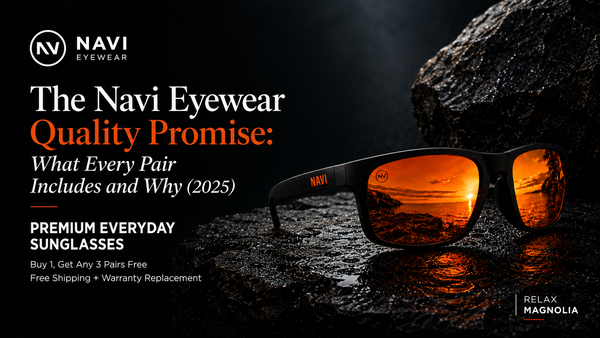

The Navi Eyewear Quality Promise: What Every Pair Includes and Why
Every sunglass brand makes quality claims. The ones worth reading are the ones that explain exactly what those claims mean, how they are achieved, and what you can do to verify them. This page does that for Navi Eyewear.
The Navi quality promise is not a marketing paragraph. It is a specific, verifiable specification applied to every pair in the collection without exception. No tier system. No basic-vs-premium distinction. Every pair that ships from Navi includes the same lens specification, the same frame construction, the same coating stack, and the same service provisions.
This page explains each element of that promise: what it is, what it physically does, why it is the right specification for genuine daily outdoor UV protection, and how you can verify it yourself rather than taking our word for it.
This is the final post in the C14 Brand and Trust cluster and the final post of the complete 80-post Navi Eyewear content calendar. It links back to the cluster pillar atwhy Navi Eyewear: our approach to UV400 and polarization.
Quick Answer
Every Navi Eyewear sunglass includes: UV400 certified polycarbonate lenses with inherent UV protection, FDA-cleared impact resistance, quality-controlled polarized PVA film, oleophobic coating, anti-saltwater coating, TR90 nylon frames, stainless 5-barrel hinges, and stainless lens logo. Four pairs for $99 with free shipping and free replacements. The specification is the same on every pair. The promise is not aspirational language — it is a description of what is physically present in each lens and frame that leaves our collection.

Table of Contents
Part 1: The Seven Promise Elements
The Navi quality promise has seven distinct elements. Each applies to every pair in the collection without exception or tier distinction. They are:
Part 2: Promise 1 — UV400 on Every Pair
|
UV400 Certification Blocks 100% of UVA and UVB to 400nm — the complete UV protection standard What it is:UV400 means the lens blocks all electromagnetic radiation in the ultraviolet range from 100 to 400 nanometres. This covers UVC (100–280nm, largely filtered by the atmosphere), UVB (280–315nm, responsible for photokeratitis and cortical cataract), and the full UVA range (315–400nm, which penetrates to the crystalline lens and retina and contributes to nuclear cataract and age-related macular degeneration). How we achieve it: Navi lenses are polycarbonate. Polycarbonate inherently absorbs UV throughout the lens material via its polymer chain chemistry. The UV protection is structural — not a surface coating. It does not degrade with surface scratching, chemical exposure, or age. How you can verify it: explicit UV400 label on the product; UV torch test (lens significantly reduces fluorescence of UV-reactive material); optician spectrophotometer measurement (definitive, takes 60 seconds, most opticians will do this free). Full verification guide:how to verify UV400 certification. Full standard explanation:what does UV400 actually mean. |
Part 3: Promise 2 — FDA-Cleared Impact Resistance
|
FDA-Cleared Impact Resistance Meets the federal standard for sunglass lens impact resistance under 21 CFR Part 801 What it is:The FDA regulates sunglasses as medical devices and requires that lenses sold in the US meet impact resistance standards before retail sale. The basic drop ball test requires lenses to withstand a 1-inch steel ball dropped from 50 inches without fracturing. Polycarbonate meets and exceeds this standard by design — it absorbs impact energy through deformation rather than fracturing catastrophically. Why it matters: glass lenses and some lower-grade plastics fracture under impact, producing sharp fragments in close proximity to the eye. The FDA standard exists specifically because glass lens fracture in everyday scenarios (road debris, drops, contact sports) is a documented cause of serious eye injury. Polycarbonate’s absence of catastrophic fracture is the safety-critical property. How you can verify it: Navi states FDA-cleared impact resistance explicitly as a product specification. For the full safety and material context, seepolycarbonate vs glass sunglass lenses: which is actually better. |
Part 4: Promise 3 — Quality-Controlled Polarization
|
Quality-Controlled Polarized Lenses Precisely aligned PVA polarizing film on every lens — verifiable with the 90-degree rotation test What it is:Navi lenses contain a polyvinyl alcohol (PVA) polarizing film embedded within the lens construction. The film is oriented vertically to block horizontally oscillating light — the polarized surface reflection from roads, water, sand, and wet surfaces that creates outdoor glare. ‘Quality-controlled’ means the film is precisely aligned and uniform, producing clean glare elimination without optical distortion or grain.How you can verify it: the 90-degree rotation test. Hold two Navi lenses face-to-face and rotate one 90 degrees while looking through both at a light source. The overlapping area should darken significantly — approaching black at full perpendicular alignment. This test confirms the presence and quality of the polarizing film. No darkening through rotation indicates absent or non-functional polarization. Full science and verification:polarized vs non-polarized sunglasses: the definitive guide. |
Part 5: Promise 4 — Oleophobic Coating
|
Oleophobic Coating Oil-repelling outer lens surface — fingerprints and smears wipe clean in one pass What it is: Oleophobic coating is an ultra-thin surface treatment that reduces the surface energy of the lens outer face. Oils from fingerprints, skin contact, and sunscreen bead up and roll off rather than spreading into smears. In practice: a single wipe with a clean microfibre cloth removes the majority of daily contamination from an oleophobic lens. Without the coating, the same contamination requires repeated buffing and often leaves residual haze. Why it matters for daily outdoor use: sunglasses are touched constantly during adjustment, removal, and storage. In active outdoor contexts, sunscreen and sweat contamination are routine. Oleophobic coating is the practical coating that makes daily usability significantly better over the lifespan of the lens. Most budget sunglass products do not include it; Navi includes it as standard. |
Part 6: Promise 5 — Anti-Saltwater Coating
|
Anti-Saltwater Coating Marine-resistant lens surface for coastal and on-water environments What it is:Anti-saltwater coating protects the outer lens surface from the specific degradation mechanism of marine environments: salt crystal deposition. When salt water evaporates on a lens surface, it leaves sodium chloride crystals. If these crystals are rubbed across the lens during cleaning — which happens automatically when wiping with fabric in the field — they act as an abrasive that scratches the lens surface and gradually degrades any surface coatings beneath them. Anti-saltwater coating reduces salt crystal adhesion, makes post-marine cleaning more effective without abrasion risk, and extends the service life of the lens surface in coastal and on-water environments. Why it matters: most sunglass brands — including heritage brands at $150–$200 per pair — do not include marine-specific lens coating as a standard feature. Navi includes it as standard because a significant proportion of sunglass use occurs in exactly these environments: beach days, boating, fishing, surfing, coastal outdoor activity. The coating that protects the lens in these conditions is part of the base specification, not a premium upgrade. |
Part 7: Promise 6 — TR90 Nylon Frames
|
TR90 Nylon Frame Construction Lightweight, flexible without snapping, impact-resistant — engineered for daily active outdoor use What it is:TR90 is a thermoplastic polyamide developed specifically for optical frame use. Its defining properties are: flexible without permanent deformation (bends under stress and springs back to shape), lightweight (approximately half the density of acetate), impact-resistant (absorbs physical impacts without snapping), and dimensionally stable across the temperature and humidity ranges of outdoor use. Why it is the right frame material for outdoor sunglasses: acetate is the premium fashion frame material for its aesthetic qualities — it looks and feels more substantial and photographs beautifully. TR90 is the right performance frame material for outdoor use because its flexibility and impact resistance mean the frame survives the physical reality of active daily use. Dropped on a hard floor. Packed without a case. Accidentally sat on. TR90 recovers from these events consistently. Acetate and thin metal frames often do not. For the material comparison, seepolycarbonate vs glass sunglass lenses: which is actually better for the parallel lens material analysis. |
Part 8: Promise 7 — Stainless 5-Barrel Hinges
|
Stainless Steel 5-Barrel Hinges The construction detail that determines whether a frame lasts 6 months or several years What it is: Every Navi frame uses stainless steel 5-barrel hinges. The 5-barrel construction distributes the rotational stress of each hinge cycle across five contact points rather than three (the standard in budget frames), dramatically extending the hinge’s working lifespan. Stainless steel resists the two most common accelerated-wear environments for hinges: salt air and marine exposure, and sweat from active outdoor use. Base metal alloys corrode and weaken in these conditions; stainless steel does not. Why it matters: the hinge is the most mechanically stressed component in any sunglass frame. A frame can have excellent lenses and poor hinges and be effectively unusable within months as the hinge loosens and the frame stops staying on the face. Stainless 5-barrel is the hinge specification used in quality-tier eyewear across performance and professional applications. Navi specifies it across the entire collection because frame longevity is part of the quality promise. |
Part 9: The Service Promise
Free Shipping
Every Navi order ships free. No minimum spend beyond the four-pair deal. Free shipping is not a promotional offer — it is the baseline delivery experience.
Free Replacements
Pairs that have been worn and develop quality issues or are damaged through normal outdoor use are replaced at no cost. The free replacement provision reflects an honest acknowledgment that sunglasses used in real outdoor conditions — dropped on trail surfaces, scratched at the beach, damaged in sport — will eventually need replacing. The cost of that reality is absorbed by Navi, not passed back to the customer.
30-Day Return Policy
Unworn sunglasses in original condition can be returned within 30 days of delivery for a full refund. Initiate via the contact form at navieyewear.com or by emailinginfo@navieyewear.com. The return policy is for buyers who decide before wearing a pair that it is not right for them. It is not a wear-and-return provision — that scenario is handled by the free replacement offer.
Buy 1, Get 3 Free
Add any four pairs to your cart atnavieyewear.com/collections/polarized. The discount auto-applies at checkout. $119 total for four pairs of the complete specification.
✨ THE COMPLETE NAVI QUALITY PROMISEUV400 • FDA-Cleared Polycarbonate • Polarized • Oleophobic • Anti-Saltwater TR90 Nylon • Stainless 5-Barrel Hinges • Free Shipping • Free Replacements • 30-Day Returns Four pairs for $119. Add 4 to cart — Buy 1, Get 3 Free auto-applies. |
Part 10: How to Verify the Promise
Every element of the Navi quality promise is verifiable. Not assumed. Not taken on faith. Here is how to test each one:
|
Promise Element |
How to Verify |
|
UV400 |
Explicit label on product + UV torch test + optician spectrophotometer |
|
FDA impact resistance |
Explicitly stated; polycarbonate material is the standard impact-resistant lens material |
|
Polarized PVA film |
90-degree rotation test: lens pair should approach black when perpendicular |
|
Oleophobic coating |
Touch test: fingerprint on coated lens beads and wipes clean; uncoated smears |
|
Anti-saltwater coating |
Stated specification; rinse test: water sheets off more cleanly than uncoated |
|
TR90 nylon |
Flex test: frame bends without snapping and returns to shape |
|
Stainless 5-barrel hinge |
Visual inspection: count barrel barrels; magnet test: stainless is not magnetic |
The complete UV400 verification guide covering all four methods — label, UV torch, rotation test, and spectrophotometer — is inhow to verify UV400 certification on any pair of sunglasses.
Part 11: The Full Specification Reference
|
Specification |
Navi Standard |
|
UV certification |
UV400 — 100% UVA/UVB to 400nm |
|
UV protection mechanism |
Inherent polycarbonate — structural, not a surface coating |
|
Lens material |
FDA-cleared impact-resistant polycarbonate |
|
Impact resistance |
Meets and exceeds FDA 21 CFR Part 801 drop ball standard |
|
Polarization |
Quality-controlled PVA polarizing film — all pairs |
|
Oleophobic coating |
Oil-repelling outer surface — all pairs |
|
Anti-saltwater coating |
Marine-resistant outer surface — all pairs |
|
Frame material |
TR90 thermoplastic polyamide nylon |
|
Hinge construction |
Stainless steel 5-barrel |
|
Logo hardware |
Stainless lens logo |
|
Frame sizing |
Dimensions on each product page |
|
Price |
$99 for four pairs (Buy 1, Get 3 Free) |
|
Shipping |
Free on all orders |
|
Replacements |
Free for worn pairs with quality issues or damage |
|
Return policy |
30 days, unworn, original condition |
|
Contact |
info@navieyewear.com or navieyewear.com contact form |
Part 12: Best For
Part 13: Common Questions About Quality
Is the quality the same across all pairs in the collection?
Yes. The specification described in this document — UV400 polycarbonate, FDA-cleared, polarized, oleophobic, anti-saltwater, TR90, stainless 5-barrel hinges — applies to every pair in the Navi collection without exception. There is no basic tier. Every pair that ships is the complete specification.
How does Navi quality compare to heritage brands?
On the specifications that determine UV protection, polarization performance, and frame durability for daily outdoor use, Navi is comparable to the quality-specified tier of heritage brands. On brand heritage, iconic silhouettes, and cultural recognition, heritage brands are distinct. The honest comparison is inNavi Eyewear vs Ray-Ban: an honest comparison.
Can the quality deteriorate over time?
The UV400 protection in polycarbonate lenses is structural and does not degrade with surface wear or age. The oleophobic coating may gradually reduce in effectiveness with extensive use and cleaning over years — this is normal for any surface treatment. The anti-saltwater coating is similarly long-lasting but not permanent. TR90 frames maintain their mechanical properties across years of normal use. Stainless hinges resist corrosion throughout their working life. If any quality issue develops in normal use, the free replacement provision is available.
What happens if I receive a defective pair?
Contact Navi Eyewear atinfo@navieyewear.com or via the contact form with your order number and a description of the issue. If a pair arrives with a manufacturing defect, Navi will replace it. For the complete returns and replacements guide, seeNavi Eyewear returns, sizing and care FAQ.
Bottom Line
The Navi quality promise is seven specific, verifiable product specifications applied without exception to every pair in the collection, backed by free shipping, free replacements, and a 30-day return policy for unworn items. It is not a marketing claim. It is a product description.
UV400 polycarbonate that does not degrade. FDA-cleared impact resistance. Quality-controlled polarization you can test in 60 seconds. Oleophobic coating that changes daily cleaning. Anti-saltwater protection for the environments most people actually use sunglasses in. TR90 frames that survive real outdoor life. Stainless 5-barrel hinges that outlast the frame.
Four pairs. $119. Free shipping. Free replacements. The complete specification. No tier system. No exceptions.
That is the Navi quality promise. Every pair. Every time.
Browse the full collection atnavieyewear.com/collections/polarized. Add 4 pairs to cart — the Buy 1, Get 3 Free discount auto-applies. Free shipping. Free replacements.

Frequently Asked Questions
Does every Navi sunglass have the same specification?
Yes. UV400 polycarbonate, FDA-cleared impact resistance, quality-controlled polarization, oleophobic coating, anti-saltwater coating, TR90 frames, and stainless 5-barrel hinges are standard on every pair in the Navi collection. There is no basic tier or entry-level model with a reduced specification.
Are Navi sunglasses FDA certified?
Navi lenses are FDA-cleared for impact resistance under 21 CFR Part 801. ‘FDA-cleared’ is the accurate regulatory term for the assessment that the lenses meet the federal impact resistance standard for retail sunglasses. Polycarbonate is the lens material used because it meets and exceeds this standard by design.
How do I verify Navi’s UV400 claim?
Four methods: (1) Check the explicit UV400 label on the product. (2) UV torch test — the lens significantly reduces UV fluorescence. (3) Optician spectrophotometer measurement — definitive and takes 60 seconds. (4) Material verification — polycarbonate inherently provides UV400 throughout the material. The complete verification guide with step-by-step instructions is inhow to verify UV400 certification on any pair of sunglasses.
Why does Navi include anti-saltwater coating when most brands don’t?
Because a significant proportion of sunglass use happens in marine and coastal environments where unprotected lens surfaces are degraded by salt crystal deposition. Including anti-saltwater coating as standard rather than as a premium upgrade means every buyer who uses their Navi sunglasses at the beach, on a boat, or in coastal outdoor settings gets a lens surface designed for that environment — not a lens surface that was not designed for it and will show the consequences over time.
What is the oleophobic coating and do I need it?
Oleophobic coating is an oil-repelling surface treatment that causes fingerprints, sunscreen, and skin oils to bead up and wipe clean rather than spreading into smears. It changes daily maintenance from ‘multiple wipes to clear’ to ‘one wipe to clear.’ For any buyer who touches their sunglasses during the day, applies sunscreen, or uses them in active conditions where sweat is involved — which describes nearly every outdoor sunglass use scenario — oleophobic coating improves the daily experience meaningfully. Navi includes it as standard because it should be standard on any sunglass priced for genuine daily outdoor use.
Why does Navi use TR90 frames rather than acetate?
Acetate is the premium fashion frame material. It photographs beautifully, has a premium feel in the hand, and is the right choice for sunglasses whose primary use is display and occasional wear. TR90 is the right frame material for sunglasses whose primary use is daily active outdoor life: driving, beach, sport, travel. It is lighter, more impact-resistant, more flexible under physical stress, and more resistant to the temperature and humidity extremes of outdoor environments. Navi makes sunglasses for daily outdoor use.
How long do Navi sunglasses last?
The polycarbonate lens UV protection is permanent — inherent throughout the material, not a degradable coating. TR90 frames maintain their mechanical properties across years of normal use. Stainless hinges resist corrosion throughout their working life. Surface coatings (oleophobic, anti-saltwater) have long service lives but gradually reduce in effectiveness with heavy use. If any pair develops a quality issue through normal use, the free replacement provision applies.
Is Navi Eyewear a trustworthy brand to buy from?
Navi Eyewear’s trustworthiness is established through specification transparency and verifiable claims rather than through marketing assertions. Every specification in the quality promise is stated explicitly and can be independently verified. The return policy is clearly defined. The contact information is publicly available. Free replacements are a stated provision, not a case-by-case discretionary offer. A brand whose claims are verifiable and whose policies are transparent is providing the conditions for trust rather than simply asserting it. For the complete brand overview, seewhy Navi Eyewear: our approach to UV400 and polarization.
Supporting Articles
THE COMPLETE SPECIFICATION. EVERY PAIR. NO EXCEPTIONS.UV400 • FDA-Cleared Polycarbonate • Polarized • Oleophobic • Anti-Saltwater • TR90 • Stainless 5-Barrel Hinges Four pairs for $119. Free shipping. Free replacements. 30-day returns on unworn items. Add 4 pairs to cart — Buy 1, Get 3 Free auto-applies at checkout. No code needed. |
SOURCES & CITATIONS[1] Taylor HR, West SK, Rosenthal FS, et al..“Effect of ultraviolet radiation on cataract formation.”New England Journal of Medicine, 1988.View source [2] Cruickshanks KJ, Klein R, Klein BE.“Sunlight and age-related macular degeneration: the Beaver Dam Eye Study.”Archives of Ophthalmology, 1993.View source [3] U.S. Food and Drug Administration.“Impact resistance requirements for sunglass lenses (21 CFR Part 801).”FDA Regulations, 2023.View source [4] Dain SJ.“Sunglasses and sunglass standards.”Clinical and Experimental Optometry, 2003.View source [5] Rosenthal FS, Bakalian AE, Lou CQ, Taylor HR.“The effect of sunglasses on ocular exposure to ultraviolet radiation.”American Journal of Public Health, 1988.View source [6] American Academy of Ophthalmology.“Sunglasses: choosing the right pair for UV protection.”AAO EyeSmart, 2023.View source [7] World Health Organization.“Solar ultraviolet radiation: global burden of disease from solar ultraviolet radiation.”WHO Environmental Burden of Disease Series, 2006.View source |