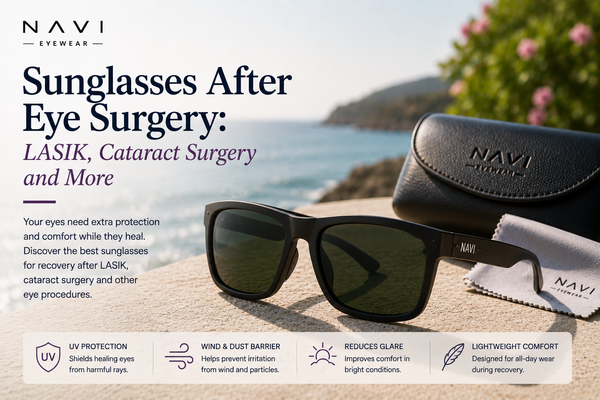

Sunglasses After Eye Surgery: LASIK, Cataract Surgery and More
Eye surgery is one of the most common elective medical procedures worldwide — cataract surgery alone is performed over 20 million times annually globally, and LASIK and other refractive procedures have been performed on hundreds of millions of patients since their introduction. For the vast majority of patients, post-operative instructions include some guidance on sun protection. For many, that guidance is incomplete, poorly explained, or not followed beyond the immediate recovery period.
The relationship between eye surgery and UV protection is nuanced and procedure-specific. For some surgeries, the procedure itself changes the eye's UV protection characteristics in ways that make long-term sunglass use more important than before the operation. For others, the immediate post-operative period is the critical window, and long-term requirements return to baseline. And for a small group — those who have lost the natural UV-filtering crystalline lens through cataract surgery and received an IOL without UV blocking — the absence of their natural UV filter makes sunglasses permanently more important than they were before the operation.
This is a C9 Eye Health Conditions supporting post. For the full science of how UV causes cumulative ocular disease — the context that makes post-surgical UV protection important — seeUV and eye disease: the complete guide to cataracts, macular degeneration and more. For the UV protection fundamentals that apply to all eyewear, seethe complete guide to UV eye protection.
Medical disclaimer:All post-surgical eye care should follow the specific instructions of your surgeon. This guide is for educational purposes only and does not substitute for professional ophthalmic advice. If you have had eye surgery and have questions about UV protection, ask your surgeon or optometrist.

Surgery by Surgery: The UV Protection Picture
|
Cataract Surgery — The Most Important Post-Surgical UV Consideration Sunglasses timing: Immediate: dark wrap-around sunglasses from the day of surgery. Long-term: depends on IOL type UV protection change: May increase or have no change depending on IOL UV-blocking status — critical to verify with surgeon Recommended spec: UV400 polycarbonate, polarized gray, close-fitting frame — confirm IOL UV blocking first
Cataract surgery removes the clouded natural crystalline lens and replaces it with an artificial intraocular lens (IOL). This has two significant UV-related implications that every cataract patient should understand. First, the natural crystalline lens — even when clouded by cataract — provides some UV filtration. Depending on how far advanced the cataract was before surgery, the natural lens may have been providing meaningful UV protection to the retina. Its removal temporarily or permanently changes the UV exposure profile of the retina.Second, and more importantly: IOL UV-blocking status varies. Modern IOLs — particularly those implanted since approximately 2000 — typically include UV-blocking material and provide UV400-equivalent protection. However, not all IOLs have this property. Some clear IOLs, particularly older designs, do not include UV blocking. If you received an IOL without UV blocking, you are now aphakic in terms of UV protection — your retina receives more UV exposure than before surgery, because the natural lens that provided some filtration has been replaced with a clear lens that provides none. The most important single action after cataract surgery: ask your surgeon specifically whether your IOL is UV-blocking. If it is, your long-term UV protection needs are similar to those of any adult — consistent UV400 sunglass use outdoors is recommended but your retinal protection is not meaningfully worse than before surgery. If your IOL is not UV-blocking, sunglasses become critically important for retinal UV protection in a way they may not have been before your operation. |
|
LASIK and Laser Refractive Surgery Sunglasses timing: Immediate post-op: dark UV400 sunglasses whenever outdoors — essential for the first week, recommended for months UV protection change: Long-term UV protection unchanged — corneal thickness reduced but UV transmission similar Recommended spec: UV400 polarized, comfortable wraparound, avoid anything that puts pressure on the eye post-op
LASIK and similar laser refractive procedures (LASEK, PRK, SMILE) reshape the corneal surface to correct refractive error. The post-operative cornea is temporarily more sensitive, more vulnerable to UV, and more susceptible to photophobia during healing. Strict UV protection in the immediate post-operative period — typically the first 1–4 weeks depending on procedure and surgeon instructions — is a universal recommendation. In the longer term, the refractive outcome of LASIK is not significantly altered by UV exposure, and UV transmission through the cornea is not meaningfully changed by the procedure. However, the thinned post-LASIK cornea is permanently less able to tolerate further corneal surgery if complications arise — making long-term ocular health protection important even when immediate post-operative recovery is complete. Consistent UV400 sunglass use protects the corneal tissue and surrounding ocular structures from the cumulative UV damage that contributes to corneal conditions, cataracts, and macular disease. Practical notes for LASIK patients in the immediate post-operative period: choose sunglasses that do not apply pressure to the eye or orbital area — avoid tight-fitting sport frames that press against the face; choose lightweight frames with minimal temple pressure; avoid rubbing the eye when removing glasses. The photophobia that commonly occurs in the immediate post-LASIK period makes good sunglass protection particularly important for comfort as well as healing. |
|
Retinal Surgery (Vitrectomy, Retinal Detachment Repair, Macular Surgery) Sunglasses timing: Follow surgeon's specific timeline — typically dark sunglasses outdoors from discharge UV protection change: Retina directly accessible to UV during recovery — heightened protection priority Recommended spec: UV400, adequate darkness (Category 3), polarized recommended; avoid frames that require bending
Retinal surgery — vitrectomy for macular holes or epiretinal membrane, retinal detachment repair, or surgery for diabetic retinopathy complications — involves the posterior segment of the eye. The retina in the post-operative period is particularly vulnerable: surgical manipulation, potential gas bubble or silicone oil tamponade, and altered intraocular dynamics all affect the retinal environment during healing. Specific UV considerations vary by procedure and whether gas or oil tamponade is used — your surgeon will provide specific guidance. As a general principle, UV400 sunglasses are recommended from the time of discharge whenever outdoors, for the full recovery period and beyond. Patients who have had retinal surgery for conditions associated with UV damage — in particular, those with macular conditions — have particular reason to be rigorous about long-term UV protection to slow progression of any underlying UV-related pathology. |
|
Glaucoma Surgery (Trabeculectomy, Tube Shunt, Minimally Invasive Glaucoma Surgery) Sunglasses timing: Strict UV and physical eye protection immediately post-op; long-term protection consistent with glaucoma management UV protection change: Surgical wound on the eye surface requires protection; light sensitivity common post-operatively Recommended spec: UV400, wraparound protection from wind and physical contact; avoid frames that press on surgical site
Glaucoma surgery creates openings in the eye or implants drainage devices to reduce intraocular pressure. The immediate post-operative period requires careful protection of the surgical site — frames must not apply pressure to the eye and must not allow direct UV or wind contact with the healing bleb (the filtration blister on the eye surface in trabeculectomy). Wraparound UV400 sunglasses that protect without pressing on the eye are appropriate. Many glaucoma patients also experience significant light sensitivity post-operatively that may persist for weeks — adequate sunglass darkness is important for comfort as well as protection. Long-term, people with glaucoma benefit from UV protection for the same reasons as any adult — cumulative UV exposure contributes to the ocular conditions that can compound glaucoma-related vision loss. |
|
Corneal Transplant (Penetrating Keratoplasty, DSAEK, DMEK) Sunglasses timing: Extended UV protection essential — corneal grafts are UV-sensitive during integration UV protection change: Transplanted cornea UV sensitivity may differ from native cornea during healing period Recommended spec: UV400, wraparound physical protection, light frames — physical impact protection also important
Corneal transplant surgery replaces diseased corneal tissue with donor tissue. The transplanted cornea integrates over months to years, during which it may have different UV transmission characteristics than a native cornea and is certainly more vulnerable to physical trauma that could displace the graft. UV400 sunglasses serve a dual purpose for corneal transplant patients: UV protection for the healing tissue and physical protection against accidental impact or rubbing. Sunglasses should be worn consistently outdoors throughout the integration period and beyond. Patients with corneal transplants should follow their surgeon's guidance on specific sunglass requirements, as the procedure type (full thickness vs partial thickness) affects healing timelines. |
The Cataract Surgery Deep Dive: IOL UV Blocking — What to Ask Your Surgeon
The IOL UV-blocking question is the most clinically significant UV consideration in all of eye surgery, yet it is one that most patients are not proactively informed about. Here is exactly what to ask and what the answers mean:
For the full context of why retinal UV protection matters long-term — including the AMD and cataract evidence — seeUV and eye disease: the complete guide.
Choosing Sunglasses for Post-Surgical Use
The Universal Post-Surgical Specification
Regardless of the specific procedure, the post-surgical sunglass specification has consistent elements. UV400 certification is non-negotiable — the recovering eye is more vulnerable to UV than a healthy one and needs the full UV400 protection standard. A close-fitting frame that protects from wind and physical contact as well as UV. Adequate darkness — Category 3 (8–18% VLT) is typically appropriate for outdoor use. Polarization is recommended for anyone who drives or is near water. Lightweight construction that does not press on the periocular area. For the UV certification verification guide, see7 signs your sunglasses are not protecting your eyes.
What to Avoid Post-Surgery
Browse theNavi Eyewear UV400 polarized collection for lightweight, close-fitting UV400 polarized frames appropriate for post-surgical use and long-term ocular UV protection. For the buying guide that applies to any sunglass purchase including post-surgical replacement pairs, seethe complete sunglasses buying guide.
Frequently Asked Questions
How soon after cataract surgery can I wear sunglasses?
Most surgeons recommend wearing sunglasses outdoors from the day of surgery — immediately after the protective shield is removed in the recovery room, or the following morning for procedures done under local anaesthetic. UV protection and physical protection from accidental eye contact are both important in the immediate post-operative period. The specific timing should follow your surgeon's instructions, but waiting any significant period before wearing sunglasses outdoors is not recommended for any common cataract surgery approach.
Do I need to wear sunglasses after cataract surgery forever?
If your IOL is UV-blocking (the majority of modern IOLs are), your long-term UV protection need is similar to that of any adult — consistent UV400 sunglass use outdoors is recommended for general eye health but not because the surgery specifically increased your UV risk. If your IOL is not UV-blocking, then yes — long-term consistent sunglasses are more important than before your surgery because your retina now lacks the natural UV filtration that your crystalline lens provided. The most important thing is to verify your IOL type with your surgeon. The UV and cataract disease science is inUV and eye disease: the complete guide.
How long should I wear sunglasses after LASIK surgery?
The immediate post-operative period — typically the first 1–2 weeks — is the most critical window for UV protection after LASIK, as the corneal flap or surface is healing and is more vulnerable to UV and physical contact. Most surgeons recommend dark UV400 sunglasses for all outdoor exposure during this period. After healing is confirmed by your surgeon, the long-term UV protection requirement returns to normal adult baseline — consistent UV400 sunglass use outdoors, not an emergency requirement but a sensible long-term health practice.
Can I wear contact lenses with sunglasses after eye surgery?
The specific contact lens timeline after eye surgery varies by procedure and surgeon instructions. After LASIK, contact lens wear is permanently discontinued (the procedure eliminates the need for them). After cataract surgery, if you previously wore contacts for distance correction and still need correction for near, your surgeon will advise on when contact lens wear can resume. In general, post-surgical eyes are more vulnerable to contact lens complications — infection risk is elevated and the ocular surface may be more fragile. For the full contact lens vs sunglasses decision after surgery, seeprescription sunglasses vs contact lenses and sunglasses.
What are the best sunglasses after cataract surgery?
UV400 polarized gray lenses in a lightweight, close-fitting frame with minimal pressure on the orbital area. Gray polarized is the most versatile specification for post-cataract everyday use — it provides color accuracy for driving and daily activities while eliminating road and surface glare. For patients whose IOL does not include UV blocking, polycarbonate lenses with inherent UV protection (not a surface coating that can degrade) are particularly important for long-term retinal protection. The full cataract surgery UV implications and IOL UV blocking question are in this guide's cataract section above. For the prescription sunglass option if your vision correction needs have changed post-surgery, seethe complete guide to prescription sunglasses.
Does LASIK make eyes more sensitive to light permanently?
Most LASIK patients experience temporary increased light sensitivity in the weeks following surgery — this is a normal part of the healing process as corneal nerves regenerate. For the majority of patients this resolves within 3–6 months. A small percentage of LASIK patients experience persistent light sensitivity beyond this period — this should be discussed with the surgeon as it may indicate incomplete healing or a complication. Long-term photophobia that predates LASIK is not caused by the procedure but may be a condition worth addressing separately through appropriate tinted lenses or clinical management.
Should I wear UV400 or polarized sunglasses after retinal surgery?
Both. UV400 for protection of the healing retinal tissue from further UV photochemical damage — particularly important for patients whose retinal surgery was related to a UV-associated condition. Polarization for glare elimination that is particularly beneficial during recovery when light sensitivity is often elevated. The combination of UV400 polarized lenses in a close-fitting frame provides the broadest protection for post-retinal surgery outdoor use. For the retinal UV disease mechanisms, seeUV and eye disease: the complete guide.
What happens if I don't wear sunglasses after eye surgery?
In the immediate post-operative period, not wearing sunglasses outdoors exposes the healing eye to: UV radiation that delays corneal healing and increases tissue stress; bright light that causes discomfort and reflexive squinting that can disrupt healing; wind and dust that carry infection risk to the surgical site; and physical risk of accidental impact or rubbing. In the longer term, not wearing sunglasses after cataract surgery with a non-UV-blocking IOL significantly increases lifetime retinal UV dose and associated AMD and phototoxic retinal damage risk.
Do I need prescription sunglasses after eye surgery?
After cataract surgery, many patients find their distance vision significantly improved or corrected, reducing or eliminating the need for prescription distance sunglasses. However, if any residual refractive error remains — which is common even after successful cataract surgery — or if the surgery was combined with reading correction that leaves distance slightly defocused, prescription sunglasses may still be beneficial. After LASIK, the goal is emmetropia (no refractive error), so prescription sunglasses are typically not needed post-operatively. For patients whose vision correction needs remain, the full prescription sunglasses options are inthe complete guide to prescription sunglasses.
Are there sunglasses specifically designed for post-eye surgery patients?
Several brands produce protective eyewear designed specifically for post-surgical patients: typically lightweight polycarbonate wraparound frames with UV400 lenses, adjustable temple arms, and foam or silicone inner rim padding to provide physical protection without pressure on the periocular area. These are available through ophthalmology practices and online optical retailers. For most patients, a quality standard UV400 polarized frame with close-fitting geometry serves the same purpose without the need for specialist surgical eyewear — the critical requirements (UV400, lightweight, close-fitting, no pressure on the eye) can be met by many mainstream options.
Can I wear sunglasses immediately after retinal detachment surgery?
Yes — UV400 sunglasses are recommended outdoors from the time of discharge. The specific post-operative instructions from your surgeon will govern when and how you can be outdoors, but when you are outside, UV400 protection is appropriate from immediately after surgery. If you have a gas bubble as part of your retinal repair, your surgeon will have specific restrictions on body position and activity — follow these precisely. The gas bubble itself can act as a lens and focus light on the retina, making UV protection during this period particularly important.
SOURCES & CITATIONS[1] Mainster MA."Intraocular lenses should block UV radiation and violet but not blue light."Archives of Ophthalmology, 2005.View source [2] Taylor HR, West SK, Rosenthal FS, et al.."Effect of ultraviolet radiation on cataract formation."New England Journal of Medicine, 1988.View source [3] Dain SJ."Sunglasses and sunglass standards."Clinical and Experimental Optometry, 2003.View source [4] Rosenthal FS, Bakalian AE, Lou CQ, Taylor HR."The effect of sunglasses on ocular exposure to ultraviolet radiation."American Journal of Public Health, 1988.View source [5] American Academy of Ophthalmology."Cataract surgery: what to expect before, during and after."AAO EyeSmart, 2023.View source [6] Sliney DH."UV radiation ocular exposure dosimetry."Documenta Ophthalmologica, 1994.View source |