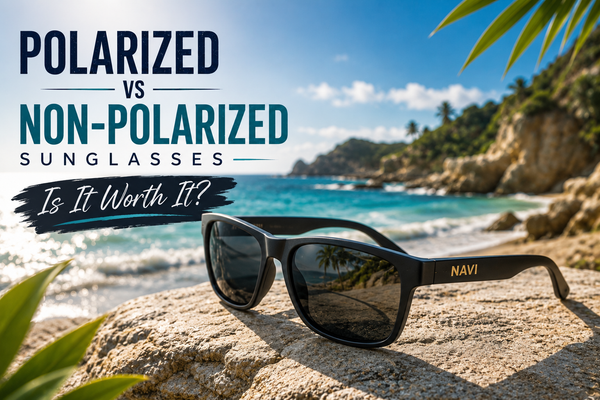

Polarized vs Non-Polarized Sunglasses: Is It Worth It?
Polarized lenses are worth it for virtually every outdoor use case involving reflective surfaces — driving, water, beach, sport, hiking. They eliminate horizontally polarized surface glare that non-polarized lenses at any darkness level cannot address. A non-polarized Cat 3 lens reduces all light by 85–92%; a polarized Cat 3 lens reduces all light by 85–92% AND removes the specific directional reflected glare component that causes the most visually disruptive outdoor glare. The result is not a darker version of the same scene — it is a qualitatively different visual experience with the glare layer removed. The one context where non-polarized is the better choice: specific ski conditions with flat light where terrain contrast cues are more important than glare elimination.

1. What Polarized Lenses Actually Do That Non-Polarized Don't
The Specific Glare They Target
When light reflects off a horizontal surface — road, water, wet sand, glass — the reflected light becomes predominantly horizontally polarized. This reflected light is brighter, more directional, and more visually disruptive than the ambient light from which it originates. It superimposes a high-luminance layer on top of the visual scene that the eye's pupil contracts to manage, reducing the effective aperture for the lower-luminance scene beneath it.
A polarization filter oriented with its transmission axis vertical blocks this horizontal component specifically. The result: the water surface glare disappears, the road surface reflection vanishes, the sand glare reduces dramatically — while the ambient scene illumination passes through normally. This is why polarized lenses feel qualitatively different from simply darker lenses: they are not reducing all light uniformly, they are removing a specific disruptive component.
What Non-Polarized Lenses Do Instead
Non-polarized tinted lenses reduce all incoming light uniformly — the tint absorbs a percentage of all wavelengths equally (gray) or selectively (amber, copper). This reduces overall brightness, which is comfortable and reduces eye fatigue from sustained bright conditions. But the ratio of glare-to-scene luminance is essentially unchanged. A water surface reflecting sunlight at 10x the ambient scene luminance still reflects at 10x after a non-polarized lens reduces both by the same factor. The glare is dimmer in absolute terms but equally dominant relative to the scene.
Non-polarized UV400 lenses provide complete UV protection — the health case for sunglasses. They do not provide the visual performance improvement that polarization adds. A non-polarized UV400 lens is adequate protection; a polarized UV400 lens is adequate protection plus significantly better outdoor vision in any environment with reflective surfaces.
2. The Difference in Practice: Key Scenarios
Driving: The Most Universal Polarization Use Case
Most drivers encounter reflective surface glare every day regardless of weather. Road surface glare from wet or damp pavement, windshield reflection from the dashboard (the instrument panel reflected on the inside of the windshield at low sun angles), and the glare from oncoming vehicles — all horizontally polarized, all eliminated specifically by polarization. For westbound afternoon driving when the setting sun hits the windshield directly, the polarization benefit for road surface reflection is most dramatic. For rain driving on wet roads, the wet surface creates more intense polarized reflection than dry pavement, making polarization most valuable precisely when driving conditions are most challenging.
Gray polarized UV400 is the driving specification — gray for color accuracy at traffic signals and road markings, polarized for road glare elimination. See best sunglasses for driving for the complete driving guide.
Water: The Most Dramatic Polarization Demonstration
Water surface glare is the most purely horizontally polarized common glare source — at Brewster's angle (approximately 53 degrees from vertical for water), reflected light is essentially completely horizontally polarized. The polarization filter eliminates this reflection with near-complete effectiveness. A water surface that appears as a bright opaque mirror through non-polarized lenses becomes visually transparent through polarized lenses — the illuminated scene below the surface becomes visible.
This is the demonstration that converts non-believers: have someone look at a lake or ocean through non-polarized lenses, then hand them polarized lenses. The transition is immediate and dramatic. Every reflective surface they've spent their life looking at through dark lenses has been obscuring what was behind it. This is the most powerful single argument for polarization — not a marginal improvement but a qualitatively different view of the world near water.
Beach: Sand and Water Combined
Beach environments combine sand surface glare (partially polarized, partially diffuse) and ocean water glare (near-completely polarized) with overhead UV from direct sun. Polarization addresses the water glare completely and the sand glare significantly. The combined visual experience at a beach through quality polarized lenses vs non-polarized is one of the most immediately perceptible differences in eyewear — the reduction in squinting alone is noticeable within minutes of switching from non-polarized to polarized at a beach environment.
Outdoor Sport: Contrast and Glare
Outdoor sport — cycling, running, hiking, ball sports — involves both surface glare (road, trail, court) and the visual performance benefits of contrast enhancement from polarization. For cycling, road surface reflection in wet conditions is hazardous as well as uncomfortable — polarization eliminates the road glare that can obscure road hazards. For trail running and hiking, ground surface reflection and water surface glare on stream crossings and ponds are eliminated. For ball sports, court surface glare that can make ball tracking more difficult is reduced.
3. The Visual Fatigue Argument
Why Glare Causes Fatigue
Sustained outdoor exposure to high-luminance glare causes progressive visual fatigue through a specific mechanism: the pupil constricts to manage the peak luminance of the glare source while the scene behind the glare requires more aperture (larger pupil) to maintain visual quality. The visual system cycles continuously between these competing demands — constricting for the glare, opening for the scene — a cycle that produces measurable fatigue over extended outdoor sessions.
Polarized lenses eliminate the high-luminance glare stimulus that drives pupillary constriction. The pupil can operate at the aperture appropriate for the ambient scene luminance without the competing high-luminance glare driving it shut. Studies of extended outdoor activity comparing polarized and non-polarized lenses consistently find reported visual fatigue lower for polarized wearers after equivalent outdoor sessions. Drivers, anglers, cyclists, and outdoor workers who use polarized lenses for the first time consistently report less end-of-day eye fatigue than with their previous non-polarized lenses.
4. When Non-Polarized Is the Right Choice
Flat Light Skiing
In flat light ski conditions — heavily overcast, diffuse illumination — the subtle surface texture variations in snow that indicate terrain features and moguls are visible primarily through contrast differences at the snow surface. Some of these contrast cues involve the specular reflection from snow surface undulations that polarization reduces. Experienced skiers in flat light conditions sometimes prefer unpolarized high-contrast lenses (amber or yellow) that maintain all surface reflection cues over polarized lenses that reduce some of them. In bright ski conditions, polarization is beneficial; in flat light, this specific consideration applies.
LCD Instrument Panels
Some car instrument clusters, aircraft cockpit displays, and industrial equipment use LCD panels with polarization that interacts with polarized sunglass lenses at certain orientations, causing the screen to appear dark or washed out. For pilots who rely on instrument panel LCD displays, non-polarized UV400 lenses avoid this interaction. For most driver applications, the interaction is manageable by adjusting viewing angle — but for professional aviation and some specific instrument panel configurations, non-polarized is the technically correct choice.
Low-Cost UV Protection When Budget Is the Constraint
Non-polarized UV400 polycarbonate lenses cost less to manufacture than polarized equivalents. When budget is the primary constraint and the choice is between a non-polarized UV400 polycarbonate lens and nothing (or a non-UV-blocking dark lens), non-polarized UV400 polycarbonate is the right choice — it provides complete UV protection even without the visual performance improvement of polarization. UV protection is the health imperative; polarization is the performance improvement.
5. Comparing the Two Directly
| Property | Non-Polarized UV400 | Polarized UV400 |
|---|---|---|
| UV protection | Complete — 100% UV-A and UV-B blocked | Complete — identical to non-polarized |
| Overall brightness reduction | Yes — by lens category (Cat 1–3) | Yes — by lens category (Cat 1–3) |
| Surface glare elimination | No — glare reduced proportionally with overall brightness | Yes — horizontally polarized surface glare specifically eliminated |
| Water surface visibility | Blocked by surface reflection | Sub-surface visible through eliminated surface glare |
| Road glare in wet conditions | Reduced but present | Essentially eliminated |
| Visual fatigue in glare environments | Higher — pupil cycles against glare | Lower — glare stimulus removed |
| LCD screen compatibility | No interaction — screens appear normal | Some LCD screens appear dark at certain orientations |
| Flat light ski terrain visibility | Better — all surface reflection cues preserved | Slightly reduced — some surface cues removed with glare |
| Cost | Lower | Slightly higher |
| First-use experience near water | Dark, comfortable | Dramatic — glare disappears, sub-surface visible |
6. How to Verify Polarization
The LCD Screen Test
Hold polarized lenses in front of an LCD screen (phone, tablet, laptop) and slowly rotate the lens. At approximately 90 degrees from the neutral orientation, the screen goes dark or completely black. The effect is distinct and unambiguous — non-polarized lenses produce no such effect at any orientation. This test works for most LCD screens; OLED screens (many flagship smartphones) do not show this effect because OLED displays don't use a polarization filter.
The Two-Lens Test
Hold two polarized lenses face to face and slowly rotate one lens relative to the other. At 90 degrees relative orientation, the combined system goes nearly black — the two polarization filters together block essentially all light. Non-polarized lenses don't show this effect regardless of relative orientation.
The Reflection Test
Look at a horizontal reflective surface (water, car hood, wet pavement) through the lens and rotate the lens 90 degrees. At the correct orientation for glare elimination, the reflection dramatically reduces or disappears. At 90 degrees from that orientation, the reflection returns to full brightness. This test directly demonstrates the functional purpose of polarization in the use context where it matters most.
Frequently Asked Questions
Are polarized sunglasses better for your eyes?
For UV protection: identical — both UV400 polarized and UV400 non-polarized provide complete UV protection. For visual comfort and fatigue: yes — polarized lenses eliminate the specific surface glare component that causes the most visual fatigue in outdoor environments. For specific use cases like flat light skiing or LCD instrument panel viewing: non-polarized may be preferable. For general outdoor use, driving, water, and sport: polarized is the better choice.
Can you tell if sunglasses are polarized without testing?
Not reliably from appearance alone — polarized and non-polarized lenses can look identical. The LCD screen test is the most reliable and accessible verification: hold the lens in front of an LCD screen and rotate slowly; genuine polarization causes the screen to go dark at 90 degrees. Looking at a water or road surface provides a functional test — polarized lenses visibly reduce the reflection in a way non-polarized lenses at the same darkness level do not.
Do polarized lenses affect color perception?
The polarization film itself does not significantly affect color perception — it selectively blocks a polarization state of light, not a wavelength range. The tint of the lens (gray, amber, copper) affects color perception; the polarization does not add meaningful additional color shift beyond the tint. Gray polarized provides color-neutral vision; amber polarized provides warm-shifted contrast-enhanced vision — these color effects come from the tint, not the polarization.
Are polarized sunglasses good for driving?
Yes — gray polarized UV400 is the standard driving recommendation. Polarization eliminates road surface reflection glare (the dominant source of driving glare on roads and wet pavement) and windshield dashboard reflection. The color accuracy of gray tint maintains traffic signal and road marking discrimination. The polarization benefit for driving is immediate and practical — particularly noticeable in wet conditions and at low sun angles. See best sunglasses for driving.
Why do polarized sunglasses make some car windows look weird?
Tempered glass (used in side and rear car windows) is stress-patterned during manufacturing — the stress produces a polarization effect that is visible through polarized lenses as a rainbow or grid pattern in the window. This is a property of the glass, not a defect in the polarized lens. Laminated windshields typically don't show this effect. The pattern is purely visual — it does not affect the glass's safety or integrity — and is not visible to non-polarized lens wearers.
Is the price difference between polarized and non-polarized worth it?
Yes — for any outdoor use involving reflective surfaces (which includes essentially all outdoor use). The polarization benefit is not marginal — it is the difference between having a specific disruptive glare component in your visual field and not having it. For driving, water, beach, and sport contexts, the improvement is immediately perceptible and sustained across every wearing session. All Navi Eyewear lenses are polarized as standard — it is the baseline specification, not an upgrade. Browse UV400 polarized options at navieyewear.com.
Do polarized sunglasses protect against UV better than non-polarized?
No — UV protection is independent of polarization. Both UV400 polarized and UV400 non-polarized lenses provide complete UV protection when the UV400 polycarbonate specification is present. Polarization provides the visual performance improvement (surface glare elimination); the polycarbonate substrate provides the UV protection. The two are additive — polarized UV400 polycarbonate provides both complete UV protection and polarized glare elimination simultaneously.
The Bottom Line
Polarized lenses are worth the upgrade for virtually every outdoor use case — they eliminate the specific horizontally polarized surface glare that non-polarized lenses cannot address at any darkness level, producing a qualitatively different visual experience near water, roads, sand, and any reflective surface. The UV protection is identical; the visual performance and reduced fatigue are meaningfully better with polarization. The one specific exception is flat light skiing where terrain contrast cues outweigh glare elimination. For driving, water activities, beach, sport, and everyday outdoor use: polarized UV400 polycarbonate is the correct specification. All Navi Eyewear lenses are polarized as standard. navieyewear.com/collections/polarized — Buy 1, Get 3 Free for $119.
Related Reading
- The Complete Sunglass Buyer's Guide | Navi Eyewear
- How Polarized Sunglasses Work: The Science of Glare Elimination | Navi Eyewear
- Cheap vs Expensive Sunglasses: What You're Actually Paying For | Navi Eyewear
- Best Sunglasses for Driving | Navi Eyewear
- Best Sunglasses for Beach Volleyball | Navi Eyewear
- The Science of Lens Color: What Tint Does Your Vision Need? | Navi Eyewear
- UV400: What It Means and Why It Matters | Navi Eyewear
- Shop Polarized UV400 Sunglasses | Navi Eyewear
Sources & Citations
[1] Hecht E. "Optics." 4th edition. Addison Wesley, 2002. View source →
[2] Dain SJ. "Sunglasses and sunglass standards." Clinical and Experimental Optometry, 2003. View source →
[3] Rosenthal FS, et al. "The effect of sunglasses on ocular exposure to ultraviolet radiation." American Journal of Public Health, 1988. View source →
[4] Sliney DH. "Ocular exposure to environmental light and ultraviolet." Journal of AAPOS, 2014. View source →
[5] Taylor HR, et al. "Effect of ultraviolet radiation on cataract formation." New England Journal of Medicine, 1988. View source →
[6] WHO. "Global solar UV index: a practical guide." World Health Organization, 2002. View source →