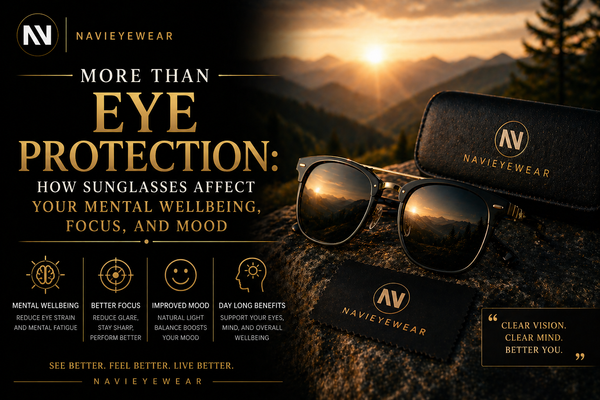
The conversation around sunglasses has almost always been framed around physical eye health — UV damage, cataract prevention, glare reduction. These are legitimate and well-documented benefits. But an emerging body of research is expanding the picture significantly, revealing meaningful connections between light management, visual comfort, and mental wellbeing that most people wearing sunglasses have never considered.

The sunglasses on your face aren't just filtering UV radiation. They're actively shaping the quality of your sensory experience — your comfort, your cognitive load, your stress levels, and your ability to focus — every moment you're wearing them. Here's the science behind that connection, and what it means for the pair you choose.
The Physiology of Glare and Cognitive Load
When your visual system encounters unfiltered glare, it doesn't simply experience discomfort and move on. According to research published inthe journal Ergonomics, sustained glare exposure triggers a measurable physiological stress response: pupillary constriction, increased cortical activation in the visual processing areas of the brain, elevated muscle tension in the face and temples, and an autonomic nervous system response consistent with mild environmental stress.
In practical terms: squinting is work. Your brain is expending real cognitive resources managing a visual environment it wasn't designed to handle. Those resources aren't available for the conversation you're having, the decision you're making, or the trail you're navigating. High-quality polarized lenses remove that cognitive tax entirely — your visual system relaxes into its natural state, and the freed-up processing capacity returns to where you want it.
Light Sensitivity and the Migraine-Glare Connection
For the estimated 39 million Americans who experience migraines, light sensitivity — photophobia — is among the most debilitating associated symptoms. TheAmerican Migraine Foundation notes that both the prodrome phase (before a migraine) and the interictal phase (between attacks) involve heightened light sensitivity that makes bright, unfiltered environments actively uncomfortable.
Polarized lenses significantly reduce the specific type of light — high-intensity, directional glare — that most acutely triggers photophobic discomfort. For migraine sufferers, wearing quality polarized sunglasses in outdoor environments isn't a luxury; it's a functional intervention that reduces the frequency and intensity of light-triggered episodes.
Beyond migraine, research cited bythe Vision Council of America identifies glare-induced eye strain as a significant contributor to tension headaches in the general population — particularly among people who spend extended periods commuting, outdoors, or in variable light environments. Consistent use of polarized UV400 eyewear is among the most accessible preventive strategies available.
Sunlight, Circadian Rhythm, and Mood
This is where the science becomes particularly nuanced. Sunlight — including the UV and high-energy visible light that sunglasses filter — plays a direct role in regulating circadian rhythm through specialized photoreceptors in the eye calledintrinsically photosensitive retinal ganglion cells (ipRGCs). These cells, described in detail bythe National Institutes of Health, are primarily sensitive to blue light and transmit directly to the suprachiasmatic nucleus — the brain's master clock.
The practical implication: your eyes are not just seeing the world. They're synchronizing your internal biology to it. Morning light exposure — even through sunglasses that don't filter all visible light — supports healthy circadian entrainment. Late-afternoon and evening sunglasses use, conversely, can help prevent the cortisol suppression and melatonin disruption associated with excessive bright light exposure in the hours before sleep.
This is one reason why the timing and quality of your light exposure — managed in part by when and what you wear on your eyes — has measurable effects on mood, energy, and sleep quality.Research from Harvard Medical Schoolon blue light's role in circadian disruption underscores that managing your light environment is a legitimate wellness intervention, not a fringe concern.
The Stress of Visual Noise
Urban environments and bright outdoor settings generate what researchers callvisual noise — the combination of contrast shifts, glare events, reflective surfaces, and movement that the visual system must continuously process and filter. In environments with high visual noise — a busy city street on a bright day, a highway drive into a low sun — the brain's attentional resources are heavily taxed by involuntary visual processing.
Polarized lenses don't just eliminate glare. They reduce visual noise across the field of view, producing a cleaner, more stable visual scene that demands less automatic processing. Users consistently report feeling calmer, more focused, and less fatigued in demanding visual environments when wearing quality polarized lenses — a subjective experience that the research on cognitive load and visual processing gives clear physiological grounding.
Color Rendering and Emotional Response
The lens tint you choose does more than adjust brightness — it shapes how you experience color, contrast, and the emotional quality of your visual environment. This is not trivial.Research in environmental psychology consistently demonstrates that color environment influences mood, arousal level, and emotional valence in measurable ways.
Neutral Gray Lenses
Preserve natural color rendering while reducing brightness. The world looks as it is, just dimmer. Ideal for those who value perceptual accuracy and find color distortion disorienting.
Amber and Brown Lenses
Warm the visual environment and enhance contrast. Users typically describe the experience as energizing and confidence-inducing — the heightened contrast and depth perception creates a visual clarity that feels active rather than passive. TheMagnolia (Relax) lens captures this quality beautifully.
Lavender and Rose Tints
Filter blue light while softening the visual environment. Typically described as calming — useful in high-stimulation environments. TheThirst (Melrose) lavender lens occupies this territory with genuine style.
The Confidence Effect
There's one more dimension worth addressing — less scientific, but genuinely real: the effect of wearing a pair of sunglasses you love on your experience of moving through the world.Research in embodied cognition — the study of how physical experience and appearance affect mental state — consistently finds that what people wear on their bodies influences their self-perception, confidence, and social performance.
A pair of sunglasses that fits beautifully, that you chose deliberately, that you know is well-made — changes how you hold yourself and how you experience public space. The protection is physical. The effect is psychological. And both are real.
Practical Implications: Choosing for Wellbeing
The wellbeing case for quality sunglasses adds several considerations to the standard UV-and-glare checklist:
— — —
Sunglasses protect your eyes. The right ones do considerably more than that.Find yours at NaviEyewear.com.