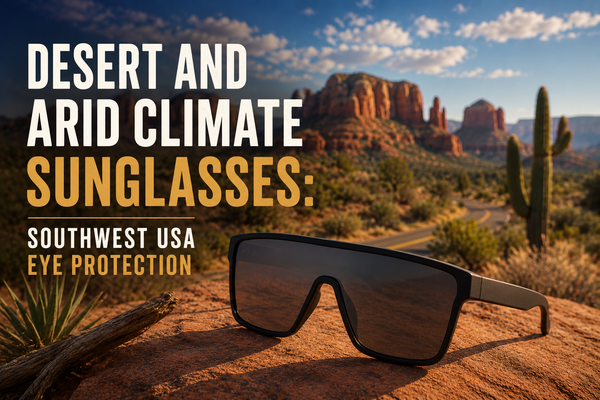

Desert and Arid Climate Sunglasses: Southwest USA Eye Protection
The American Desert Southwest — Arizona, Nevada, New Mexico, Utah's canyon country, Southern California deserts — is the highest UV zone in the continental United States. UV index values exceed 10 on clear days from March through October across most of the region, with Phoenix and Las Vegas regularly hitting 12+ in summer. Desert UV combines high base UV from southern latitude with altitude amplification (most popular destinations sit at 1,000–2,000m above sea level) and sand and rock reflectance (10–20% UV reflected upward). The lens specification for desert travel: gray or amber polarized UV400 Cat 3, with wraparound geometry for wind and dust, and oleophobic coating for effective lens cleaning in dusty conditions.
Desert destinations attract millions of visitors annually — Grand Canyon, Zion, Bryce Canyon, Sedona, Joshua Tree, Arches, Death Valley, the Las Vegas Strip, Scottsdale, Santa Fe — and the UV environment at all of them is significantly more intense than most visitors' home UV baseline. A traveler from Seattle or Chicago visiting Arizona in April is moving from a home UV index of 3–5 to a destination UV index of 8–10, in an environment where outdoor sightseeing, hiking, and desert exploration means 6–10 hours of peak-UV outdoor time. For the complete travel UV framework, see the traveler's complete sunglasses guide.

1. Why Desert UV Is Different
The Three Desert UV Amplifiers
Desert Southwest UV is amplified above the raw UV index by three compounding factors that are simultaneously present at virtually every popular desert destination:
- Southern latitude: the Desert Southwest lies between approximately 31–37°N latitude — significantly closer to the equator than most US population centers. This positions the sun at a higher elevation angle year-round, reducing atmospheric path length and increasing UV intensity at ground level.
- Altitude: the Sonoran Desert (Phoenix) sits at 330m; Sedona at 1,310m; Flagstaff at 2,100m; the Grand Canyon South Rim at 2,100m; Zion National Park at 1,100–2,600m; Moab at 1,220m. At these elevations, UV is 10–25% above sea-level baseline for the same latitude and season. Many visitors don't account for altitude UV when planning desert trips because altitude is typically associated with cold, not heat.
- Surface reflectance: dry desert sand reflects approximately 15–20% of UV upward; light-colored sandstone and limestone rock (the dominant surface material at most Utah canyon destinations) reflects 10–15% of UV. Combined with direct overhead UV, desert ground surfaces create meaningful upward UV exposure that reaches the lower orbital area and under-eye skin that overhead sun doesn't directly contact.
Year-Round Desert UV
Unlike most of the continental US where UV drops substantially in winter, Desert Southwest UV remains meaningful year-round. Phoenix UV index in December and January averages 4–6 on clear days — comparable to spring UV in the Northeast or Midwest. For snowbirds, winter visitors, and year-round desert residents, UV protection is not a seasonal consideration but a permanent one.
Desert Light and Visual Intensity
Beyond UV, the visual light environment of desert destinations is uniquely intense. Desert air is exceptionally clear — low humidity and minimal particulate matter means reduced atmospheric scattering of visible light. The result is a visual environment of exceptionally high contrast and brightness that is visually fatiguing without appropriate eye protection. Glare from desert rock surfaces, white salt flats, and sand dunes produces a sustained high-luminance visual environment that demands darker lens categories than most everyday environments.
2. Desert UV by Location
| Destination | Elevation | Summer UV Index | Winter UV Index | Key Notes |
|---|---|---|---|---|
| Phoenix, AZ | 330m | 11–12 | 4–6 | Highest sustained UV in continental US; year-round protection essential |
| Las Vegas, NV | 620m | 11–12 | 4–5 | Pool and strip outdoor time in peak UV; tourists underprotected |
| Sedona, AZ | 1,310m | 11–12+ | 5–7 | Altitude + red rock reflection; hiking UV very high |
| Grand Canyon South Rim, AZ | 2,100m | 12–13+ | 5–7 | High altitude + open sky + pale limestone; Cat 3 mandatory |
| Moab / Arches, UT | 1,220m | 11–12 | 4–6 | Red sandstone reflection; popular spring/fall hiking — both high UV |
| Zion National Park, UT | 1,100–2,600m | 11–13 | 4–6 | Altitude variation; canyon walls reflect UV laterally |
| Joshua Tree, CA | 820–1,240m | 11–12 | 5–7 | High desert altitude; pale granite reflection; year-round visitor destination |
| Death Valley, CA | -86–900m | 12–13 | 5–7 | Lowest elevation in US + extreme southern latitude = highest UV |
| Santa Fe, NM | 2,100m | 11–12 | 4–6 | High altitude; outdoor arts and markets; significant tourist outdoor time |
| Scottsdale, AZ | 370m | 11–12 | 4–6 | Golf, pool, and outdoor dining in peak desert UV |
3. Desert Outdoor Activities and UV Exposure
Desert Hiking: Extended Duration at Peak UV
Desert hiking is one of the highest UV accumulation outdoor activities available in the US — not because of any single UV amplifier but because of duration. Popular desert hikes (Bright Angel Trail at the Grand Canyon, Angels Landing at Zion, Delicate Arch at Arches, the West Fork Trail in Sedona) take 4–8 hours to complete, with most of that time in full direct sun at high UV index conditions. A 6-hour Grand Canyon hike at UV index 12–13 accumulates UV dose comparable to a full beach day at a tropical destination.
Desert hikers face the additional challenge that UV at canyon destinations arrives from multiple directions. Canyon walls reflect UV laterally, and pale rock surfaces below reflect UV upward. The total UV environment in a canyon is meaningfully higher than the direct overhead UV index alone suggests.
Pool and Resort Outdoor Time
Las Vegas and Scottsdale resort pools operate in peak desert UV conditions — UV index 11–12 during peak summer pool hours, with pool water reflection adding to direct overhead UV. Resort visitors who spend 4–6 hours at a desert resort pool are accumulating UV at rates comparable to a tropical beach vacation. The resort setting — pool, outdoor dining, walking the strip — keeps people outdoors in peak UV conditions for extended periods without the cultural sun protection awareness that a beach destination typically triggers.
Desert Road Driving
Road trips through the Desert Southwest — the classic routes through Arizona, Utah, Nevada, and New Mexico — involve driving through peak desert UV for extended hours with the side window UV-A accumulation problem described in the road trip sunglasses guide. The combination of high UV index and extended driving hours on these routes makes side window UV-A accumulation particularly significant. Gray polarized UV400 Cat 2 for driving; amber or gray Cat 3 for stops and outdoor exploration.
Spring and Fall Desert Travel: Still High UV
Spring (March–May) and fall (September–November) are the peak visitor seasons at most Desert Southwest national parks — cooler temperatures make outdoor hiking and exploration comfortable. UV is still high during these seasons: April UV index at Zion or Arches runs 8–10; October runs 6–8. Visitors who associate lower temperatures with lower UV are systematically underprepared for spring and fall desert UV. Cat 3 amber or gray polarized remains appropriate for spring and fall desert hiking.
4. Lens Specification for Desert Environments
Gray Polarized UV400: The Desert Driving Standard
Gray polarized UV400 Cat 3 is the desert driving and general sightseeing lens. The vast distances of Desert Southwest road trips demand a color-neutral lens that maintains traffic signal accuracy across hours of driving. Gray's color-neutral transmission also handles the high-contrast desert visual environment — bright white salt flats, pale limestone, and bleached sandstone — without the color shift of amber that can alter depth perception on unfamiliar desert terrain.
Amber Polarized UV400: The Desert Hiking Standard
Amber polarized UV400 Cat 3 is the desert hiking and outdoor activity lens. Amber's contrast enhancement is particularly valuable on desert trails where terrain definition — distinguishing trail surface from adjacent rock, identifying foot placement on uneven terrain, reading trail markers against rock backgrounds — benefits from enhanced contrast. Red sandstone and orange desert rock are within amber's optimal contrast enhancement range.
Why Cat 3 Is Non-Negotiable for Desert
Cat 2 lenses that handle most everyday UV conditions are undersized for peak desert UV. At UV index 11–13, Cat 2 (transmitting 18–43% of light) allows too much total light through for comfortable sustained outdoor use. Cat 3 (transmitting 8–18%) is the appropriate darkness level for the sustained bright sun, high-reflectance surface environment, and extreme UV index of desert destinations. Cat 4 (transmitting under 8%) is excessive for most desert contexts outside extreme altitude and is unsafe for driving — Cat 3 is the desert standard.
Wraparound Design for Desert Wind and Dust
Desert wind carries fine particulate matter — dust, sand, and dry plant material — that enters the eye area from the sides and below when standard frames are worn. Close-fitting wraparound designs that minimize the gap between the frame and face reduce the particulate intrusion that makes eye irritation a common complaint on desert hikes and outdoor days. Wraparound geometry also provides peripheral UV coverage from the lateral and upward-reflected UV that desert environments produce.
Oleophobic and Hydrophobic Coatings for Desert Conditions
Desert dust and sunscreen — both constant companions on desert outdoor days — are the primary lens contamination sources in arid environments. Oleophobic coating significantly reduces the bonding of sunscreen and skin oil to the lens surface, making cleaning more effective. Hydrophobic coating repels water and sweat, reducing the smearing that occurs when wiping a wet lens in dry conditions. Both coatings extend the clean optical performance of lenses between cleanings — important on multi-hour desert hikes where stopping to clean lenses is inconvenient.
5. Desert Eye Health: What the UV Is Doing
Cumulative UV at Desert Destinations
A week of active desert travel — hiking, sightseeing, resort time, road driving — in the Desert Southwest accumulates UV at rates that are among the highest of any US domestic travel context. UV index 11–13 for 6–8 hours of daily outdoor exposure, repeated across a 5–7 day trip, represents a total UV dose that contributes meaningfully to lifetime UV accumulation. Consistent Cat 3 UV400 protection across the full trip reduces this contribution to near zero.
Photokeratitis Risk in Desert Environments
Photokeratitis — UV corneal sunburn — is a genuine risk on full-day desert hikes and outdoor days in peak desert UV conditions. The high UV index, extended duration, and the absence of shade on many desert trails creates the sustained UV-B exposure above the photokeratitis threshold that can produce symptoms 6–12 hours after exposure. UV400 sunglasses completely prevent photokeratitis by blocking the UV-B wavelengths responsible.
Dry Desert Air and Eye Comfort
Beyond UV, desert environments have extremely low humidity — often 10–20% relative humidity in summer. This accelerates tear film evaporation, causing dry eye symptoms that are more pronounced in the wind and particulate environment of desert outdoor activity. While sunglasses don't directly treat dry eye, the wraparound design that reduces wind and particulate exposure to the eye reduces one of the primary environmental triggers for desert dry eye symptoms.
Navi Eyewear — UV400 Polarized Sunglasses
Buy 1, Get Any 3 Pairs Free — $119.00 for 4 pairs. Discount auto-applies at cart. Free shipping. Free replacements. 30-day return on unworn pairs.
Every lens: UV400 certified polycarbonate · FDA-cleared impact resistance · polarized PVA film · oleophobic coating · anti-saltwater coating · TR90 nylon frames · stainless 5-barrel hinges.
Shop now: navieyewear.com/collections/polarized
6. Packing for Desert Travel
Two Pairs Minimum
Desert travel — hiking, off-road exploration, canyon country — loses and breaks sunglasses at rates comparable to beach travel. A pair dropped on a desert trail may be irretrievable. A pair broken on day 2 of a Grand Canyon trip means days of unprotected UV index 12+ exposure. Navi Eyewear's Buy 1, Get 3 Free offer — $119 for 4 pairs — provides the redundancy that desert travel specifically benefits from. Pack gray Cat 3 for driving and a backup of either gray or amber for hiking.
Lens Care for Desert Conditions
- Never wipe dry desert dust from lenses: desert particulate is abrasive — always rinse with water before wiping. A small spray bottle of lens cleaning solution in the hiking pack is practical for multi-day desert hiking.
- Hard case at camp: tent and vehicle environments accumulate dust that scratches stored lenses in soft cases. Hard case only in desert environments.
- Retention strap for hiking: desert trails involve scrambling, steep sections, and wind — a retention strap prevents the frame loss that is otherwise the most common desert sunglasses casualty.
- Clean before driving: desert road film on lenses in bright sun creates a dangerous glare pattern — clean lenses before getting behind the wheel after a dusty desert day outdoors.
Frequently Asked Questions
Why is UV so high in the Desert Southwest?
Three compounding factors: southern latitude (closer to the equator than most US cities), altitude (most popular desert destinations sit 1,000–2,100m above sea level, adding 10–25% to UV), and surface reflectance (desert sand and rock reflect 10–20% of UV upward). The combination produces UV index values of 11–13+ at popular hiking destinations — among the highest routinely encountered in the continental US.
What sunglasses do I need for desert hiking?
Amber or gray polarized UV400 Cat 3 polycarbonate in a close-fitting wraparound frame. Cat 3 for the high UV index; polarized to eliminate glare from rock and sand surfaces; wraparound to reduce wind, dust, and lateral UV entry; polycarbonate for impact resistance on rough terrain. Amber tint for terrain contrast on desert trails; gray for driving between destinations.
Is desert UV worse than beach UV?
Comparable or higher, depending on the specific location. A Grand Canyon rim hike at UV index 12–13 in June produces UV exposure similar to a tropical beach day. The key difference is that beach UV has strong cultural recognition as a sun protection context; desert hiking does not. Visitors who would automatically apply sunscreen at a beach often hike all day at the Grand Canyon without comparable protection awareness.
Do I need sunglasses in the desert in winter?
Yes — desert UV in winter remains meaningful. Phoenix, Scottsdale, and Las Vegas UV index runs 4–6 in December and January — comparable to spring UV in northern states, well above the WHO's UV index 3 protection threshold. Year-round UV400 polarized protection is appropriate for Desert Southwest residents and winter visitors.
How does desert dust affect sunglasses?
Desert dust is abrasive — dry wiping dust across a lens surface scratches the coating progressively. Always rinse before wiping. Oleophobic coating reduces dust bonding to the lens surface, making cleaning more effective. Hard cases prevent dust accumulation on lenses during storage. Replace microfiber cloths regularly — a cloth that has been used in desert conditions accumulates abrasive particles that scratch lenses on subsequent cleaning.
What about glare at Las Vegas resort pools?
Pool environments in desert locations combine peak desert UV (UV index 11–12 at midday) with water reflection (25%+ UV reflectance) and highly reflective pool deck surfaces. The glare and UV environment at a Las Vegas resort pool is comparable to a tropical beach. Copper or amber polarized UV400 Cat 3 handles the glare elimination and UV protection needed for extended pool time in peak desert conditions.
Can I use regular sunglasses at the Grand Canyon?
Fashion sunglasses with dark lenses but uncertified UV blocking provide visual comfort (darker lens) without UV protection. At Grand Canyon UV index 12–13, unprotected UV-A and UV-B exposure during a full-day hike is substantial. Explicit UV400 certification and polycarbonate construction are the non-negotiable specifications — fashion frames without these certifications should not be relied on for the UV protection case, regardless of how dark the lens appears.
The Bottom Line
The Desert Southwest is the highest UV zone most US travelers routinely visit — UV index 11–13+ at popular national park and resort destinations, amplified by altitude and surface reflectance, present year-round rather than only in summer. The lens that handles it: gray or amber polarized UV400 Cat 3 polycarbonate in a close-fitting wraparound frame. Pack two pairs, protect against dust with hard cases and proper cleaning protocol, and treat desert outdoor time with the same UV awareness as a tropical beach day — because the UV exposure is comparable. navieyewear.com/collections/polarized — Buy 1, Get 3 Free for $119.
Related Reading
- The Traveler's Complete Sunglasses Guide | Navi Eyewear
- Road Trip Sunglasses: Long-Haul Driving Eye Protection | Navi Eyewear
- Sunglasses for Hot and Sunny Climates: Sun Belt UV Guide | Navi Eyewear
- Sunglasses for High-Altitude Mountain UV | Navi Eyewear
- Summer Peak UV: Maximizing Eye Protection | Navi Eyewear
- UV and Eye Disease: Cataracts, Macular Degeneration and Prevention | Navi Eyewear
- City and Urban Travel Sunglasses | Navi Eyewear
- Shop Polarized UV400 Sunglasses | Navi Eyewear
Sources & Citations
[1] WHO. "Global solar UV index: a practical guide." World Health Organization, 2002. View source →
[2] Diffey BL. "Sources and measurement of ultraviolet radiation." Methods, 2002. View source →
[3] Taylor HR, et al. "Effect of ultraviolet radiation on cataract formation." New England Journal of Medicine, 1988. View source →
[4] Sliney DH. "Ocular exposure to environmental light and ultraviolet." Journal of AAPOS, 2014. View source →
[5] Dain SJ. "Sunglasses and sunglass standards." Clinical and Experimental Optometry, 2003. View source →
[6] Rosenthal FS, et al. "The effect of sunglasses on ocular exposure to ultraviolet radiation." American Journal of Public Health, 1988. View source →