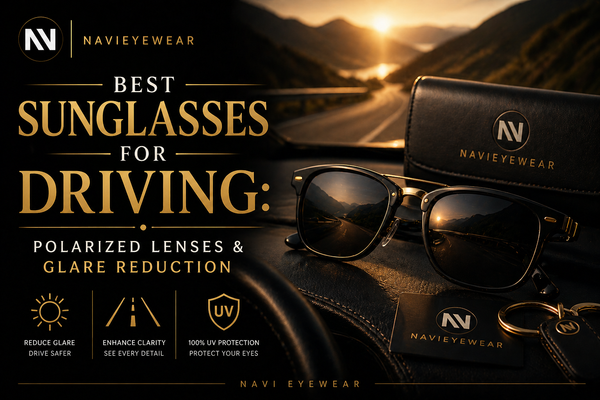
Driving is the single most common activity during which people are exposed to intense, sustained glare — and the single activity where that glare carries the greatest risk. Glare from the hood of your car, from the wet road ahead, from oncoming windshields at low sun angles — each is a momentary loss of visual clarity that, at highway speed, corresponds to real distance traveled blind.
TheNational Highway Traffic Safety Administration (NHTSA) identifies sun glare as a contributing factor in thousands of accidents annually. The right pair of sunglasses isn't a comfort luxury for drivers — it's a genuine safety instrument. This guide explains exactly what to look for, what to avoid, and whichNavi Eyewearstyles are engineered for the road.

Why Standard Sunglasses Fall Short Behind the Wheel
Regular tinted lenses reduce overall brightness — but they do nothing about the directional, horizontal glare that creates the most dangerous visual conditions on the road. This glare bounces off flat surfaces: the car hood, the road surface, other vehicles, water on the pavement.
According tothe American Optometric Association, unpolarized dark lenses worn in high-glare driving conditions can actually worsen eye strain over extended periods — the eye works harder to compensate for inconsistently filtered light, accelerating fatigue faster than driving without any lenses in some scenarios.
How Polarized Lenses Work for Driving
Polarized lenses contain a laminated filter oriented horizontally within the lens, blocking reflected light that travels in a horizontal wave pattern — which is precisely the orientation of light reflecting off flat surfaces like roads and car bodies.
The practical result, documented inresearch from the American Journal of Ophthalmology, is a measurable reduction in visual cortex strain and a significant improvement in reaction-relevant contrast detection. Drivers wearing polarized lenses showed faster identification of road hazards in glare conditions compared to those wearing non-polarized lenses of equivalent tint.
What you notice immediately: the haze that normally sits over a sun-struck road disappears. Colors of traffic lights become more saturated and distinctly readable. Lane markings emerge from surface glare. Wet roads become readable rather than mirror-bright.
UV400: Why It Matters Even More in a Car
Most people assume their car windows provide UV protection. They provide partial protection at best. According toa study published in JAMA Ophthalmology, standard automotive side glass blocks nearly all UVB rays but filters only about 44% of UVA radiation. Windshields offer better protection, but you're also exposed through side and rear windows for the entire duration of a drive.
UV400 lenses — standard on everyNavi frame — close this gap completely, providing 100% filtration of both UVA and UVB regardless of which window you're near or what angle the sun is hitting. For commuters who spend an hour or more in the car daily, this cumulative protection adds up significantly over a lifetime.
Lens Color: Which Tint Is Best for Driving?
Lens color affects contrast perception, color rendering accuracy, and depth judgment — all of which matter for safe driving. Here's how the primary options compare, according tothe Sunglass Association of America:
Gray / Neutral
The most universally recommended driving lens. Reduces overall brightness without color distortion, meaning traffic signals and road signs appear in their true colors. Ideal for bright, sunny driving conditions.
Amber / Brown
Increases contrast and depth perception, particularly effective in variable light conditions — partly cloudy days, dawn and dusk driving, and foggy conditions. The most popular choice among professional drivers and truck operators. Filters blue light, reducing the haze associated with overcast skies.
Yellow
Maximum contrast enhancement in low-light conditions. Ideal for dusk, dawn, and overcast driving. Less effective — and potentially problematic — in very bright sunlight due to insufficient overall brightness reduction.
Green
A middle-ground option that provides good contrast while maintaining relatively accurate color rendering. Well-suited to varied conditions.
Avoid: Blue, Red, and Mirror Lenses for Driving
High-contrast novelty tints can distort traffic signal colors in ways that create safety issues, particularly for drivers with any degree of color vision deficiency.The American Academy of Ophthalmology recommends neutral or contrast-enhancing tints — not aesthetic novelty tints — for driving use.
Frame Fit and Design: What Matters on the Road
Beyond the lens, frame design significantly affects driving performance:
The Best Navi Styles for Driving
For everyday commuting and bright conditions:Trevi (Golden) — neutral lens geometry, secure TR90 fit, and classic proportions that work as naturally in the car as outside it.
For long-haul and variable conditions:Navi Vibes (Cool Breeze) — the structured frame provides excellent brow coverage and the secure 5-barrel hinge means zero slippage on extended drives.
For morning and evening commutes with low sun angles:Magnolia (Relax) — the amber-adjacent red-orange lens tone enhances contrast in the challenging golden-hour light that causes the most glare during peak commute times.
What NOT to Wear While Driving
A few common mistakes that compromise both safety and comfort:
Children and Sunglasses in the Car
UV exposure through car windows is a significant and often overlooked risk for children.According to Cascadia Eye, an estimated 50% of cumulative UV eye damage occurs before age 18 — yet fewer than 8% of parents report their children consistently wear sunglasses outdoors, let alone in the car.
Children's retinas transmit more UV light than adult retinas due to higher lens clarity, making UV400 protection even more critical for younger passengers on long drives. TheAmerican Academy of Ophthalmology recommends UV protection from as young as six months old.
— — —
The road demands the best from your vision.Find your ideal driving pair at NaviEyewear.com — where UV400 protection, polarized lenses, and TR90 construction are standard on every frame.