
Airport, Flying and In-Cabin UV: Do You Need Sunglasses on a Plane?
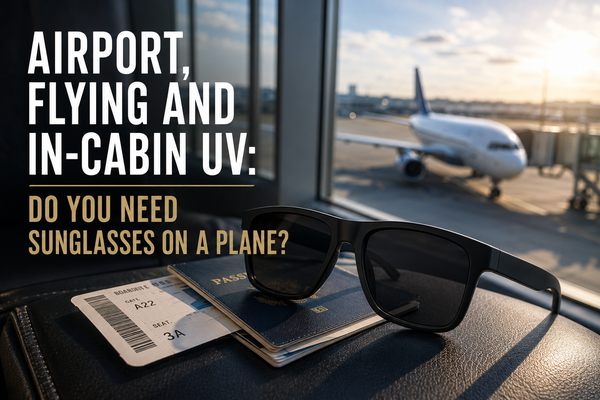
Yes — for window seats on daytime flights. Commercial aircraft cruise at 10,000–12,500 meters, above the bulk of the ozone layer and atmosphere that filters UV at ground level. Sunlight entering aircraft windows during daytime flight is 2–3 times higher UV intensity than at ground level. Most aircraft windows filter UV-B reasonably well but provide incomplete UV-A filtering. Window seat passengers on long daytime flights — particularly transatlantic and transcontinental routes — accumulate meaningful UV-A dose. Cat 1–2 gray polarized UV400 handles in-flight UV without making the cabin environment too dark to read or work.
The question "do I need sunglasses on a plane?" typically receives one of two responses: either confident dismissal ("planes have tinted windows") or vague anxiety ("probably?"). The accurate answer is more specific: it depends on your seat position, the time of day, the flight duration, and what the specific aircraft windows actually filter. For the complete travel sunglasses context, see the traveler's complete sunglasses guide.

1. The UV Science of Flying
Cruising Altitude and Atmospheric UV Filtering
The atmosphere provides UV protection through two mechanisms: ozone absorption (primarily UV-B) and Rayleigh scattering (the mechanism that makes the sky appear blue — short wavelengths scatter more than long ones). Both mechanisms operate most effectively in the lower atmosphere, below approximately 12 kilometers altitude. Commercial aircraft cruise between 10,000 and 12,500 meters — at or above the altitude where these protective mechanisms are most concentrated.
At cruising altitude, the atmosphere above the aircraft is thin and provides minimal UV filtering. The atmosphere below the aircraft is present but the aircraft is positioned above the densest, most UV-absorbing layers. The net result: the UV environment at cruising altitude is approximately 2–3 times the UV intensity of ground level at the same latitude and time of day.
The Ozone Layer Position
The ozone layer that absorbs UV-B is concentrated in the stratosphere, between approximately 15 and 35 kilometers altitude. Commercial aircraft cruise at the lower boundary of this zone — effectively inside or just below the ozone layer rather than beneath it. This means commercial flight occurs in a UV environment where ozone absorption is reduced compared to the ground-level benefit of looking up through the full ozone column.
Above the Clouds: No Diffusion
Above cloud cover at cruising altitude, direct solar radiation is unobstructed by clouds entirely. The diffuse sky radiation that provides some UV protection at ground level is also reduced. The practical result for window seat passengers: direct sunlight entering through the window is essentially unfiltered solar radiation at higher intensity than would reach them at ground level, even on a clear day.
What Research Shows About Flight Crew UV Exposure
The most compelling evidence for in-flight UV significance comes from studies of commercial airline pilots and flight attendants. Multiple studies have found elevated rates of melanoma and other UV-related skin conditions in flight crew compared to the general population, even after controlling for other risk factors. The dose-response relationship between flight crew UV exposure and UV-related conditions supports the conclusion that aircraft window UV exposure is biologically significant over career-level cumulative exposure.
2. What Aircraft Windows Actually Filter
Aircraft Window Construction
Commercial aircraft windows are not simple glass panes — they are typically three-layer assemblies consisting of an outer structural pane (acrylic or polycarbonate), a middle pane, and an inner dust pane. The materials and thicknesses vary by aircraft type, manufacturer, and window age. Most modern aircraft windows use acrylic outer panes.
UV-B Filtering: Generally Good
Standard acrylic aircraft windows filter UV-B (280–315nm) reasonably effectively. Acrylic absorbs shorter UV wavelengths well, and the multi-layer construction provides additional UV-B attenuation. Most aircraft windows reduce UV-B transmission to low levels — somewhat comparable to standard glass windows in buildings.
UV-A Filtering: Incomplete and Variable
UV-A (315–400nm) is where aircraft windows are significantly less protective. Acrylic and standard polycarbonate transmit UV-A at much higher rates than UV-B. Studies measuring UV-A transmission through commercial aircraft windows consistently find UV-A transmission rates of 30–80% depending on the specific window, aircraft type, and window age. This wide range means some aircraft windows provide substantial UV-A filtering while others provide relatively little.
The practical implication: window seat passengers cannot assume their aircraft window provides adequate UV-A protection. UV-A is the wavelength associated with deep tissue penetration, lens protein damage contributing to cataract formation, and the majority of UVA-related skin changes. A window blocking UV-B but transmitting 50–70% of UV-A is providing partial protection that leaves a meaningful dose reaching the passenger.
Electrochromic Dimmable Windows
Newer aircraft — including the Boeing 787 Dreamliner and Airbus A350 — use electrochromic windows that darken on demand via electrical current rather than pull-down shades. UV-A transmission in these windows is somewhat reduced when dimmed, but the relationship between visible light dimming and UV-A blocking is not always proportional. A window that appears dark may still transmit meaningful UV-A. UV400 sunglasses provide certified UV-A blocking regardless of window type or dimming state.
3. When In-Flight UV Matters Most
Window Seat Position
The key variable for in-flight UV exposure is window proximity and orientation. Middle and aisle seat passengers receive negligible UV — the overhead cabin lighting in modern aircraft is fluorescent or LED, which produces minimal UV, and they have no direct window exposure. Window seat passengers receive direct or near-direct sunlight through the window for whatever portion of the flight the sun is on their side of the aircraft.
Daytime Flight Duration
Short domestic flights (under 2 hours) in daylight accumulate modest UV even at window seats. Long-haul daytime flights — transatlantic (6–9 hours), transcontinental US (5–6 hours), transpacific (10–14 hours) — accumulate meaningful UV-A during the daytime portions. The cumulative UV-A dose for a window seat passenger on a 9-hour daytime transatlantic flight is comparable to several hours of moderate-intensity ground-level UV exposure.
Time of Day and Route
UV is only relevant during daylight. Night flights, regardless of altitude, produce no UV exposure. On a typical north-south or east-west routing, the sun is on one side of the aircraft throughout most of the flight. A transatlantic flight from New York to London travels roughly northeast, with the sun generally to the south — meaning passengers on the right (south-facing) side receive sustained window sun exposure during the daytime portion.
Latitude of the Route
Flights at lower latitudes — Caribbean routes, Central American routes, transequatorial flights — experience higher UV at any given sun angle than high-latitude routes. A flight from Miami to Bogotá crosses latitudes where solar elevation angles are high throughout the daytime flight, producing more consistent window UV than a New York to London route that spends significant time at high northern latitudes.
4. The Airport UV Context
Terminal Skylights and Glass Walls
Modern airport terminals are architectural showcases of glass — skylights, floor-to-ceiling window walls, and open-air courtyards are standard features of major international terminals. Architectural glass in airports is standard soda-lime glass that blocks UV-B but transmits UV-A at rates of 30–70% depending on glass type and age. Passengers spending extended time in skylit areas, sitting near large window walls, or waiting in open-air terminal sections accumulate UV-A from these architectural glass surfaces.
Outdoor Airport Areas
Many airports have outdoor waiting areas, terminal courtyards, hotel transfer zones, and departure/arrival curbs where passengers spend substantial time. These areas are full ground-level UV environments — no different from standing on a sidewalk at the same location. For airports in high-UV locations (Miami, Las Vegas, Phoenix, Los Angeles), the outdoor transit time between gates, vehicles, and terminal entrances accumulates meaningful UV in tropical and Sun Belt UV conditions.
Airport Layovers and Connection Times
Long layovers at tropical hub airports — a common situation for international connecting itineraries through Caribbean, Central American, or Mexican hubs — may involve outdoor terminal time in UV index 10–12 conditions. Passengers who exit the secure area, use rooftop lounges, or travel between terminals via outdoor walkways accumulate ground-level tropical UV during these layover periods.
5. Lens Recommendations for Flying
Window Seat, Long Daytime Flight
Cat 1–2 gray polarized UV400 polycarbonate is the appropriate specification for window seat passengers on daytime long-haul flights. Cat 1 (43–80% visible light transmission) maintains comfortable visibility in the cabin while providing UV400 blocking for the UV-A that passes through the aircraft window. Gray tint is preferred over amber for in-flight use because color accuracy is useful for reading, working on screens, and looking at cabin displays — the cabin environment doesn't benefit from amber's contrast enhancement the way outdoor sport does.
Middle or Aisle Seat
UV exposure for non-window seat passengers is negligible — overhead cabin lighting produces minimal UV. Sunglasses are not needed for UV protection in middle or aisle positions.
Airport Outdoor Areas and Tropical Hubs
Cat 2 gray or amber polarized UV400 for extended outdoor airport time at high-UV locations. The same specification appropriate for general outdoor activity at the destination applies to outdoor airport time at tropical and Sun Belt hub airports.
In-Flight Lens Conditions Table
| Flight / Airport Context | UV Exposure | Recommended Lens | Notes |
|---|---|---|---|
| Window seat, long daytime flight (5+ hrs) | Moderate — UV-A through window | Cat 1–2 gray polarized UV400 | UV-A transmission through aircraft windows is 30–80%; UV400 blocks it |
| Window seat, short daytime flight (<2 hrs) | Low | Optional — Cat 1 if comfortable | Brief exposure; low cumulative UV but UV400 still provides protection |
| Middle or aisle seat | Negligible | Not needed for UV | No meaningful window UV exposure from non-window positions |
| Night flight, any seat | None | Not needed for UV | No UV during darkness regardless of altitude |
| Airport outdoor areas, tropical hub | High (full ground UV) | Cat 2 gray polarized UV400 | Full UV index of tropical location; same as any outdoor tropical exposure |
| Airport terminal skylights, extended layover | Low–Moderate | Cat 1 optional | Glass transmits UV-A; extended skylit terminal time accumulates some UV-A |
6. Practical Considerations for Flying With Sunglasses
Sunglasses in Carry-On, Not Checked Luggage
Always keep sunglasses in carry-on baggage or in a jacket/bag on your person. Checked luggage subjects frames and lenses to compression, temperature extremes in the cargo hold, and handling impacts that crack frames and scratch lenses. The controlled cabin environment is always preferable to cargo hold storage.
Screen Use and Polarized Lenses
Some passengers find that polarized lenses interact with laptop or tablet screens — LCD screens have their own polarization filter, and at certain relative orientations between the lens and screen, the screen can appear dark or washed out. This is a known polarization interaction, not a lens defect. It can be managed by tilting the screen slightly or by choosing a seating position where the screen angle and lens orientation don't conflict. For passengers who primarily use screens during flight, non-polarized UV400 Cat 1 is an alternative that avoids this issue while maintaining UV-A protection.
Cabin Pressure and Lenses
Aircraft cabins are pressurized to the equivalent of approximately 6,000–8,000 feet altitude. This pressurization change has no meaningful effect on sunglass lenses. Polarized PVA film lenses are not pressure-sensitive. The temperature in the cabin (typically 68–72°F) is within the normal operating range of all quality sunglass lens materials.
7. Flight Crew and Frequent Flyers
Accumulated UV for Flight Crew
Commercial pilots and flight attendants spend 70–100+ flight hours per month in the cabin environment. For window-proximate crew positions — pilots in cockpit seats, flight attendants working galley-to-window service — the cumulative UV-A exposure over a career is meaningfully higher than for the general flying public. Multiple studies have documented elevated melanoma and skin cancer rates in pilots consistent with UV occupational exposure. The same UV-A that reaches skin in the cockpit reaches the eyes — flight crew who do not use UV400 eyewear during daytime flight operations are accumulating UV that contributes to lifetime cataract and macular degeneration risk.
Recommendations for Frequent Flyers
Business travelers and others logging significant annual flight hours should treat window seat UV as a cumulative exposure concern. 50+ window-seat flight hours per year begins to represent meaningful cumulative UV-A dose. Gray polarized UV400 Cat 1–2 that can be worn comfortably through a 6-hour work flight without interfering with screen use or reading is the practical specification for this use case.
Frequently Asked Questions
Do airplane windows block UV?
Partially — aircraft windows generally filter UV-B reasonably well but provide incomplete UV-A filtering. UV-A transmission through typical aircraft windows ranges from 30–80% depending on window type, aircraft model, and window age. Window seat passengers on daytime flights receive UV-A at levels that are meaningfully above zero, particularly on long flights.
Can you get UV damage from flying?
For frequent flyers and flight crew with high annual flight hours, yes — the cumulative UV-A from window seat exposure accumulates over time and contributes to lifetime UV dose. For occasional travelers on short domestic flights, the per-trip UV accumulation is modest. The UV significance scales with: window seat vs non-window, daytime vs night flight, flight duration, and frequency of flying.
Should I wear sunglasses on a plane?
For window seat passengers on long daytime flights: yes — Cat 1–2 gray polarized UV400 provides UV-A blocking that aircraft windows don't fully deliver, while remaining comfortable enough for the cabin environment. For middle and aisle seat passengers: not needed. For night flights: not needed.
What's the best lens for flying?
Cat 1 gray polarized UV400 polycarbonate for window seat use — light enough to be comfortable in the cabin environment, providing UV400 blocking for UV-A that passes through aircraft windows, color neutral for reading and screen use. Cat 1 is specifically designed for low-light conditions where UV protection is still relevant — the aircraft cabin is exactly this context.
Are pilots required to wear UV protection?
Not universally mandated by regulation, but UV protection for pilots is increasingly recognized as an occupational health measure. Some airlines have specific eyewear recommendations for cockpit crew. Individual pilots who spend significant daytime hours at altitude choose UV400 eyewear for the same cumulative UV protection reasons applicable to any high-UV outdoor occupation.
Does flying increase your UV exposure for the rest of the trip?
Flying itself contributes UV during the flight, but does not change UV exposure on the ground at the destination. Ground-level destination UV is determined by latitude, season, altitude, and surface reflectance — independent of how you arrived. The flight UV and the destination ground UV are separate cumulative contributions to the trip's total UV dose.
What about UV from airport skylights?
Architectural glass in airports transmits UV-A at rates similar to aircraft windows — 30–70% depending on glass type. Passengers spending extended time under large skylights or near glass walls in modern terminal buildings accumulate some UV-A. For typical airport transit time (under an hour), this is a low-significance UV context. For extended layovers (3+ hours) in skylit terminal areas at tropical hub airports, Cat 1 UV400 provides meaningful protection.
The Bottom Line
Flying exposes window seat passengers to elevated UV-A that aircraft windows do not fully filter — at cruising altitude above the protective ozone column, UV intensity is 2–3 times ground level, and UV-A specifically passes through aircraft windows at 30–80%. For long daytime flights in window seats, Cat 1–2 gray polarized UV400 is appropriate and protective. For frequent flyers logging significant annual hours, this is a cumulative UV exposure concern comparable to a daily outdoor commute. Pack UV400 sunglasses as part of any travel kit — the same pair appropriate for the destination is appropriate for the window seat. navieyewear.com/collections/polarized — Buy 1, Get 3 Free for $119.
Related Reading
- The Traveler's Complete Sunglasses Guide | Navi Eyewear
- Road Trip Sunglasses: Long-Haul Driving Eye Protection | Navi Eyewear
- Sunglasses for Tropical Travel: Caribbean, Mexico and Hawaii | Navi Eyewear
- Cruise Ship and Open Water Travel Sunglasses | Navi Eyewear
- Best Sunglasses for Driving | Navi Eyewear
- The Science of Lens Color: What Tint Does Your Vision Need? | Navi Eyewear
- UV and Eye Disease: Cataracts, Macular Degeneration and Prevention | Navi Eyewear
- Shop Polarized UV400 Sunglasses | Navi Eyewear
Sources & Citations
[1] WHO. "Global solar UV index: a practical guide." World Health Organization, 2002. View source →
[2] Sanlorenzo M, et al. "The risk of melanoma in airline pilots and cabin crew." JAMA Dermatology, 2015. View source →
[3] Moan J, et al. "UV radiation, vitamin D, and cancer incidence." Photochemical and Photobiological Sciences, 2012. View source →
[4] Taylor HR, et al. "Effect of ultraviolet radiation on cataract formation." New England Journal of Medicine, 1988. View source →
[5] Dain SJ. "Sunglasses and sunglass standards." Clinical and Experimental Optometry, 2003. View source →
[6] Diffey BL. "Sources and measurement of ultraviolet radiation." Methods, 2002. View source →