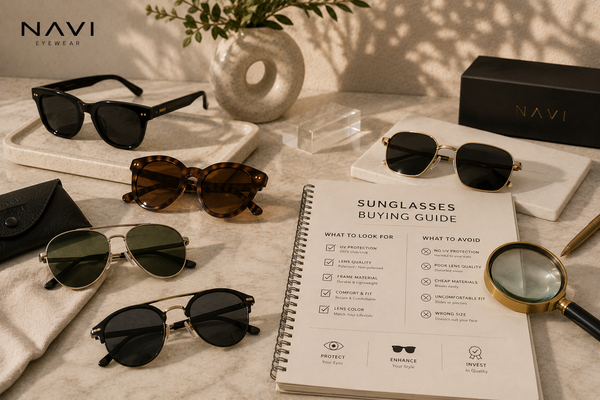

The Complete Sunglasses Buying Guide: What to Look For & What to Avoid
Most sunglass buying advice falls into one of two traps: it is either too general to be useful ('buy UV400') or too specific to apply broadly ('this exact model is best'). This guide occupies the middle ground. It covers every specification that actually matters — in the order of priority they deserve — with enough technical context to evaluate any pair rather than just a list of recommendations you have to take on trust.
The goal is to leave you able to walk into any store, open any product listing, or assess any pair of sunglasses you already own and know exactly what you are looking at. No guesswork, no marketing noise filtering required.
This is the C5 Buying Guides pillar post. The supporting guides in this cluster go deeper on specific buying contexts:the sunglasses gift guide,how to build a complete sunglasses collection,the environmental cost of cheap sunglasses, andpremium vs budget: what do you actually get for the money. The technical foundation for all of this — how lens technology actually works — is inthe complete guide to sunglass lens technology.

The Buying Priority Hierarchy: What Matters Most
Not all specifications are equally important. The following hierarchy reflects the order in which each factor should be evaluated — starting with the non-negotiables that determine whether a pair is safe to wear, through to the preference-based decisions that determine whether it is right for you specifically.
|
Priority |
Specification |
Non-Negotiable? |
What to Check |
|
1 |
UV400 Certification |
Yes — absolute |
Labeled UV400 or 100% UVA/UVB on lens, tag, or packaging |
|
2 |
Optical Quality |
Yes — near absolute |
No visible distortion on straight-line test |
|
3 |
Fit |
Yes — for protection |
Frame width matches face; bridge sits flat; no large gaps |
|
4 |
Polarization |
Strongly recommended |
Labeled polarized; verify with lens-rotation or screen test |
|
5 |
Lens Tint |
Preference-based |
Match tint to primary environment and activity |
|
6 |
Lens Material |
Recommended |
Polycarbonate for durability and inherent UV protection |
|
7 |
Frame Material |
Context-dependent |
TR90 for sport/outdoor; acetate for lifestyle |
|
8 |
Lens Coatings |
Recommended |
Hydrophobic + scratch-resistant as baseline |
|
9 |
Style and Aesthetic |
Personal choice |
Face shape proportional match; personal identity alignment |
The hierarchy matters because cheap sunglasses typically fail at priorities 1 and 2 while excelling at priority 9. An attractive pair that looks great but fails the UV400 check and the distortion test is not a good pair of sunglasses — it is a fashion accessory that happens to be shaped like sunglasses. The7-sign checklist for whether any pair of sunglasses is actually protecting you runs through priorities 1, 2, 3, and 4 in practical, checkable terms.
The Six-Step Buying Process
|
Step 1: Confirm UV400 Certification Before any other evaluation, check for UV400 certification. Look for: 'UV400', '100% UVA/UVB protection', or '100% UV protection to 400nm' on the lens itself, on a swing tag, or on the original packaging. Vague language like 'UV protection' without specifying 400nm leaves a real gap. No visible UV claim means no verified protection — treat the pair as unprotected. This check takes thirty seconds and is the single most important thing you can do before buying any pair. For the full technical explanation of why UV400 is the standard that matters and what it actually means for how UV blocks inside the lens, seethe complete guide to UV eye protection. |
|
Step 2: Do the Optical Quality Test Hold the glasses at arm's length and slowly sweep one lens across a straight horizontal reference line — a window frame, a door edge, a shelf. A quality lens will leave the straight line looking perfectly straight across the full lens surface. Any bending, waviness, or swimming of the line indicates optical distortion in the lens. A distorted lens forces the visual system to compensate continuously, producing fatigue over extended wear and indicating manufacturing quality issues that often correlate with other quality failures including inadequate UV protection. Reject any lens that fails this test. |
|
Step 3: Check the Fit Put the glasses on and check five things: the bridge sits flat on the nose without sliding; the temples extend straight back without splaying outward or pressing inward; the lenses cover the full orbital area without large gaps above or below; the outer edge of the frame roughly aligns with your face width; and the lenses sit close to the face without touching the cheeks. Each of these fit points has a direct consequence for comfort and UV protection — gaps in the frame coverage allow UV to enter from above, below, and the sides, reducing real-world protection even with a UV400-certified lens. The full fit guide with specific fixes for each problem is inhow to tell if sunglasses actually fit. |
|
Step 4: Verify Polarization (If Claimed) If the pair is sold as polarized, verify it with one of two quick tests. The rotation test: hold two polarized lenses face to face and rotate one 90 degrees — genuine polarized lenses will darken dramatically as the perpendicular polarizing films block all light between them. The screen test: look at a phone or laptop screen through the lens and rotate it — a genuine polarized lens will cause the screen to darken or blacken at specific rotation angles. No change indicates the lens is not genuinely polarized. For the full case on why polarization matters and what environments it benefits most, seepolarized sunglasses: are they worth it. |
|
Step 5: Choose the Right Tint for Your Environment Lens tint is the most personalised specification decision. The right tint depends on your primary use environment: gray for driving and everyday color-accuracy needs; brown or amber for outdoor activities requiring terrain contrast; copper for fishing and sub-surface water visibility; yellow or amber for low-light and overcast conditions; green for all-round outdoor use with mild contrast enhancement. Style tints — rose gold, pale blue, gradient lenses — are valid aesthetic choices but should be confirmed as UV400-certified independently. The full tint science with activity-by-activity recommendations is inthe science of lens color and what tint your vision actually needs. |
|
Step 6: Evaluate Frame Material and Coatings for Your Use Case Lens material: polycarbonate is the recommended choice for most buyers — it provides inherent UV protection regardless of surface condition, is impact-resistant, and is lighter than glass. TR90 nylon is the recommended frame material for active and sport use; acetate for everyday lifestyle use. Coatings: hydrophobic and oleophobic surface treatments should be standard on any quality pair; scratch-resistant hard coat is essential for polycarbonate. For the full coating breakdown and how to maintain each type, seelens coatings explained: anti-reflective, hydrophobic, mirror and more. |
Red Flags: What to Walk Away From
Certain signals reliably indicate a pair is not worth buying — either for protection, quality, or both. These are the patterns that distinguish genuinely adequate eyewear from the cheap pairs that populate tourist shops, market stalls, and low-end online listings. The full economic and environmental case for why cheap sunglasses are a false economy is inthe environmental cost of cheap sunglasses.
Buying Online: Getting Fit Right Without Trying On
The majority of sunglass purchases now happen online, where you cannot do the distortion test or check fit in person before buying. The following process makes online buying reliable:
Budget Guidance: What Different Price Points Actually Deliver
The full analysis of what you actually get for your money at different price points is inpremium vs budget sunglasses: what do you actually get for the money. The summary:
|
Price Range |
UV400 Reliability |
Optical Quality |
Coating Durability |
Frame Quality |
|
Under £15 / $20 |
Unreliable — 30–50% failure rate in testing |
Often has distortion |
Poor — degrades quickly |
Cheap plastic, prone to failure |
|
£15–40 / $20–50 |
More reliable but still worth verifying |
Usually acceptable |
Moderate |
Adequate for casual use |
|
£40–100 / $50–130 |
Generally reliable if from reputable brands |
Good — low distortion |
Good |
TR90 or quality acetate |
|
£100–200 / $130–250 |
Very reliable — brand reputation at stake |
Excellent — verified optics |
Very good |
Premium materials, quality hardware |
|
Over £200 / $250 |
Excellent |
Optician-grade optics |
Excellent |
Premium acetate, titanium hardware |
The meaningful quality jump is between the under-£40 tier and the £40–100 tier. Below that threshold, UV protection reliability, optical quality, and coating durability are genuinely uncertain. Above it, the incremental gains are real but smaller — the difference between a £60 pair and a £150 pair is less dramatic than the difference between a £15 pair and a £60 pair.
The Pre-Purchase Checklist
|
BEFORE YOU BUY — RUN THROUGH THESE ✓ UV400 certification is visibly stated on lens, tag, or product listing ✓ Straight-line distortion test passed — no visible bending or waviness ✓ Frame fit checked — bridge sits flat, no large gaps, temples extend straight ✓ Polarization verified (if claimed) — rotation test or screen test passed ✓ Tint matches your primary use environment ✓ Lens material confirmed — polycarbonate recommended for most uses ✓ Frame material appropriate — TR90 for sport/outdoor, acetate for lifestyle ✓ Coatings confirmed — hydrophobic and scratch-resistant at minimum ✓ Brand or retailer is reputable with a clear returns policy ✓ Price is consistent with genuine quality — suspiciously cheap is a red flag |
Browse theNavi Eyewear UV400 polarized collection with this checklist in hand. All pairs in the collection carry UV400 certification and polarized lenses as baseline standards — the two most important specifications in the hierarchy above. For building a collection that covers multiple activities and contexts,the guide to building a complete sunglasses collection covers a systematic approach to multi-pair coverage without over-investing.
Frequently Asked Questions
What should I look for when buying sunglasses?
In priority order: UV400 certification (labeled explicitly — not inferred from darkness), no visible optical distortion on the straight-line test, a fit that covers the orbital area without large gaps, polarization for any environment with significant glare (roads, water, snow), a tint matched to your primary activity, and polycarbonate lenses for durability. For the full specification breakdown and how to evaluate each one, seehow sunglass lenses actually work.
How do I know if sunglasses have real UV400 protection?
Look for 'UV400', '100% UVA/UVB protection', or '100% UV protection to 400nm' on the lens itself, on the tag, or on the product packaging. Vague language without the 400nm specification leaves a genuine gap. No UV claim means no verified protection. If you are unsure about a pair you already own, most opticians can test UV transmission in under a minute at no charge. The full guide to verifying UV protection — including the 7 warning signs — is in7 signs your sunglasses are not protecting your eyes.
Are cheap sunglasses worth buying?
For very occasional use where you would otherwise go without, a cheap UV400-certified pair is better than nothing — but verification is essential since testing finds UV protection failure rates of 30–50% in low-cost unverified sunglasses despite labelling claims. For regular use, cheap sunglasses are a false economy: coating degradation, optical distortion, and poor fit produce worse outcomes than a quality pair maintained properly. The full cost-benefit analysis is inpremium vs budget sunglasses: what do you actually get for the money.
Do polarized sunglasses cost significantly more?
At quality brands, the cost premium for polarized over non-polarized lenses at the same quality tier is typically modest — 15–30% more. At cheap fashion price points, polarized claims are often unverified and can be checked with the rotation or screen test. The performance benefit of genuine polarization — eliminating horizontal reflected glare rather than merely reducing all light — is sufficiently significant in most outdoor environments that the modest cost premium is well justified.
What is the best lens material for sunglasses?
Polycarbonate for most buyers. It is impact-resistant, lightweight, and provides inherent UV protection throughout the lens material regardless of surface condition — meaning UV protection cannot be degraded by scratching the way surface-coated UV protection can. CR-39 plastic provides slightly better optical clarity but requires a surface UV coating and is less impact-resistant. Glass offers the best optical clarity but is heavy, fragile, and unsuitable for active sport use.
How much should I spend on a good pair of sunglasses?
The meaningful quality threshold is approximately £40–50 / $50–60 for everyday use — below this, UV protection reliability, optical quality, and coating durability are genuinely variable and require careful verification. Between £50–150 / $60–200, quality is generally reliable from reputable brands and incremental improvements are real but smaller. Above £200 / $250, you are paying for premium materials, optician-grade optics, and heritage branding. For most buyers, the £50–120 / $65–150 tier delivers the best combination of reliable specification, durable materials, and accessible style range.
Can I buy good sunglasses online without trying them on?
Yes, reliably — with the right approach. Measure a well-fitting existing pair to establish your lens width, bridge width, and temple length benchmarks. Check that the online listing provides these three dimensions for the pair you are considering. Confirm UV400 certification is stated explicitly in the product description, not just in generic brand copy. Read user reviews specifically for fit accuracy. Confirm a clear returns policy before purchasing — a quality brand should offer easy returns if fit is not right.
SOURCES & CITATIONS[1] Tanner DF, Kent JS, Jagger JD."Spectral transmittance characteristics of commercially available UV-protective sunglass lenses."Optometry and Vision Science, 2007.View source [2] Dain SJ."Sunglasses and sunglass standards."Clinical and Experimental Optometry, 2003.View source [3] Rosenthal FS, Bakalian AE, Lou CQ, Taylor HR."The effect of sunglasses on ocular exposure to ultraviolet radiation."American Journal of Public Health, 1988.View source [4] De Faber JT, Naeser K, Kessing SV."Polarized light and contrast sensitivity under glare conditions."Ophthalmic Research, 2013.View source [5] Lakey PS, Berkowitz CM, Nirmalakhandan N, et al.."The impact of frame geometry on peripheral UV exposure at the eye."Ophthalmic and Physiological Optics, 2020.View source [6] Taylor HR, West SK, Rosenthal FS, et al.."Effect of ultraviolet radiation on cataract formation."New England Journal of Medicine, 1988.View source [7] American Academy of Ophthalmology."Sunglasses: protecting your eyes from UV radiation."AAO EyeSmart, 2023.View source |