
Men's vs Women's Sunglasses: Does the Distinction Actually Matter?
Walk into any eyewear retailer and the display is divided: men's on one side, women's on the other. The implication is that these are fundamentally different products requiring different purchasing paths. In reality, the situation is considerably more nuanced — and the gender label is a significantly less useful guide to choosing the right sunglasses than the actual variables it is meant to represent.
This post covers what the men's and women's distinction actually reflects in practice, where the differences are real and functionally meaningful, where they are purely marketing convention, and how to use the right variables — face size, face shape, and personal style — to find a pair that works regardless of which side of the display it came from.
This is the final C4 Style and Identity supporting post. For the complete style framework — face shape matching, frame identities, trends — seethe ultimate sunglasses style guide. For the physical fit mechanics that matter more than gender labelling, seehow to tell if sunglasses actually fit.
What the Gender Label Actually Represents

The Real Differences: Size and Proportion
The genuinely meaningful difference between frames marketed as men's and frames marketed as women's is dimensional. On average, adult male faces are wider, longer, and have a larger overall surface area than adult female faces. Men's frames are therefore typically manufactured with wider frame widths, larger lens widths, longer temple lengths, and slightly higher bridge widths to account for typically broader nose bridges.
These are population averages, not individual certainties. A man with a narrow face will often fit better in frames from the women's section. A woman with a wider face will often fit better in frames from the men's section. The gender label is a proxy for face size — a useful first filter when shopping from a large range, but a filter that should be abandoned the moment you identify that your face dimensions do not match the population average the label assumes.
The Marketing Differences: Shape and Colour
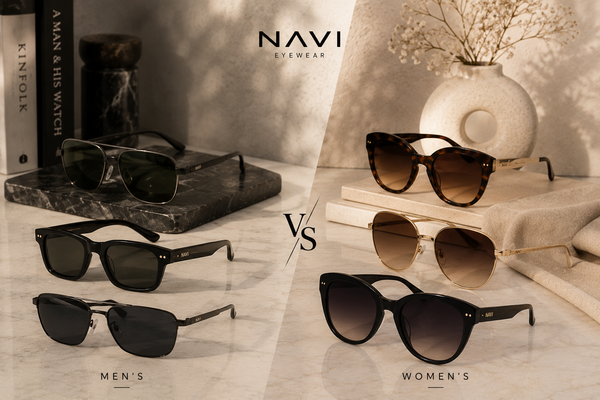
Beyond dimensions, men's and women's frames are differentiated by shape vocabulary and colour palette — and these differences are almost entirely marketing convention rather than functional necessity. Women's sections tend to feature cat-eye shapes, butterfly shapes, more colour variety, and more decorative detailing. Men's sections tend toward rectangles, aviators, wayfarers, and more neutral colour palettes. Neither shape nor colour has a functional relationship with gender — it has a cultural and historical relationship, rooted in 20th-century eyewear marketing conventions that defined certain shapes as feminine and others as masculine. The historical development of these associations is traced ina century of cool: the history of sunglasses and style evolution.
Where It Matters and Where It Does Not
|
Factor |
Does Gender Label Help? |
What Actually Matters |
|
Frame width |
Yes — men's frames are typically wider |
Your actual face width in mm at temples |
|
Lens width |
Yes — men's lenses are typically larger |
Your preferred lens width from current well-fitting pair |
|
Temple length |
Yes — men's temples are typically longer |
Distance from hinge to ear — measure your current pair |
|
Bridge width |
Partially — men's bridges are typically wider |
Your nose width — adjustable pads offer more flexibility |
|
Frame shape |
No — shape preference is personal, not gender |
Your face shape and personal aesthetic |
|
Frame colour |
No — colour is marketing convention |
Your skin tone, personal style, wardrobe |
|
UV protection |
No — same requirement regardless of gender |
UV400 certification — applies identically to all |
|
Polarization |
No — same optical benefit regardless of gender |
Whether your environment has significant reflective glare |
|
Lens tint |
No — tint is environment and activity driven |
Your primary activity and lighting environment |
The table makes the conclusion clear: the gender label is a reasonable proxy for dimensions but has no functional relationship with the specification variables that actually determine whether sunglasses protect and perform. UV400 certification, polarization, tint, and optical quality are identical requirements for any wearer. The only thing the gender label genuinely proxies is approximate face size — and you can determine your face size directly and precisely without using gender as an intermediary. The frame dimension guide inhow to tell if sunglasses actually fit covers exactly how to measure and use those numbers.
The Rise of Unisex and Gender-Neutral Eyewear
The past decade has seen significant growth in explicitly unisex and gender-neutral eyewear — frames designed without gender signalling, sized for a range of face widths, and marketed without a men's or women's designation. This trend is driven by both cultural shifts and a practical recognition that the gender binary in eyewear was always more of a marketing convention than a functional necessity.
In practice, unisex frames tend to occupy the middle of the dimensional range — wide enough for average male faces, not so wide as to overpower smaller female faces. The shapes that work best unisex are those with the broadest cross-gender cultural acceptance: classic aviators, medium ovals, clean rectangles, and round wire frames. These also happen to be the shapes identified as most timeless insunglasses trends 2025 — which is not coincidental. Timeless shapes are timeless partly because they transcend the cultural coding of any single gender, era, or subculture.
Can Men Wear Women's Sunglasses — and Vice Versa?
Yes — with the only meaningful constraint being dimensional fit. A man who fits the dimensions of a women's frame — particularly if he has a narrower or smaller face — will find many women's frames fit better than men's frames sized for the average male face. The shape associations are cultural conventions, not rules. Wearing a cat-eye frame as a man, or a classic rectangle as a woman, is a style choice, not a category error.
The cultural associations of certain shapes are real — a cat-eye reads as feminine in most cultural contexts — but they are not fixed. Fashion history is full of examples of frames crossing gender lines successfully: round wire frames were strongly associated with male intellectuals before becoming widely unisex; the oversized round was associated with feminine glamour before becoming a fashion staple across all genders; the aviator has moved between masculine and feminine readings multiple times across its 90-year history. As explored inthe psychology of sunglasses, what matters more than gender coding is whether the frame aligns with your self-concept and the identity you want to project.
The Functional Non-Difference: UV Protection Is the Same for Everyone
One point worth stating plainly: the UV protection requirement is identical for men and women. The mechanisms by which UV causes cataracts, macular degeneration, and photokeratitis do not differ by gender. UV400 certification is the same standard, the same specification, and the same protection requirement regardless of which side of the eyewear display a pair came from. Some lower-quality fashion eyewear marketed to women — where style often takes precedence over functional specification — is more likely to lack UV400 certification than frames from the men's section. This is worth checking specifically for any fashion-forward purchase. The7-sign checklist for whether sunglasses are actually protecting you applies equally regardless of gender designation.
How to Choose Without the Gender Label
The most effective approach to sunglass shopping is to replace the men's/women's filter with the variables it imperfectly proxies:
Browse theNavi Eyewear UV400 polarized collection with face dimensions and style preference as your primary filters. All pairs carry UV400 certification and polarized lenses as baseline standards — the specification variables that matter most apply uniformly across the range.
Frequently Asked Questions
Are men's and women's sunglasses actually different?
In dimension, yes — typically. In function, no. Men's frames are on average wider, have larger lenses, and longer temples to suit the average male face proportions. Women's frames are on average narrower and smaller. Beyond dimensions, the shape and colour differences are marketing conventions rather than functional distinctions. UV protection, polarization, tint, and lens quality requirements are identical for all wearers. The detailed breakdown of which variables the gender label proxies (and which it does not) is in the comparison table above, and the full fit guide is inhow to tell if sunglasses actually fit.
Can men wear women's sunglasses?
Yes — the only meaningful constraint is dimensional fit. A man with a narrower face will often find women's frames fit better than men's frames sized for a wider average face. Shape associations like cat-eye reading as feminine are cultural conventions, not rules, and fashion history shows them crossing gender lines repeatedly. The frame that fits your face dimensions and aligns with your style identity is the right frame, regardless of which section it came from.
Can women wear men's sunglasses?
Yes — for the same reasons in reverse. A woman with a wider or larger face may find men's frames fit better than women's frames. Classic shapes like aviators, rectangles, and wayfarers have strong cross-gender appeal and a long history of being worn across both. Dimensions are the primary practical consideration — if the frame sits correctly on the face, the gender designation is irrelevant.
How do I know if sunglasses are the right size for my face?
The most reliable approach: measure a pair of sunglasses you currently own that fit well. Lens width, bridge width, and temple length are typically stamped on the inside of the temple arm in millimetre format (e.g. 55-18-140). Use these as your benchmark when shopping. For the complete fit guide including what each measurement means and how to apply it, seehow to tell if sunglasses actually fit.
Are unisex sunglasses a good choice?
Yes — particularly for buyers who want to shop by style and fit rather than gender category. Unisex frames typically occupy the middle of the dimensional range and use shapes with broad cross-gender cultural appeal: aviators, ovals, round frames, clean rectangles. They are often the most timeless shapes available because they have already demonstrated the ability to transcend gender, era, and subculture coding.
Do men and women need the same UV protection in sunglasses?
Yes — completely identical. UV radiation causes the same ocular damage regardless of the wearer's gender. The mechanisms of cataract formation, macular degeneration, and photokeratitis are biological processes that do not differ by gender. UV400 certification is the same standard, the same specification, and the same protection requirement for all wearers. Any pair of sunglasses — regardless of gender designation — should carry explicit UV400 certification.
What sunglasses look good on both men and women?
The most consistently cross-gender shapes are: the classic aviator (90 years of cross-gender cultural relevance), the medium oval in neutral acetate (versatile proportions and no strong gender coding), the clean rectangle in black or tortoiseshell (masculine heritage but widely worn across genders), and the thin round wire frame (intellectual/artistic coding that transcends gender). These are also the shapes identified as most timeless insunglasses trends 2025 — and the face shape matching logic insunglasses for your face shape: the complete guideapplies equally to finding which of these works for your specific proportions.
SOURCES & CITATIONS[1] Farkas LG, Hreczko TA, Kolar JC, Munro IR."Vertical and horizontal proportions of the face in young adult North American Caucasians: revision of neoclassical canons."Plastic and Reconstructive Surgery, 1985.View source [2] Dain SJ."Sunglasses and sunglass standards."Clinical and Experimental Optometry, 2003.View source [3] Lakey PS, Berkowitz CM, Nirmalakhandan N, et al.."The impact of frame geometry on peripheral UV exposure at the eye."Ophthalmic and Physiological Optics, 2020.View source [4] Tanner DF, Kent JS, Jagger JD."Spectral transmittance characteristics of commercially available UV-protective sunglass lenses."Optometry and Vision Science, 2007.View source [5] Knapp ML, Hall JA, Horgan TG."Nonverbal Communication in Human Interaction (8th ed.)."Cengage Learning, 2014.View source |