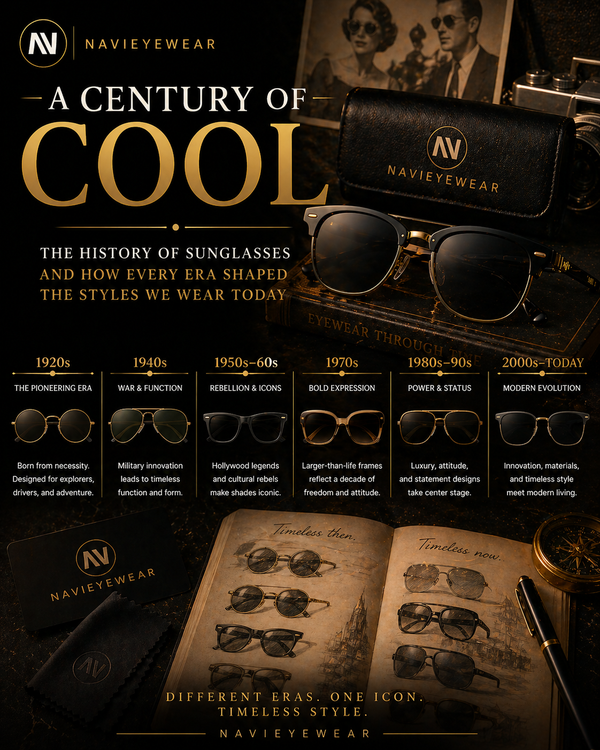
Few accessories carry more cultural DNA than sunglasses. In a century of evolution from crude UV-blocking shields to precision-engineered fashion statements, sunglasses have absorbed the aesthetics, anxieties, and aspirations of every era they passed through — and deposited that history directly onto our faces every time we put on a pair.
Understanding where the shapes, materials, and silhouettes came from makes you a more intentional buyer and a more culturally fluent wearer. Here's the full story — from the first commercial sunglass to theNavi collectionthat synthesizes a century of design evolution into its current form.

The Origins: Before Sunglasses Were Fashion
The history of eye protection from sunlight predates modern sunglasses by centuries.The Smithsonian Institution's history of eyewear documents that Inuit peoples in the Arctic crafted slitted goggles from bone, ivory, and antler thousands of years ago — not for fashion, but to prevent snow blindness in the high-UV reflective environment of the Arctic summer.
The first tinted lenses in a recognizably modern format appeared in China during the 12th century — flat panels of smoked quartz held in frames of tortoiseshell or bone. These weren't UV protection; they were used by judges to conceal their expressions in court. The eye protection function came later; the mystique function came first — a historical detail that feels entirely appropriate given how the accessory evolved.
Commercial production of tinted sunglasses in the Western world began in the early 20th century, driven by the same industrial capacity that was producing eyeglasses at scale. Sam Foster began mass-producing and selling inexpensive sunglasses on the Atlantic City boardwalk in 1929 — the first time sunglasses were an accessible consumer product rather than a luxury or specialty item.

The 1930s–1940s: Hollywood and the Birth of Sunglasses as Mystique
The transformation of sunglasses from functional eye protection to cultural symbol happened with remarkable speed in the 1930s, driven almost entirely by Hollywood. Screen actors wore sunglasses to shield their UV-lamp-damaged eyes between takes — and then wore them off set, where the association between dark lenses and star power quickly became self-reinforcing.
The aviator silhouette — developed in 1936 for US Army Air Corps pilots by Bausch & Lomb, the precursor to Ray-Ban — became the defining frame of the decade. Its oversized teardrop lenses, designed to maximize coverage of the visual field in open cockpits, translated effortlessly into a civilian aesthetic of rugged authority.As documented by the Fashion Institute of Technology, the aviator's association with flight, adventure, and masculine competence made it the first sunglasses frame to carry genuine cultural capital.
The 1950s–1960s: Glamour, the Riviera, and the Birth of the Cat-Eye
The postwar prosperity of the 1950s created the conditions for sunglasses to become a genuine fashion category. Increased leisure time, the emergence of beach and resort culture, and a growing middle class with disposable income for accessories drove demand for sunglasses that were designed as much for aesthetic impact as practical function.
The cat-eye frame — whose upswept corners referenced both the exaggerated eye makeup of the era and the angular optimism of 1950s design — became the defining silhouette for women. Grace Kelly, Audrey Hepburn, and Marilyn Monroe each associated themselves with specific sunglasses aesthetics that their fans immediately attempted to replicate.
The 1960s layered the Riviera onto this foundation. Onassis-scale oversized frames worn by Jackie Kennedy in Capri and Saint-Tropez established a template for sunglasses-as-status-armor that remains influential. The larger the frame, the more complete the visual barrier between the celebrity and the world — an aesthetic logic thatcontinues to drive oversized frame trends in 2025.
The 1970s: Architecture, Funk, and the Lens as Canvas
The 1970s brought the most architecturally ambitious decade in sunglasses design. Freed from the more conservative aesthetic conventions of the 1950s and 60s, designers began treating the frame as a sculptural object — thick acetate in amber, tortoise, and translucent colors; geometric shapes that referenced Italian brutalist architecture; lenses tinted in blue, yellow, and rose.
This is the decade that produced the silhouettes most directly referenced by contemporary high-fashion eyewear. TheTrevi (Golden) andMagnolia (Relax) collections draw directly on this decade's architectural confidence — warm tones, geometric precision, a frame that announces itself through proportion rather than branding.
The 1980s: Sport, Performance, and the Wraparound
The fitness culture explosion of the 1980s brought performance engineering to sunglasses for the first time. Wraparound frames, lightweight nylon, and interchangeable lens systems developed for cycling, skiing, and running created a new category — sport performance eyewear — that had never existed as a distinct segment.
The decade also brought the mirror lens into mainstream fashion — a direct visual metaphor for the era's interest in reflection, surface, and spectacle. Mirrored lenses worn by Top Gun's Maverick and Miami Vice's Crockett became the decade's defining sunglasses images.
The 1990s: Minimalism, Matrix, and the Rise of the Rectangle
The 1990s aesthetic reaction against 1980s excess produced two distinct sunglasses movements: radical minimalism (tiny rectangular frames, wire rims, a deliberate de-escalation of visual weight) and radical maximism (the Oakley-led performance aesthetic of wrap shields and neon accents).
The Matrix (1999) crystallized both into a single cultural moment: the protagonist's narrow rectangular lenses became one of the most recognizable sunglasses in cinema, and sparked a fashion movement toward small, geometric frames that re-emerged as a defining 2020s trend.
The 2000s–2010s: Logo Culture and the Designer Premium
The 2000s brought the rise of visible branding as sunglasses' primary value proposition. Logo placement — on the temple, the lens, the bridge — became as important as optical quality, and premium pricing became primarily a function of brand equity rather than material specification.
This dynamic created the gap that purpose-built performance brands like Navi were eventually positioned to fill:genuine material quality — TR90, UV400, stainless steel hardware — at prices that reflect manufacturing excellence rather than marketing spend.
2020s: The Synthesis — Quality, Identity, and Conscious Design
The defining quality of contemporary eyewear culture is synthesis: a simultaneous appetite for archival references (1970s geometry, 1990s minimalism, 1960s oversize), genuine performance specification (UV400, TR90, polarization), and design that works across the conventional boundaries of gender, age, and occasion.
TheNavi collection exists precisely at this intersection. The Trevi references Roman architectural grandeur. The Aspen draws from mountain performance culture. The Thirst channels the chromatic energy of contemporary fashion's most experimental lens tinting. Each frame is historically literate without being nostalgic — aware of the century of design language that preceded it, and using that awareness to build something current.
— — —
Every pair of sunglasses you wear carries a century of design evolution. Make sure yours is worthy of the lineage.Explore the Navi collection at NaviEyewear.com.